
🩺 Nursing Question of the Day
Challenge yourself with one exam-style nursing question every day.
✅ Think carefully • ✅ Choose your answer • ✅ Then scroll down to check the explanation.
📝 Today’s Question:
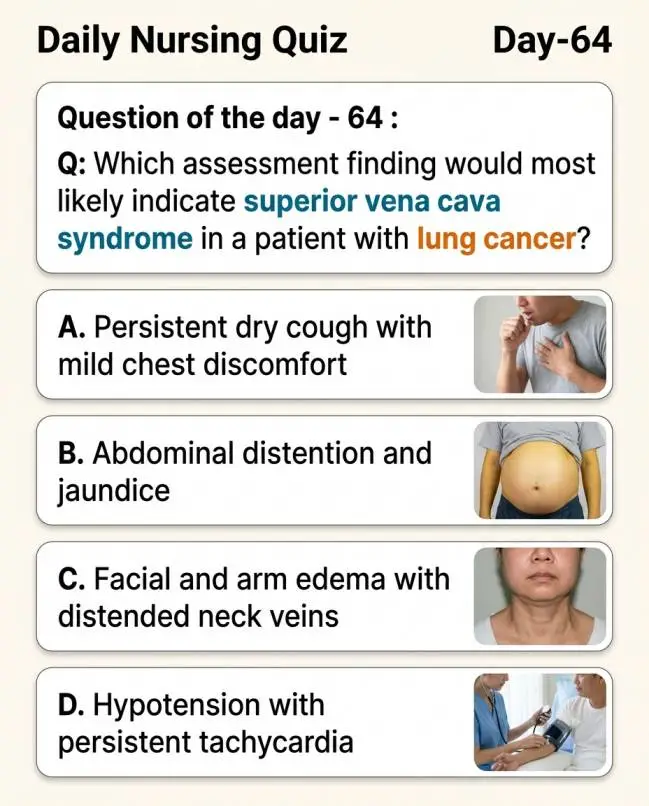
Which assessment finding would most likely indicate superior vena cava syndrome in a patient with lung cancer?
👆 Comment your answer and the tap an option to check your answer.
Don’t forget to Comment your answer below.
🫀 Superior Vena Cava Syndrome
Which assessment finding would most likely indicate superior vena cava syndrome in a patient with lung cancer?
A. Persistent dry cough with mild chest discomfort
B. Abdominal distention and jaundice
C. Facial and arm edema with distended neck veins
D. Hypotension with persistent tachycardia
🔬 What is Superior Vena Cava Syndrome?
Superior vena cava syndrome (SVCS) occurs when blood flow through the superior vena cava (SVC) becomes partially or completely obstructed.
The superior vena cava is a large vein that carries deoxygenated blood from the head, neck, upper chest, and upper limbs back to the right side of the heart.
In a patient with lung cancer, a tumor or enlarged lymph nodes in the chest can compress the SVC. This makes it difficult for venous blood to return normally to the heart.
Lung cancer / mediastinal mass → compression or obstruction of SVC → impaired venous drainage from upper body → venous blood backs up → increased venous pressure → facial edema + upper-extremity edema + distended neck veins
👤 Why does the face become swollen?
When the SVC is obstructed, blood cannot easily return from the head and upper extremities to the heart. The pressure therefore increases in the veins above the obstruction.
Increased venous pressure pushes fluid from the blood vessels into surrounding tissues, producing edema.
That is why a patient may develop a puffy or swollen face, neck swelling, and swelling of the arms. The neck veins may also become visibly distended because of increased venous pressure.
Facial edema + neck-vein distention + arm edema in a lung-cancer patient = think SVC syndrome.
⚠️ Other Possible Findings
- Swelling of the face, neck, and upper limbs
- Distended neck or chest-wall veins
- Shortness of breath
- Cough
- Headache or a feeling of head fullness
- Difficulty swallowing may occur
- Symptoms may become worse when lying down or bending forward
Severe obstruction can increase intracranial venous pressure and may cause confusion, visual changes, reduced level of consciousness, or other neurologic symptoms.
🩺 Nursing Priority
The nurse should assess the patient’s respiratory status, oxygen saturation, level of consciousness, facial/upper-extremity swelling, and venous distention.
The patient is often positioned with the head of the bed elevated to help reduce venous pressure and improve breathing, while the healthcare team is notified for further evaluation and treatment.
Any rapidly worsening breathing difficulty, stridor, severe neurologic changes, or airway compromise requires urgent escalation.
❌ Why are the other options wrong?
Cough and chest discomfort can occur with lung cancer itself, but they are not the characteristic findings of SVC obstruction. The combination of upper-body edema and distended neck veins is much more suggestive of SVC syndrome.
These findings are more associated with conditions involving the abdomen, liver, or portal circulation. SVC syndrome primarily affects venous drainage from the upper body.
Correct. Obstruction of the SVC causes venous blood to back up in the head, neck, and upper extremities. This produces facial/arm edema and prominent neck veins.
Hypotension and tachycardia are not the classic assessment findings of SVC syndrome. They can occur in many serious cardiovascular conditions, but they do not specifically indicate obstruction of the superior vena cava.
📚 SVC Syndrome: What to Remember
| Finding | Reason |
|---|---|
| Facial edema | Venous blood backs up from the head and face |
| Arm edema | Impaired venous drainage from upper extremities |
| Distended neck veins | Increased venous pressure above the obstruction |
| Dyspnea/cough | May result from the underlying thoracic disease and/or venous congestion |
“SVC = Swelling Above the Chest.”
Think: Face + Neck + Arms swell, neck veins show.
In a patient with lung cancer, look for the classic upper-body venous congestion:
Facial edema + arm edema + distended neck veins → Superior vena cava syndrome.
The key is that the superior vena cava drains the upper part of the body, so obstruction produces symptoms mainly above the diaphragm.
Concept clarity • Easy recall • Nursing success
Don’t forget to comment the answer below.