
🩺 Nursing Question of the Day
Challenge yourself with one exam-style nursing question every day.
✅ Think carefully • ✅ Choose your answer • ✅ Then scroll down to check the explanation.
🎯 Today’s Challenge
Don’t scroll to the explanation immediately!
First, observe the question carefully, select the answer you believe is correct, and then compare it with the detailed explanation below. This daily practice will strengthen your clinical thinking and improve your performance in NCLEX, NORCET, AIIMS, ESIC, RRB, DSSSB, HAAD, Prometric, and Staff Nurse recruitment exams.
Added on Dated 29.07.2026.
📝 Today’s Question
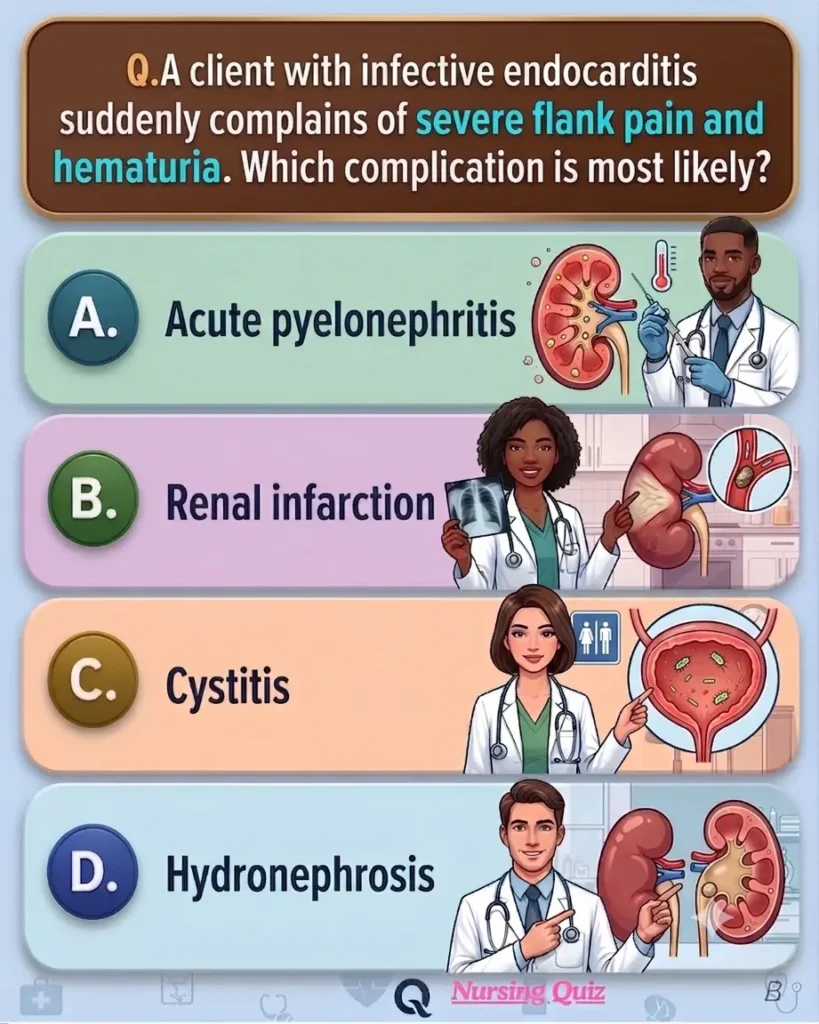
A client with infective endocarditis suddenly complains of severe flank pain and hematuria. Which complication is most likely?
👆 Comment your answer and the tap an option to check your answer.
Don’t forget to Comment your answer below.
❤️🩸 Infective Endocarditis – Renal Infarction
✅ Answer: (B) Renal Infarction
📖 What is Infective Endocarditis?
Infective = Caused by microorganisms (usually bacteria)
Endo = Inner
Carditis = Inflammation of the heart
👉 Infective Endocarditis (IE) is an infection of the inner lining of the heart (endocardium), usually involving the heart valves.
In IE, infected clumps called vegetations form on the valves. Small pieces of these vegetations can break off and travel through the bloodstream as septic emboli.
🩺 Why is Option (B) Correct?
A septic embolus can block the renal artery, cutting off blood supply to part of the kidney.
This causes a renal infarction, which typically presents with:
- ✔ Sudden severe flank pain
- ✔ Hematuria (blood in urine)
- ✔ Possible fever and nausea
- ✔ Elevated LDH due to tissue damage
👉 The combination of infective endocarditis + sudden flank pain + hematuria is highly suggestive of renal infarction.
❌ Why Other Options Are Wrong?
(A) Acute Pyelonephritis
❌ Usually presents with fever, chills, dysuria, costovertebral angle tenderness, and urinary infection symptoms. It is not a typical embolic complication of infective endocarditis.
(C) Cystitis
❌ Causes burning during urination, urinary frequency, and urgency. Severe flank pain is uncommon.
(D) Hydronephrosis
❌ Caused by obstruction of urine flow. Although flank pain can occur, it is not a common embolic complication of infective endocarditis.
📝 Embolic Complications of Infective Endocarditis
| Organ | Possible Complication |
|---|---|
| Brain | Stroke or brain abscess |
| Kidney | Renal infarction (flank pain + hematuria) |
| Spleen | Splenic infarction (left upper abdominal pain) |
| Lungs | Septic pulmonary emboli (right-sided IE) |
❤️ Endocarditis → Emboli → Kidney
🩸 Flank Pain + Hematuria = Think Renal Infarction
📌 Exam Tip: In infective endocarditis, sudden symptoms affecting another organ usually indicate an embolic complication. For the kidney, the classic MCQ clue is sudden flank pain with hematuria, pointing to renal infarction.
Concept clarity • Easy recall • Nursing success
Don’t forget to comment the answer below.