
🩺 Nursing Question of the Day
Challenge yourself with one exam-style nursing question every day.
✅ Think carefully • ✅ Choose your answer • ✅ Then scroll down to check the explanation.
Added on Dated 07.08.2026.
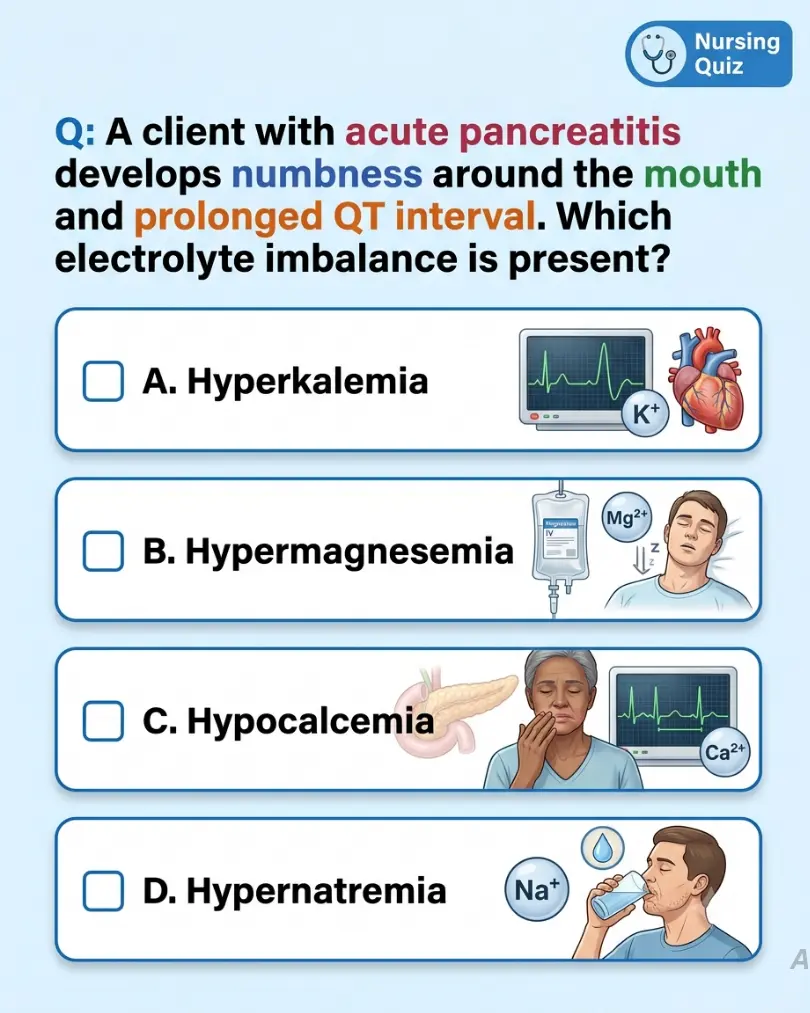
📝 Today’s Question:
A client with acute pancreatitis develops numbness around the mouth and prolonged QT interval. Which electrolyte imbalance is present?
👆 Comment your answer and the tap an option to check your answer.
Don’t forget to Comment your answer below.
🩺 Acute Pancreatitis and Hypocalcemia
✅ Answer: (C) Hypocalcemia
📖 What is Acute Pancreatitis?
Acute = Sudden onset.
Pancreatitis = Inflammation of the pancreas.
👉 Acute pancreatitis occurs when pancreatic enzymes become activated within the pancreas, causing inflammation and tissue damage.
📖 What is Hypocalcemia?
Hypo = Low.
Calcemia = Calcium level in the blood.
👉 Hypocalcemia means the serum calcium level is lower than normal (typically < 8.5 mg/dL).
In acute pancreatitis, released fatty acids bind with calcium (fat saponification), causing blood calcium levels to fall.
🩺 Why is Option (C) Correct?
The patient has two classic signs of hypocalcemia:
- ✔ Perioral numbness (tingling around the mouth)
- ✔ Prolonged QT interval on ECG
Other common manifestations include:
- ✔ Muscle cramps
- ✔ Tetany
- ✔ Positive Chvostek’s sign
- ✔ Positive Trousseau’s sign
- ✔ Seizures in severe cases
👉 Therefore, the electrolyte imbalance is Hypocalcemia.
❌ Why Other Options Are Wrong?
(A) Hyperkalemia
❌ Usually causes muscle weakness and ECG changes such as tall peaked T waves, not prolonged QT interval or perioral numbness.
(B) Hypermagnesemia
❌ Causes decreased reflexes, hypotension, and respiratory depression rather than tetany or prolonged QT interval.
(D) Hypernatremia
❌ Produces intense thirst, confusion, and neurological symptoms but is not associated with perioral numbness and prolonged QT interval.
📝 Signs of Hypocalcemia
| Finding | Reason |
|---|---|
| Perioral Numbness | Increased neuromuscular excitability |
| Tetany | Low calcium increases nerve and muscle irritability |
| Chvostek’s & Trousseau’s Signs | Classic signs of hypocalcemia |
| ECG | Prolonged QT interval |
🧈 Pancreatitis → Fat Saponification → Calcium Falls
⚡ Low Calcium = Tingling + Tetany + Long QT
Pancreatitis + Perioral Numbness = Think Hypocalcemia
📌 Exam Tip: Hypocalcemia is a classic complication of acute pancreatitis. Remember the key clues: perioral tingling, muscle spasms, positive Chvostek’s and Trousseau’s signs, and a prolonged QT interval. Severe hypocalcemia may require intravenous calcium gluconate.
Concept clarity • Easy recall • Nursing success
Don’t forget to comment the answer below.