
🩺 Nursing Question of the Day
Challenge yourself with one exam-style nursing question every day.
✅ Think carefully • ✅ Choose your answer • ✅ Then scroll down to check the explanation.
🎯 Today’s Challenge
Don’t scroll to the explanation immediately!
First, observe the question carefully, select the answer you believe is correct, and then compare it with the detailed explanation below. This daily practice will strengthen your clinical thinking and improve your performance in NCLEX, NORCET, AIIMS, ESIC, RRB, DSSSB, HAAD, Prometric, and Staff Nurse recruitment exams.
Added on Dated 25.07.2026.
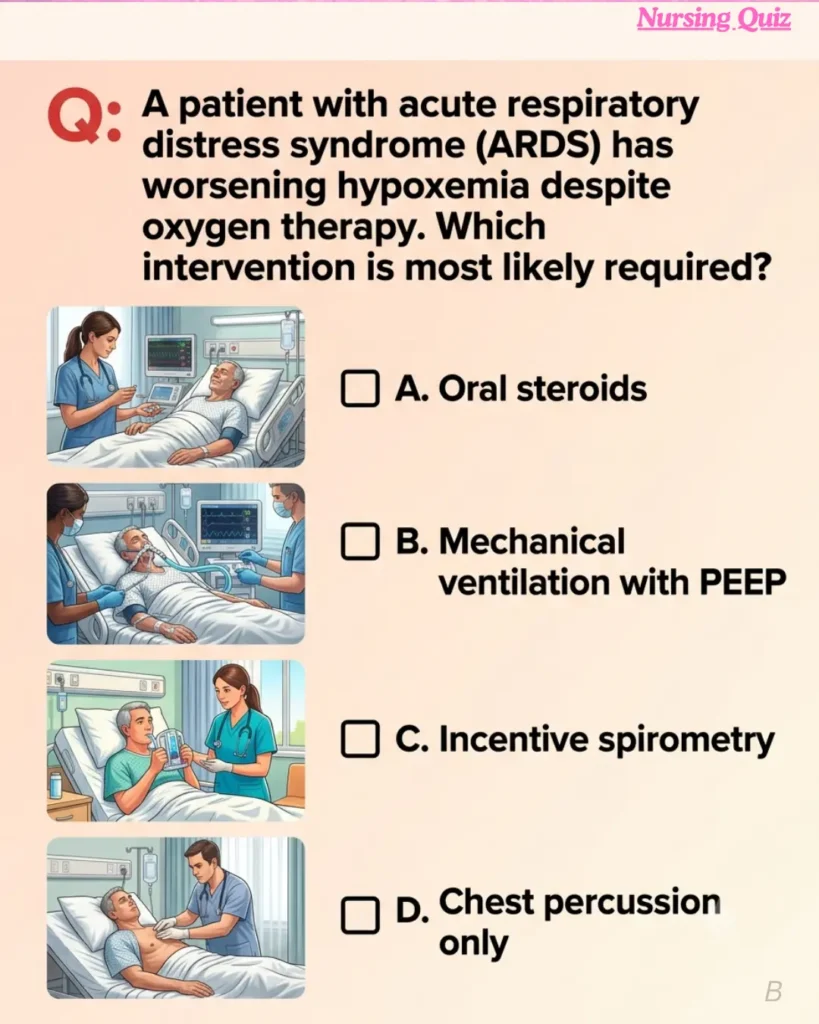
📝 Today’s Question
A patient with acute respiratory distress syndrome (ARDS) has worsening hypoxemia despite oxygen therapy. Which intervention is most likely required?
👆 Comment your answer and the tap an option to check your answer.
Don’t forget to Comment your answer below.
🫁 ARDS and Mechanical Ventilation with PEEP
✅ Answer: (B) Mechanical ventilation with PEEP
📖 What is ARDS?
ARDS (Acute Respiratory Distress Syndrome) is a life-threatening condition in which the lungs become severely inflamed and the alveoli fill with fluid.
👉 This reduces oxygen exchange, leading to severe hypoxemia (low blood oxygen) that often does not improve with oxygen therapy alone.
📖 What is PEEP?
PEEP stands for Positive End-Expiratory Pressure.
It is a ventilator setting that keeps the alveoli open at the end of expiration, preventing alveolar collapse and improving oxygenation.
Benefits of PEEP include:
- ✔ Improves oxygen exchange
- ✔ Prevents alveolar collapse (atelectasis)
- ✔ Increases functional residual capacity (FRC)
- ✔ Reduces the work of breathing
🩺 Why is Option (B) Correct?
The patient has worsening hypoxemia despite receiving oxygen therapy, indicating severe ARDS.
👉 In this situation, mechanical ventilation with PEEP is often required to maintain adequate oxygenation and support breathing.
❌ Why Other Options Are Wrong?
(A) Oral Steroids
❌ Corticosteroids may be considered in selected ARDS cases, but they do not immediately correct severe hypoxemia and are not the priority intervention.
(C) Incentive Spirometry
❌ Incentive spirometry is useful for preventing postoperative atelectasis in cooperative patients, but it is ineffective in severe ARDS with refractory hypoxemia.
(D) Chest Percussion Only
❌ Chest percussion helps mobilize secretions but does not treat the impaired gas exchange caused by ARDS.
📝 Key Features of ARDS
| Feature | Description |
|---|---|
| Cause | Diffuse lung inflammation and alveolar damage |
| Main Problem | Severe hypoxemia |
| Chest X-ray | Bilateral diffuse infiltrates (“white-out” appearance) |
| Priority Treatment | Mechanical ventilation with low tidal volume and PEEP |
🫁 ARDS = Alveoli Are Drowning
💨 PEEP = Pops the alveoli open to improve oxygenation.
📌 Exam Tip: In ARDS, if hypoxemia persists despite supplemental oxygen, the next step is usually mechanical ventilation with PEEP. Lung-protective ventilation using low tidal volumes (≈6 mL/kg predicted body weight) is the current standard of care.
Concept clarity • Easy recall • Nursing success
right B
Correct! Well done Keep practicing and keep learning.