
🩺 Nursing Question of the Day
Challenge yourself with one exam-style nursing question every day.
✅ Think carefully • ✅ Choose your answer • ✅ Then scroll down to check the explanation.
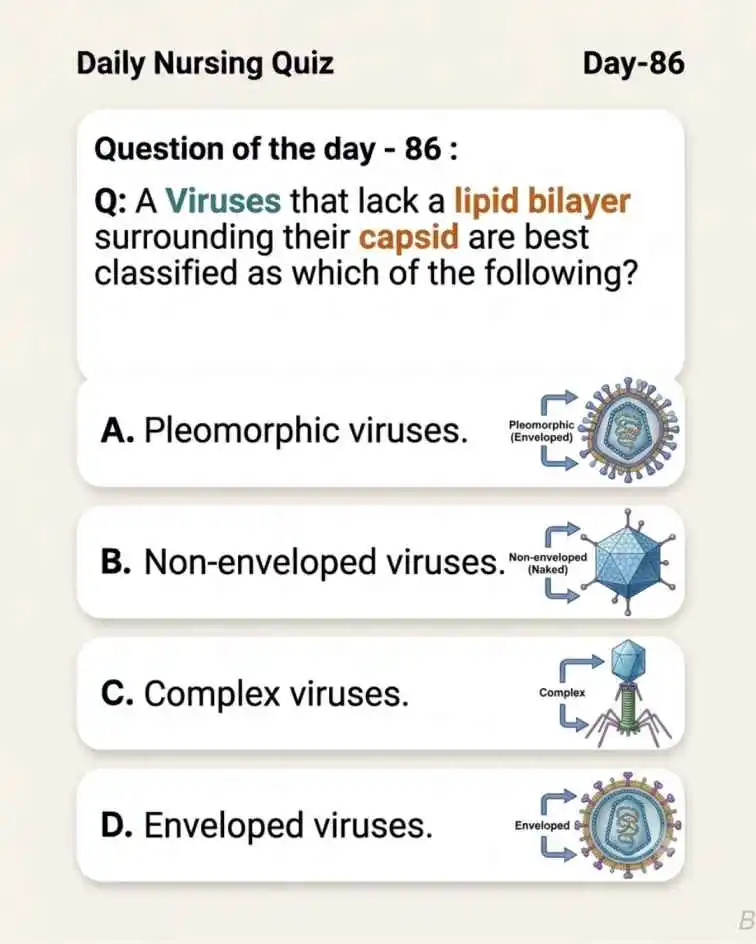
📝 Today’s Question:
Q: Viruses that lack a lipid bilayer surrounding their capsid are best classified as which of the following?
👆 Comment your answer and then tap an option to check your answer.
Don’t forget to Comment your answer below.
Classification of Viruses Without a Lipid Envelope
🦠 What is a Virus?
A virus is a very small infectious agent that cannot reproduce independently like bacteria or human cells. It must enter a living host cell and use the cell’s machinery to make more viruses.
The word virus comes from the Latin word virus, meaning poison or poisonous substance.
🧬 What is a Capsid?
A capsid is the protein coat that surrounds and protects the viral genetic material, such as DNA or RNA.
The term capsid comes from the Latin word capsa, meaning box or container. This is a useful way to remember its function: the capsid acts like a protective container around the viral genetic material.
🧫 What is a Lipid Bilayer?
A lipid bilayer is a double layer of fat-like molecules. In viruses, this membrane-like covering is called the viral envelope.
Many enveloped viruses obtain this lipid membrane from the host cell when new virus particles leave the cell. Viral proteins called glycoproteins are often embedded in this envelope and help the virus attach to and enter host cells.
The word lipid refers to fat-like substances, while bilayer simply means two layers.
🔬 Non-enveloped vs Enveloped Viruses
| Feature | Non-enveloped | Enveloped |
|---|---|---|
| Lipid envelope | Absent | Present |
| Capsid | Present | Present |
| Outer covering | Capsid | Envelope outside capsid |
A simple picture in your mind is helpful: non-enveloped virus = genetic material + capsid. An enveloped virus has an additional lipid covering outside the capsid.
❌ Why the Other Terms Are Wrong
Pleomorphic viruses: The word pleomorphic means having many or variable shapes. It describes the shape or appearance of a virus, not specifically the absence of a lipid envelope.
Complex viruses: These have unusual or complicated structural arrangements that do not fit the simpler common capsid shapes. “Complex” does not mean that the virus lacks an envelope.
Enveloped viruses: These viruses have a lipid envelope surrounding the capsid. Therefore, this is the opposite of the condition described.
💡 Why Does This Difference Matter?
The presence or absence of an envelope affects how easily a virus is damaged by environmental conditions. The lipid envelope is relatively fragile and can be disrupted by substances such as detergents and some lipid solvents.
Non-enveloped viruses generally lack this fragile lipid covering and can therefore be more resistant to environmental conditions in many situations. This is one reason why understanding viral structure is important in infection control.
🧠 Easy Memory Trick
If there is no lipid envelope around the capsid → think NON-ENVELOPED VIRUS.
Concept clarity • Easy recall • Nursing success
Don’t forget to comment the answer below.