
🩺 Nursing Question of the Day
Challenge yourself with one exam-style nursing question every day.
✅ Think carefully • ✅ Choose your answer • ✅ Then scroll down to check the explanation.
📝 Today’s Question:
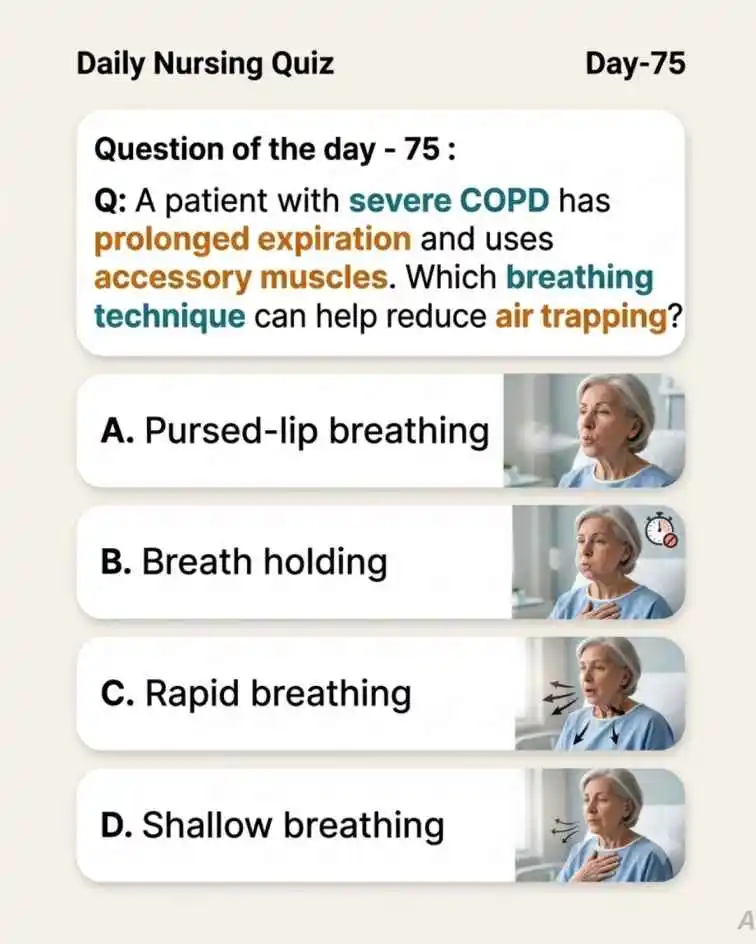
Q: A patient with severe COPD has prolonged expiration and uses accessory muscles. Which breathing technique can help reduce air trapping?
👆 Comment your answer and then tap an option to check your answer.
Don’t forget to Comment your answer below.
Pursed-Lip Breathing in Severe COPD
📖 First, What Is COPD?
COPD stands for Chronic Obstructive Pulmonary Disease. It is a long-term lung disease in which airflow is persistently limited, making it especially difficult for the patient to breathe air out.
The word chronic comes from the Greek word chronos, meaning “time.” It means something that continues for a long period.
Obstructive comes from the Latin obstruere, meaning “to block or close up.” In COPD, airflow is obstructed, particularly during expiration.
Pulmonary comes from the Latin pulmo, meaning “lung.” So pulmonary simply means related to the lungs.
Disease refers to an abnormal condition that affects normal body function.
🫁 What Is Happening in COPD?
In severe COPD, the small airways may become narrowed and the lungs may lose some of their elastic recoil. Because of this, air can enter the lungs but has difficulty getting back out.
This is called air trapping.
↓
Difficult expiration
↓
Air remains trapped in lungs
↓
More difficulty breathing
🔎 Important Medical Terms
Expiration
Expiration means breathing air out of the lungs. The word comes from Latin exspirare, meaning “to breathe out.” In COPD, expiration can become prolonged because air has difficulty leaving the lungs.
Accessory muscles
Accessory means “additional” or “helping.” Normally, breathing is mainly performed by the diaphragm and intercostal muscles. When breathing becomes difficult, the patient may recruit additional muscles of the neck, shoulders, and chest to help breathe.
Air trapping
This means that air remains inside the lungs because the patient cannot completely exhale it. Repeated air trapping can contribute to hyperinflation, meaning excessive expansion of the lungs.
Pursed lips
Pursed means the lips are brought close together, leaving only a small opening. During this technique, the patient breathes in through the nose and slowly breathes out through partially closed lips.
Dyspnea
Dyspnea means shortness of breath or difficult breathing. The word comes from Greek roots: dys- means difficult or abnormal, and -pnea relates to breathing.
🌬️ How Does Pursed-Lip Breathing Help?
When the patient exhales slowly through partially closed lips, the technique creates a small amount of back pressure in the airways.
This can help keep the smaller airways open longer during expiration, allowing trapped air to leave more effectively.
The patient should generally be taught to:
- Relax the shoulders and neck.
- Inhale slowly through the nose.
- Pucker or partially close the lips as if gently blowing out a candle.
- Exhale slowly and gently through the pursed lips.
- Make the exhalation longer than the inhalation.
Imagine blowing gently through a small straw. You are not forcing the air out quickly; instead, you are allowing it to leave slowly and in a controlled manner.
❌ Why Are the Other Options Wrong?
❌ B. Breath holding
Holding the breath does not help remove trapped air. In a patient already struggling to exhale, prolonged breath holding can increase discomfort and does not provide the controlled expiration needed in COPD.
❌ C. Rapid breathing
Rapid breathing can shorten the time available for expiration and may worsen air trapping. It can also increase the patient’s work of breathing and fatigue.
❌ D. Shallow breathing
Shallow breathing is not the preferred technique for reducing air trapping. The goal is controlled breathing with a slow, prolonged expiration rather than quick, shallow breaths.
🩺 Nursing Points
- Teach pursed-lip breathing during episodes of dyspnea and activity when appropriate.
- Encourage a slow, controlled expiration.
- Position the patient comfortably, often sitting upright or leaning slightly forward.
- Monitor respiratory rate, oxygen saturation, work of breathing, and mental status.
- Allow rest periods to reduce respiratory muscle fatigue.
- Teach the patient to avoid unnecessary rapid breathing when feeling short of breath.
COPD + difficult expiration = Slow it down.
Think: “Purse the lips → prolong the exhale → reduce air trapping.”
If you see COPD + prolonged expiration + air trapping, think pursed-lip breathing. It promotes slow, controlled exhalation and can help prevent premature airway closure during expiration.
Concept clarity • Easy recall • Nursing success
Don’t forget to comment the answer below.