
🩺 Nursing Question of the Day
Challenge yourself with one exam-style nursing question every day.
✅ Think carefully • ✅ Choose your answer • ✅ Then scroll down to check the explanation.
📝 Today’s Question:
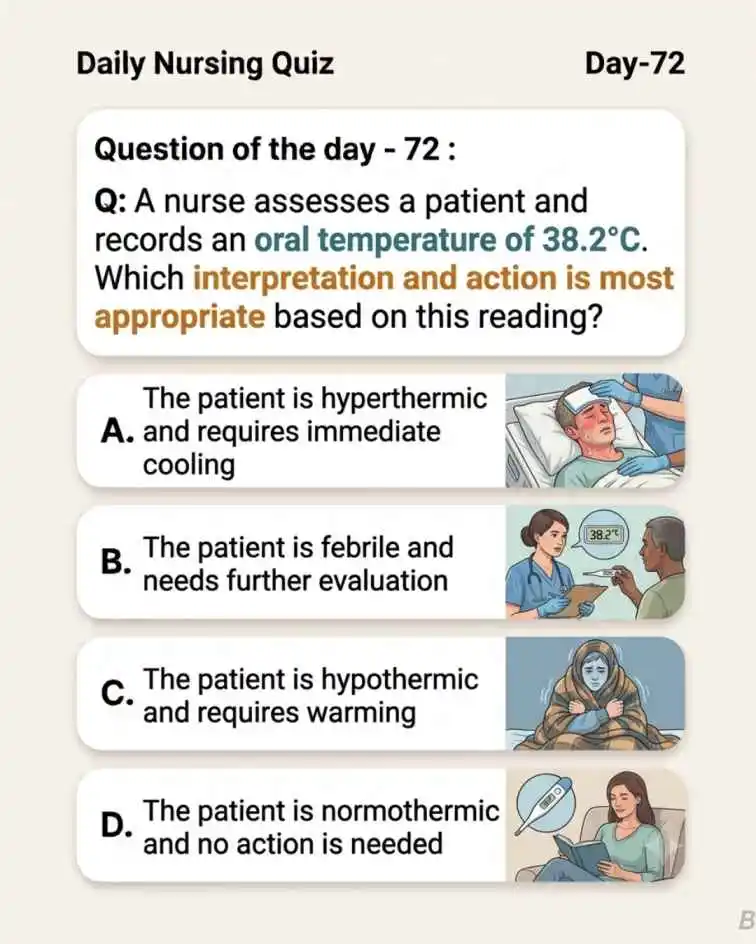
Q: A nurse assesses a patient and records an oral temperature of 38.2°C. Which interpretation and action is most appropriate based on this reading?
👆 Comment your answer and the tap an option to check your answer.
Don’t forget to Comment your answer below.
🌡️ Understanding Fever and Body Temperature
A nurse assesses a patient and records an oral temperature of 38.2°C. Which interpretation and action is most appropriate based on this reading?
A. The patient is hyperthermic and requires immediate cooling
B. The patient is febrile and needs further evaluation
C. The patient is hypothermic and requires warming
D. The patient is normothermic and no action is needed
📖 Understanding the Concept
Fever (pyrexia) is an elevation in body temperature, commonly associated with infection or inflammation. An oral temperature of 38.2°C (100.8°F) is generally considered a fever in an adult.
The nurse should assess the patient’s overall condition, check for associated symptoms, and investigate the possible cause. The temperature reading alone does not automatically mean that emergency cooling is required.
- Fever: Usually 38°C or higher, depending on the measurement site and clinical context.
- Normothermia: Temperature within the expected normal range.
- Hypothermia: Core body temperature below 35°C.
- Hyperthermia: Excessive body temperature elevation due to heat accumulation or impaired heat dissipation, rather than a raised hypothalamic set point.
🔍 Explanation of Each Option
❌ A. The patient is hyperthermic and requires immediate cooling
A temperature of 38.2°C indicates fever, but it does not by itself establish a hyperthermic emergency. Immediate cooling is not routinely required for every patient with fever. The nurse should assess the patient’s symptoms, vital signs, and clinical history before deciding on appropriate care.
✅ B. The patient is febrile and needs further evaluation
This is the best answer. A temperature of 38.2°C is above the usual adult fever threshold. The nurse should assess for symptoms such as chills, cough, pain, urinary symptoms, or signs of infection and monitor other vital signs. Further action depends on the patient’s condition and the suspected cause.
❌ C. The patient is hypothermic and requires warming
Hypothermia means an abnormally low body temperature, generally below 35°C when measured as core temperature. A reading of 38.2°C is elevated, not low, so warming is inappropriate.
❌ D. The patient is normothermic and no action is needed
Normothermia means the body temperature is within the expected normal range. An oral temperature of 38.2°C is generally above that range and should not be ignored. Further assessment is needed to identify the cause and determine whether treatment is required.
🩺 Important Nursing Actions
- Reassess the temperature if the reading is unexpected or inconsistent with the patient’s condition.
- Check pulse, respiratory rate, blood pressure, oxygen saturation, and mental status as appropriate.
- Ask about symptoms and possible sources of infection.
- Encourage fluids if appropriate and not contraindicated.
- Follow clinical protocols for further investigations, treatment, and monitoring.
- Escalate promptly if the patient appears seriously unwell or has signs of sepsis.
Fever in a patient receiving chemotherapy, a patient with severe immunosuppression, or a patient showing signs of sepsis requires urgent assessment. Do not judge the severity of illness by temperature alone.
38°C or more = Think fever.
Assess the patient, look for the cause, and decide the next action based on the clinical picture.
When an exam question gives a temperature of 38.2°C and asks for the most appropriate interpretation, choose fever with further evaluation. Do not confuse fever with hypothermia or assume that every fever requires immediate cooling.
Concept clarity • Easy recall • Nursing success
Don’t forget to comment the answer below.