
🩺 Nursing Question of the Day
Challenge yourself with one exam-style nursing question every day.
✅ Think carefully • ✅ Choose your answer • ✅ Then scroll down to check the explanation.
📝 Today’s Question:
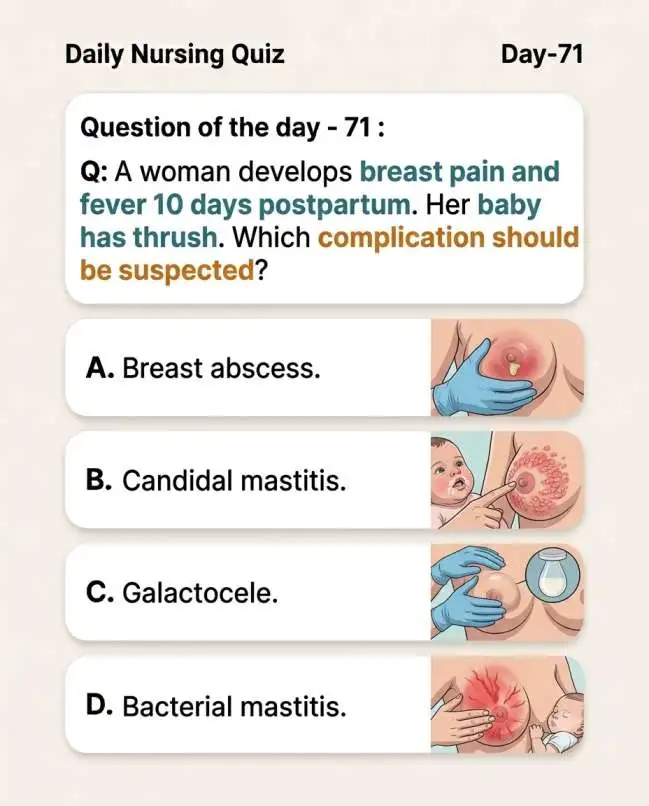
Q: A woman develops breast pain and fever 10 days postpartum. Her baby has thrush. Which complication should be suspected?
👆 Comment your answer and the tap an option to check your answer.
Don’t forget to Comment your answer below.
🤱 Breast Pain and Fever in a Breastfeeding Mother
A woman develops breast pain and fever 10 days postpartum. Her baby has thrush. Which complication should be suspected?
A. Breast abscess
B. Candidal mastitis
C. Galactocele
D. Bacterial mastitis
🔍 Why is B correct?
The important clue in this question is that the baby has thrush. Thrush is a Candida infection of the baby’s mouth, and Candida can be transmitted between the infant’s mouth and the mother’s nipple during breastfeeding.
When a breastfeeding mother develops burning or painful nipples/breasts, especially when the infant has oral thrush, Candida-associated breast infection (candidal mastitis) should be considered.
The timing and combination of findings are therefore important:
↓
Possible Candida transmission during breastfeeding
↓
Mother develops breast/nipple pain ± burning
↓
Think about candidal breast infection
Both mother and baby may need assessment and treatment when Candida infection is suspected, because reinfection can occur if only one member of the breastfeeding pair is treated.
🦠 What is Candida?
Candida is a type of yeast. In infants, Candida can cause oral thrush, which commonly appears as creamy or white patches in the mouth that may be difficult to wipe away.
During breastfeeding, organisms can pass between the infant’s mouth and the mother’s nipple. This is why the baby’s oral infection is an important clue when the mother develops unusual nipple or breast pain.
🧠 Understanding the other options
A breast abscess is a localized collection of pus that can develop as a complication of mastitis. It often presents with a tender, localized, fluctuant or mass-like area, persistent symptoms, and sometimes fever. The baby’s thrush, however, specifically points toward Candida in this question.
This is the best answer because the mother has breast pain and fever while her breastfeeding infant has oral thrush. The mother-baby Candida connection is the key clue.
A galactocele is a milk-filled cyst that can occur during lactation, usually because of obstruction of milk flow. It generally presents as a relatively well-defined breast lump and does not typically explain fever or the baby’s thrush.
Bacterial mastitis is also an important cause of postpartum breast pain, redness, swelling, and fever. However, the specific clue that the baby has thrush makes Candida-associated infection the expected answer in this question.
📊 Quick Comparison
| Condition | Typical Clue |
|---|---|
| Candidal mastitis | Breast/nipple pain + infant oral thrush |
| Bacterial mastitis | Localized inflammation, pain, redness, fever |
| Breast abscess | Localized collection/mass, persistent infection |
| Galactocele | Milk-filled breast cyst/lump |
👩⚕️ Nursing Points
- Assess the mother’s breast and nipple symptoms carefully.
- Ask about the infant’s feeding pattern and oral findings.
- Look for signs of oral thrush in the infant.
- Encourage appropriate breastfeeding support and good nipple hygiene.
- Ensure the mother and infant are assessed when Candida infection is suspected.
- Administer prescribed antifungal treatment as directed.
- Monitor the mother for worsening fever, localized swelling, or signs of abscess.
“Baby with Thrush → Think Candida in Mom.”
When a breastfeeding infant has oral thrush and the mother develops unusual breast or nipple pain, remember Candida.
In postpartum breastfeeding questions, look carefully for clues connecting the mother and infant. Infant oral thrush + maternal breast/nipple pain is a classic clue for candidal breast infection. Do not automatically choose bacterial mastitis just because fever is present.
Concept clarity • Easy recall • Nursing success
Don’t forget to comment the answer below.