
🩺 Nursing Question of the Day
Challenge yourself with one exam-style nursing question every day.
✅ Think carefully • ✅ Choose your answer • ✅ Then scroll down to check the explanation.
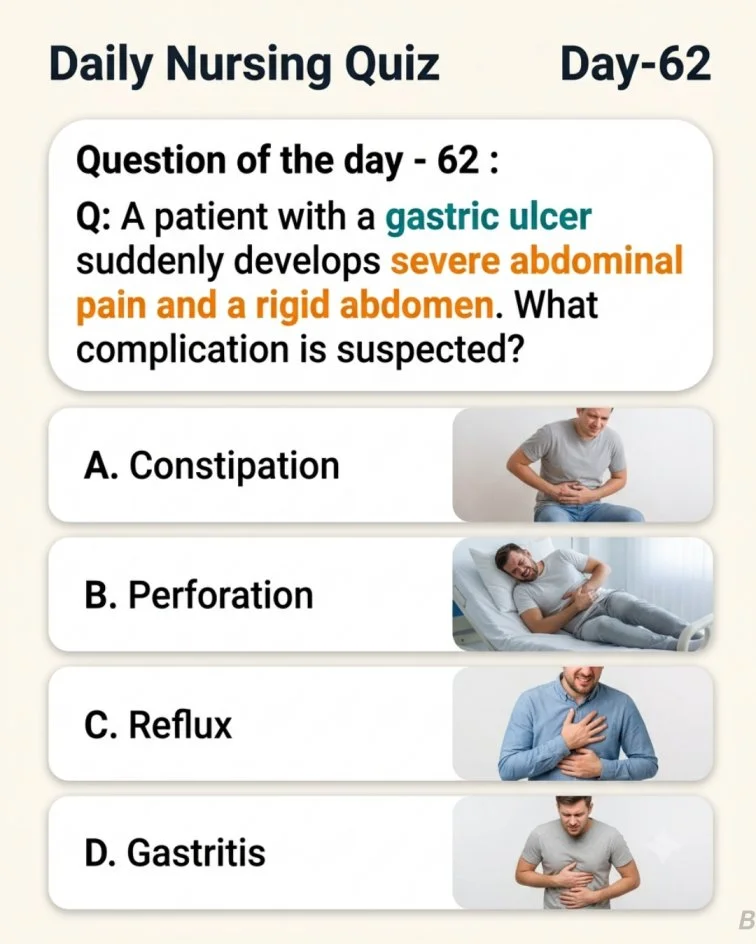
📝 Today’s Question:
A patient with a gastric ulcer suddenly develops severe abdominal pain and a rigid abdomen. What complication is suspected?
👆 Comment your answer and the tap an option to check your answer.
Don’t forget to Comment your answer below.
🩺 Gastric Ulcer Perforation
A patient with a gastric ulcer suddenly develops severe abdominal pain and a rigid abdomen. What complication is suspected?
A. Constipation
B. Perforation
C. Reflux
D. Gastritis
🔬 What is gastric ulcer perforation?
A gastric ulcer is an open lesion in the stomach lining caused by breakdown of the protective mucosal barrier and injury from gastric acid and digestive enzymes.
Normally, the stomach wall protects deeper tissues from gastric acid. If an ulcer becomes deep enough, it can penetrate through the entire stomach wall and create a hole (perforation).
Gastric ulcer becomes deeper → ulcer penetrates through stomach wall → gastric contents escape into the peritoneal cavity → intense peritoneal irritation → sudden severe abdominal pain + rigid abdomen → possible peritonitis and shock
🚨 Why does the abdomen become rigid?
The peritoneum is a sensitive membrane lining the abdominal cavity and covering many abdominal organs. Gastric acid, digestive enzymes, and stomach contents are highly irritating when they enter the normally sterile peritoneal cavity.
This irritation produces peritoneal inflammation. The abdominal muscles may contract involuntarily, producing a firm or rigid “board-like” abdomen.
Sudden severe abdominal pain + rigid/board-like abdomen = think perforation with peritonitis.
⚠️ Other Possible Findings
- Sudden, severe abdominal pain
- Rigid or board-like abdomen
- Guarding and rebound tenderness may occur
- Nausea or vomiting
- Tachycardia
- Fever may develop as inflammation progresses
- Hypotension may occur with severe infection or shock
Perforation is a medical and surgical emergency because leakage of gastric contents can cause chemical peritonitis followed by bacterial peritonitis and potentially sepsis.
🩺 Nursing Priority
A patient with suspected gastrointestinal perforation requires urgent assessment and escalation. The nurse should monitor vital signs, assess the severity and progression of abdominal findings, keep the patient appropriately NPO if ordered/protocol indicates, establish or maintain IV access as appropriate, and promptly notify the healthcare team.
Further management may include IV fluids, analgesia, antibiotics, diagnostic imaging, and surgical intervention depending on the patient’s condition and provider orders.
❌ Why are the other options wrong?
Constipation can cause abdominal discomfort, bloating, and difficulty passing stool, but it does not typically cause sudden severe abdominal pain with a rigid abdomen. Rigidity is a major warning sign of peritoneal irritation.
Correct. A gastric ulcer can penetrate completely through the stomach wall. Leakage of gastric contents into the peritoneal cavity causes intense irritation, resulting in acute severe abdominal pain and abdominal rigidity.
Gastroesophageal reflux occurs when stomach contents move backward into the esophagus. Typical symptoms include heartburn and acid regurgitation, not a sudden rigid abdomen.
Gastritis is inflammation of the stomach lining. It may cause epigastric pain, nausea, vomiting, or indigestion, but it does not explain the classic emergency combination of sudden severe pain and abdominal rigidity.
📚 Important Peptic Ulcer Complications
| Complication | Key clue |
|---|---|
| Perforation | Sudden severe pain + rigid abdomen |
| Hemorrhage | Hematemesis, melena, weakness, shock |
| Gastric outlet obstruction | Persistent vomiting, early satiety, abdominal distention |
| Penetration | Ulcer extends into an adjacent organ rather than freely perforating the wall |
“Ulcer + sudden pain + rigid belly = PERFORATION.”
Think: Hole in stomach → contents leak → peritoneum irritated → rigidity.
For peptic-ulcer questions, recognize the classic clues:
Sudden severe abdominal pain + board-like/rigid abdomen → Perforation
Hematemesis or melena → Hemorrhage
Persistent vomiting + distention → Gastric outlet obstruction
Concept clarity • Easy recall • Nursing success
Don’t forget to comment the answer below.