
🩺 Nursing Question of the Day
Challenge yourself with one exam-style nursing question every day.
✅ Think carefully • ✅ Choose your answer • ✅ Then scroll down to check the explanation.
📝 Today’s Question:
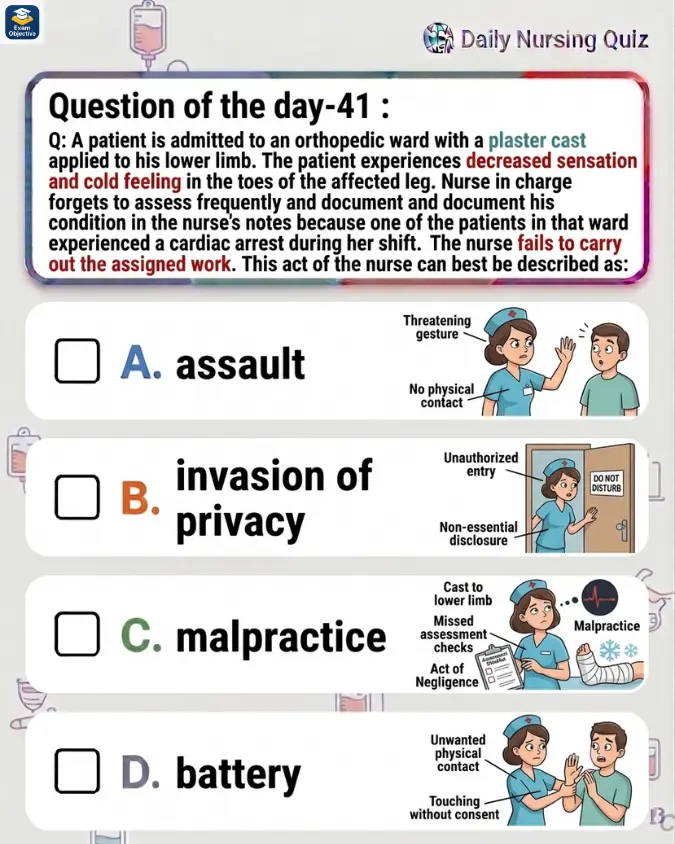
A patient is admitted to an orthopedic ward with a plaster cast applied to his lower limb. The patient experiences decreased sensation and cold feeling in the toes of the affected leg. Nurse in charge forgets to assess frequently and document his condition in the nurse’s notes because one of the patients in that ward experienced a cardiac arrest during her shift. The nurse fails to carry out the assigned work. This act of the nurse can best be described as:
👆 Comment your answer and the tap an option to check your answer.
Don’t forget to Comment your answer below.
⚖️ Nursing Negligence — Malpractice
B. Invasion of privacy
C. Malpractice
D. Battery
✅ Answer: (C) Malpractice
📖 Why is Malpractice the Correct Answer?
Malpractice is a form of professional negligence in which a healthcare professional fails to provide the standard of care expected from a reasonably competent professional, resulting in or potentially contributing to patient harm.
In this case, the patient has a plaster cast and develops decreased sensation and cold toes. These findings may indicate impaired circulation or neurovascular compromise and require prompt assessment and documentation.
The nurse fails to perform the required assessments and documentation because of another emergency occurring on the ward. Although the cardiac arrest required attention, the nurse still had a professional responsibility to ensure appropriate care and follow-up for the other patient.
🦶 Why Are Cold Toes and Decreased Sensation Important?
A patient with a plaster cast requires regular neurovascular assessment. The nurse should monitor circulation, sensation, movement, skin color, temperature, and pulses as appropriate.
Cold toes and decreased sensation can be warning signs of compromised circulation or nerve function. If the problem is not recognized and managed promptly, tissue damage may occur.
For a patient with a cast, think about neurovascular checks. Changes in temperature, sensation, color, movement, or circulation should be reported promptly.
❌ Why Are the Other Options Wrong?
A. Assault ❌
Assault is an intentional act or threat that makes a person fear that harmful or unwanted contact is about to occur. Simply failing to assess a patient does not constitute assault.
B. Invasion of privacy ❌
This occurs when a patient’s personal information, body, or private affairs are improperly exposed or accessed. There is no privacy violation described in this situation.
C. Malpractice ✅
The nurse fails to provide the professional care expected of a nurse, specifically failing to perform necessary assessment and documentation. Therefore, the best answer is malpractice.
D. Battery ❌
Battery involves intentional, unauthorized physical contact with a patient. For example, performing a procedure without the patient’s consent when consent is required. That is not what happened here.
📊 Quick Comparison
| Term | Meaning |
|---|---|
| Assault | Threat of unwanted harm/contact |
| Battery | Unauthorized physical contact |
| Invasion of privacy | Improper intrusion into privacy |
| Malpractice | Professional negligence |
“MALPRACTICE = PROFESSIONAL CARE MISSED”
If a nurse fails to perform a required professional duty and the patient may be harmed → think Malpractice.
📌 Exam Tip: Remember the basic distinction: Assault = threat, Battery = unwanted contact, Privacy = intrusion, Malpractice = professional negligence. Failure to assess, monitor, document, or provide required nursing care is commonly tested as malpractice/negligence.
Concept clarity • Easy recall • Nursing success
Don’t forget to comment the answer below.