
🩺 Nursing Question of the Day
Challenge yourself with one exam-style nursing question every day.
✅ Think carefully • ✅ Choose your answer • ✅ Then scroll down to check the explanation.
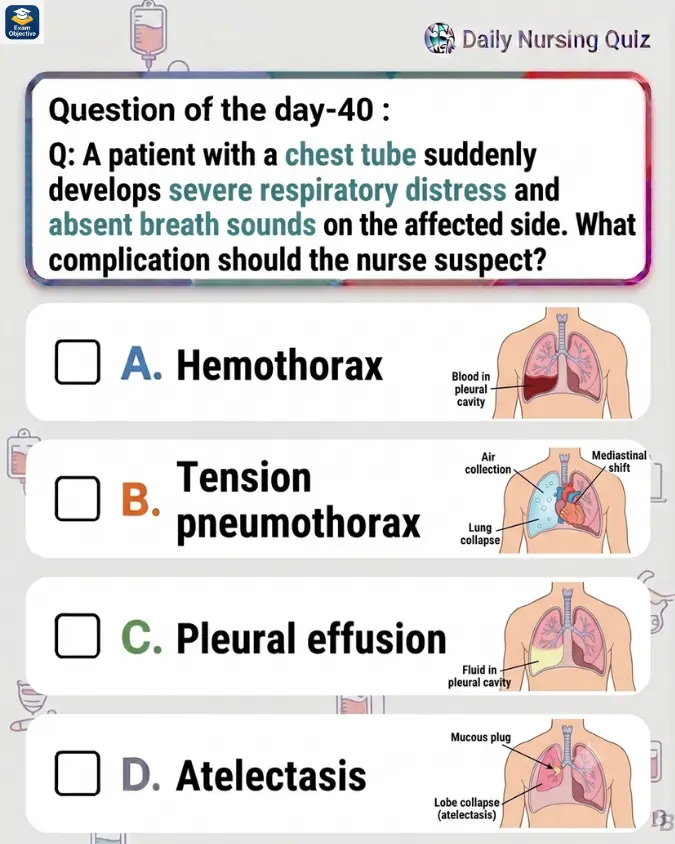
📝 Today’s Question:
A patient with a chest tube suddenly develops severe respiratory distress and absent breath sounds on the affected side. What complication should the nurse suspect?
👆 Comment your answer and the tap an option to check your answer.
Don’t forget to Comment your answer below.
🫁 Chest Tube Emergency — Tension Pneumothorax
B. Tension pneumothorax
C. Pleural effusion
D. Atelectasis
✅ Answer: (B) Tension pneumothorax
📖 Why is Tension Pneumothorax the Correct Answer?
A tension pneumothorax occurs when air enters the pleural space but cannot escape. The trapped air progressively increases pressure inside the chest and causes the affected lung to collapse.
The sudden development of severe respiratory distress + absent breath sounds on one side is a major warning sign. In a patient who already has a chest tube, a sudden change can indicate a serious complication such as tube obstruction, disconnection, or worsening pneumothorax leading to tension physiology.
As pressure continues to rise, the mediastinum can shift toward the opposite side and compress major blood vessels. This reduces venous return to the heart and can cause hypotension, shock, and cardiac arrest.
🚨 Important Clinical Findings
- Sudden severe dyspnea
- Absent or markedly decreased breath sounds on the affected side
- Unilateral chest expansion may be reduced
- Tachycardia
- Hypotension in advanced cases
- Distended neck veins may occur
- Tracheal deviation away from the affected side is a late sign
Key point: Do not wait for every classic sign to appear. Tension pneumothorax is a life-threatening emergency.
🔎 Why Can This Happen With a Chest Tube?
A chest tube is inserted to remove air, blood, or fluid from the pleural space. If the tube becomes blocked, kinked, displaced, or disconnected, air may accumulate rather than being adequately evacuated.
This can cause rapid deterioration and potentially produce tension physiology.
Sudden respiratory distress with absent breath sounds is an emergency. Assess the patient immediately, call for urgent medical assistance, provide oxygen as indicated, and rapidly evaluate the chest-tube system for obstruction, kinking, disconnection, or displacement according to facility protocol.
❌ Why Are the Other Options Wrong?
A. Hemothorax ❌
Hemothorax is the accumulation of blood in the pleural space. It can cause decreased breath sounds, but the sudden severe respiratory distress described with a chest tube is more suggestive of tension pneumothorax.
B. Tension pneumothorax ✅
Rapidly worsening respiratory distress with absent unilateral breath sounds is a classic emergency presentation.
C. Pleural effusion ❌
Pleural effusion is the accumulation of fluid in the pleural space. It generally develops more gradually rather than producing sudden severe respiratory distress.
D. Atelectasis ❌
Atelectasis is collapse of alveoli or part of the lung, commonly occurring after surgery or prolonged immobility. It usually does not cause the sudden, severe unilateral presentation described here.
📊 Quick Comparison
| Condition | Main Problem |
|---|---|
| Tension pneumothorax | Trapped air + rising pressure |
| Hemothorax | Blood in pleural space |
| Pleural effusion | Fluid in pleural space |
| Atelectasis | Alveolar/lung collapse |
“TENSION = PRESSURE + DISTRESS”
Sudden respiratory distress + one-sided absent breath sounds → think Tension Pneumothorax.
📌 Exam Tip: In chest-tube questions, sudden severe respiratory distress + absent breath sounds on the affected side should make you immediately suspect tension pneumothorax. It is a life-threatening emergency requiring rapid intervention.
Concept clarity • Easy recall • Nursing success
Don’t forget to comment the answer below.