
🩺 Nursing Question of the Day
Challenge yourself with one exam-style nursing question every day.
✅ Think carefully • ✅ Choose your answer • ✅ Then scroll down to check the explanation.
📝 Today’s Question:
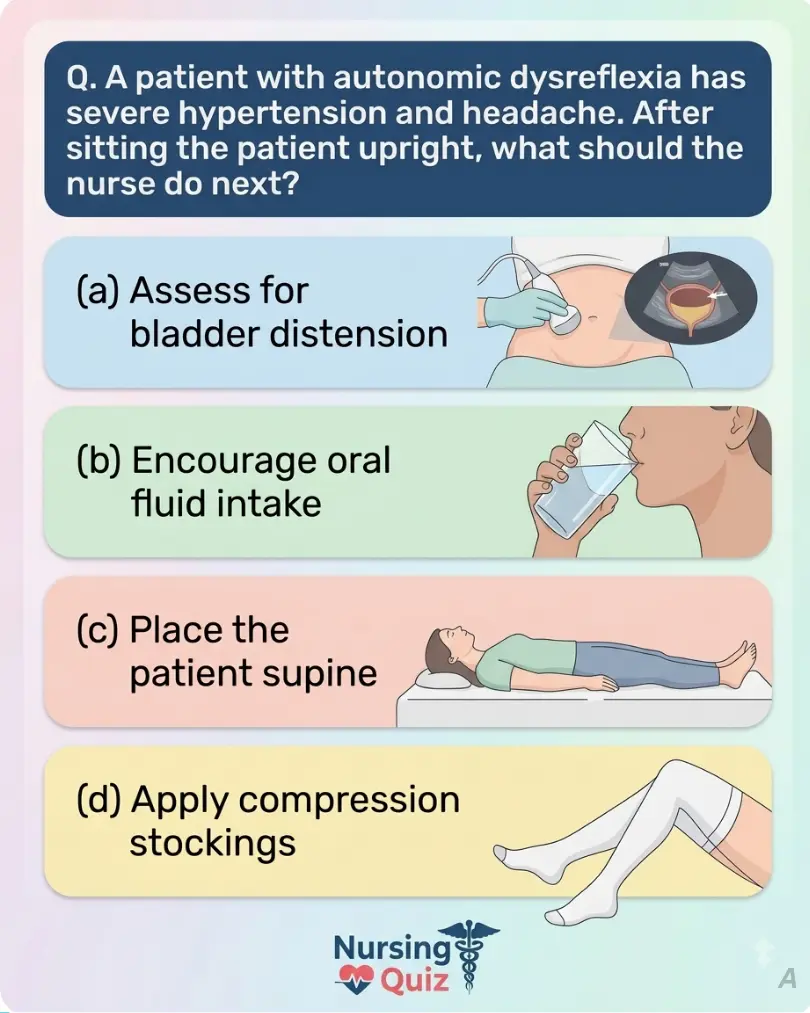
A patient with autonomic dysreflexia has severe hypertension and headache. After sitting the patient upright, what should the nurse do next?
👆 Comment your answer and the tap an option to check your answer.
Don’t forget to Comment your answer below.
⚠️ Autonomic Dysreflexia — Priority Nursing Action
B. Encourage oral fluid intake
C. Place the patient supine
D. Apply compression stockings
✅ Answer: (A) Assess for bladder distension
📖 What is Autonomic Dysreflexia?
Autonomic = Related to the autonomic nervous system, which controls involuntary body functions.
Dys = Abnormal or impaired.
Reflexia = An exaggerated reflex response.
👉 Autonomic dysreflexia (AD) is a potentially life-threatening condition that can occur in patients with a spinal cord injury, particularly injuries at or above T6.
A noxious stimulus below the level of injury can trigger a massive sympathetic response, producing sudden severe hypertension.
🩺 Why is Option A Correct?
The urinary bladder is one of the most common triggers of autonomic dysreflexia. Bladder distension, often caused by a blocked or kinked catheter or urinary retention, can trigger the episode.
Therefore, after positioning the patient upright, the nurse should promptly look for the underlying trigger, beginning with the urinary system.
⬇️
🪑 Sit upright
⬇️
🩺 Check bladder / urinary catheter
⬇️
🔎 Remove the triggering stimulus
👉 Thus, assessing for bladder distension is the best answer.
📖 Why Sit the Patient Upright?
Sitting the patient upright helps promote lower-extremity venous pooling, which can reduce blood pressure while the underlying cause is being identified and treated.
The nurse should also monitor blood pressure frequently because severe hypertension can lead to serious complications such as stroke, seizures, or cardiac complications.
❌ Why Are the Other Options Wrong?
A. Assess for bladder distension
✅ Correct. Bladder distension and urinary catheter obstruction are common triggers and should be assessed promptly.
B. Encourage oral fluid intake
❌ This does not treat the acute episode and could worsen bladder distension if urinary retention is present.
C. Place the patient supine
❌ The patient should remain upright initially. Lying flat can increase blood pressure.
D. Apply compression stockings
❌ Compression stockings do not address the underlying trigger and are not the priority intervention during acute autonomic dysreflexia.
📝 Common Triggers of Autonomic Dysreflexia
| Trigger | Examples |
|---|---|
| Bladder | Distension, urinary retention, blocked catheter |
| Bowel | Fecal impaction, constipation |
| Skin | Pressure injury, tight clothing, burns |
AD = “Sit → Search the bladder → Solve the trigger.”
🪑 Sit upright → 🩺 Check bladder/catheter → 🔎 Find and remove the trigger
📌 Exam Tip: In autonomic dysreflexia, think “severe hypertension + headache + spinal cord injury”. Sit the patient upright, monitor BP, and rapidly identify and remove the trigger—especially bladder distension or catheter obstruction.
Concept clarity • Easy recall • Nursing success
Don’t forget to comment the answer below.