
🩺 Nursing Question of the Day
Challenge yourself with one exam-style nursing question every day.
✅ Think carefully • ✅ Choose your answer • ✅ Then scroll down to check the explanation.
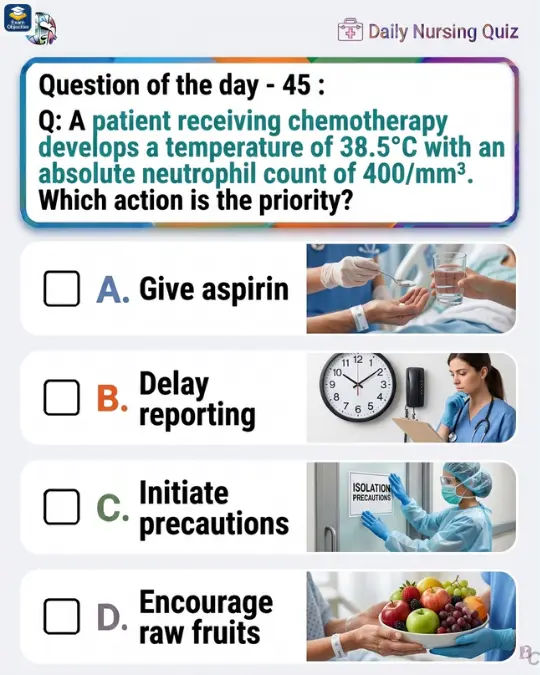
📝 Today’s Question:
A patient receiving chemotherapy develops a temperature of 38.5°C with an absolute neutrophil count of 400/mm³. Which action is the priority?
👆 Comment your answer and the tap an option to check your answer.
Don’t forget to Comment your answer below.
🧪 Chemotherapy + Fever + Neutropenia
A patient receiving chemotherapy develops a temperature of 38.5°C with an absolute neutrophil count of 400/mm³. Which action is the priority?
B. Delay reporting
C. Initiate precautions
D. Encourage raw fruits
📖 First Understand the Two Important Findings
This question gives us two major warning signs:
This is a significant fever in a patient receiving chemotherapy.
This represents severe neutropenia, meaning the patient has very few neutrophils available to fight bacterial and fungal infections.
When fever + severe neutropenia occur together, the patient is at high risk for a rapidly progressing infection. This situation is commonly referred to clinically as febrile neutropenia and requires urgent assessment and management.
Chemotherapy + fever + very low ANC = infection emergency.
Do not wait for the patient to develop obvious local signs of infection.
🧬 What Does ANC Mean?
ANC stands for Absolute Neutrophil Count. Neutrophils are white blood cells that play an important role in defending the body against infections, especially bacterial and fungal infections.
The lower the ANC, the greater the risk of serious infection.
| ANC | General Interpretation |
|---|---|
| ≥1500/mm³ | Usually normal range |
| 1000–1499/mm³ | Mild neutropenia |
| 500–999/mm³ | Moderate neutropenia |
| <500/mm³ | Severe neutropenia |
An ANC of 400/mm³ is therefore extremely low. The patient has a greatly reduced ability to mount an effective defense against infection.
💊 Why Does Chemotherapy Cause This Problem?
Chemotherapy targets rapidly dividing cells. Unfortunately, it can also affect the bone marrow, where blood cells are produced.
When chemotherapy suppresses bone marrow activity, production of neutrophils decreases. This is called chemotherapy-induced neutropenia.
↓
🦴 Bone-marrow suppression
↓
🩸 ↓ Neutrophils
↓
🦠 ↑ Infection risk
🚨 Why Is Fever So Important in Neutropenia?
A healthy person may develop redness, pus, swelling, or a strong inflammatory response when an infection occurs. A severely neutropenic patient may not be able to produce these typical signs effectively.
Therefore, fever may be one of the earliest or only signs of a serious infection.
In this patient, a temperature of 38.5°C should never be dismissed simply because the patient may not have obvious symptoms such as a productive cough or pus at an infection site.
👩⚕️ What Does “Initiate Precautions” Mean?
The correct option is “Initiate precautions.” In a neutropenic patient, nursing care focuses on reducing exposure to infectious organisms and promptly escalating the fever for medical evaluation.
Depending on institutional policy and the patient’s condition, precautions may include:
- Performing meticulous hand hygiene.
- Using appropriate protective measures according to facility protocol.
- Limiting exposure to people who are ill or have contagious infections.
- Monitoring temperature and other vital signs closely.
- Assessing for subtle signs of infection.
- Promptly notifying the healthcare team about the fever.
- Obtaining ordered cultures and laboratory tests without unnecessary delay.
- Preparing for prompt antimicrobial treatment when ordered.
“Precautions” does not mean simply isolating the patient and doing nothing else. The priority is infection prevention + immediate assessment + rapid reporting and treatment.
❌ Why Are the Other Options Wrong?
A. Give aspirin ❌
Aspirin is not the priority treatment for febrile neutropenia. More importantly, giving an antipyretic can potentially mask fever, which is an important clinical warning sign. The underlying cause of the fever must be urgently assessed.
B. Delay reporting ❌
This is dangerous. A severely neutropenic patient can deteriorate rapidly from infection. Fever should be reported promptly rather than observed for a prolonged period.
C. Initiate precautions ✅
This is the best answer because the patient has fever with severe neutropenia. Infection-control measures and urgent clinical evaluation are essential.
D. Encourage raw fruits ❌
Raw or unwashed foods can carry microorganisms. During severe neutropenia, food-safety practices are particularly important. The patient should follow the facility’s guidance on safe food handling rather than being encouraged to eat raw fruits.
📊 Quick Comparison
| Finding | Meaning |
|---|---|
| Fever | Possible infection |
| ANC 400/mm³ | Severe neutropenia |
| Fever + ANC <500 | High-risk febrile neutropenia |
| Priority | Rapid assessment + infection precautions |
🧠 The “Numbers” You Should Remember
Fever + severe neutropenia → Medical emergency
The exact fever definition used for febrile neutropenia can vary slightly by clinical guideline and institutional protocol, but an oral temperature around 38.3°C once or 38.0°C sustained for an hour is a commonly used clinical threshold. This patient’s temperature of 38.5°C clearly warrants urgent attention.
“CHEMO + FEVER + LOW ANC = ACT FAST!”
Do not delay. Think infection precautions, immediate assessment, rapid reporting, and prompt treatment.
📌 Exam Tip: When a chemotherapy patient has a significant fever and an ANC below 500/mm³, think febrile neutropenia. The patient is highly vulnerable to serious infection, so the nurse should not delay reporting or simply suppress the fever. Prioritize infection precautions and urgent evaluation.
Concept clarity • Easy recall • Nursing success
Don’t forget to comment the answer below.
option C
Yes, Option C is correct! 👍😊 Well done for getting it right. Keep practicing and keep up the good work!