
🩺 Nursing Question of the Day
Challenge yourself with one exam-style nursing question every day.
✅ Think carefully • ✅ Choose your answer • ✅ Then scroll down to check the explanation.
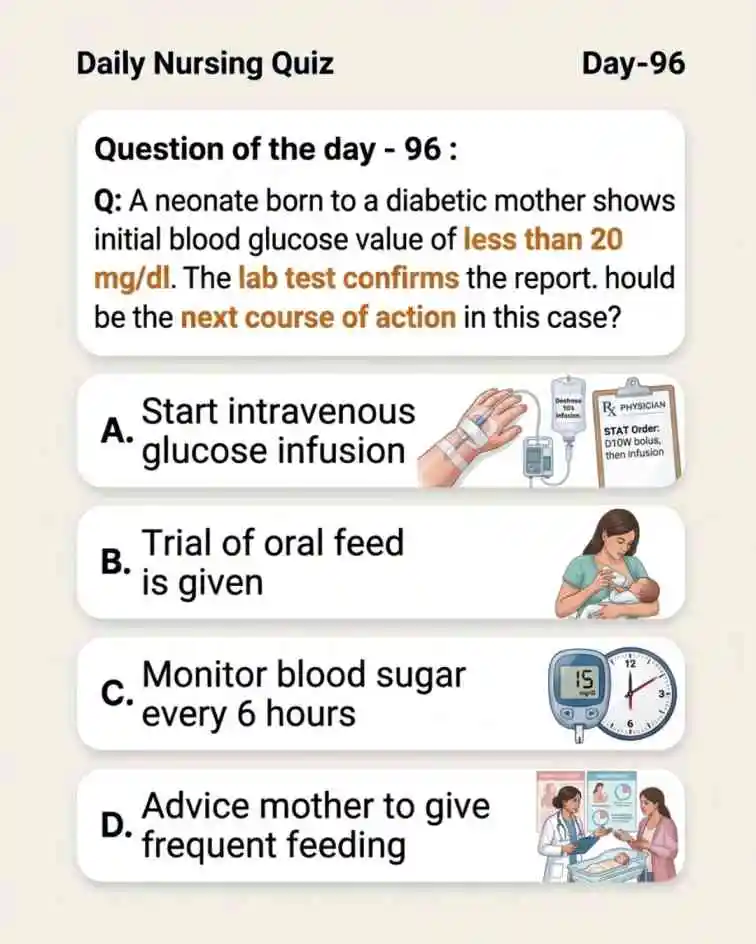
📝 Today’s Question:
Q: A neonate born to a diabetic mother shows initial blood glucose value of less than 20 mg/dl. The lab test confirms the report. What should be the next course of action in this case?
👆 Comment your answer and then tap an option to check your answer.
Don’t forget to Comment your answer below.
👶 Severe Neonatal Hypoglycemia
A confirmed blood glucose level of less than 20 mg/dL in a neonate is dangerously low and requires prompt treatment. In this situation, IV glucose is the appropriate immediate management.
🚨 Why Is This an Emergency?
Hypoglycemia means an abnormally low blood glucose level. Hypo- means low, while -glycemia refers to glucose in the blood.
Glucose is especially important for a newborn’s brain. The brain depends heavily on glucose for energy. A very low glucose level can therefore cause neurological problems if it is not corrected quickly.
👩🍼 Why Are Babies of Diabetic Mothers at Risk?
A baby born to a mother with diabetes may have been exposed to higher glucose levels before birth. In response, the baby’s pancreas may produce more insulin.
After birth, the glucose supply from the placenta suddenly stops, but the baby’s insulin level may remain high for some time. This can cause the baby’s blood glucose to fall.
💉 Why IV Glucose?
Intravenous (IV) means giving a medicine or fluid directly into a vein. “Intra” means within, and “venous” refers to a vein.
IV glucose provides glucose directly into the bloodstream. This makes it useful when the blood glucose is severely low and needs rapid correction.
The newborn should also have close glucose monitoring after treatment because the level may fall again, particularly when hyperinsulinism is involved.
❌ Why Not the Other Options?
Feeding can be useful for mild or moderate asymptomatic hypoglycemia when the newborn can safely feed. But a confirmed glucose level below 20 mg/dL is severe enough to require prompt glucose replacement rather than relying only on an oral feeding trial.
Monitoring is important, but simply waiting and checking every 6 hours does not correct severe hypoglycemia. Treatment must come first.
Frequent feeding can help prevent recurrent low glucose in at-risk newborns, but it is not adequate as the sole immediate treatment for such severe hypoglycemia.
🩺 What Should the Nurse Watch For?
Neonatal hypoglycemia may not always produce obvious symptoms. Watch carefully for:
- Jitteriness or tremors
- Poor feeding
- Lethargy
- Weak or abnormal cry
- Apnea
- Temperature instability
- Seizures
Jitteriness means small, rapid involuntary movements or trembling. Lethargy means unusual tiredness with reduced activity or responsiveness. Apnea means a temporary stop in breathing.
🔬 Why Can Low Glucose Affect the Brain?
The newborn brain has high energy needs. When glucose becomes severely low, the brain may not receive enough fuel to function normally. Prolonged or severe hypoglycemia can therefore lead to serious neurological injury.
A very low glucose value is not a “wait and watch” situation. Think rapid treatment + repeat glucose monitoring + observation for neurological symptoms.
🧠 Easy Memory Trick
When neonatal glucose is dangerously low, remember that the baby needs a rapid glucose source.
In a neonate of a diabetic mother, always think about hypoglycemia. If the confirmed glucose is extremely low, do not choose simple observation or feeding alone—think prompt IV glucose treatment and close monitoring.
Concept clarity • Easy recall • Nursing success
Don’t forget to comment the answer below.