
🩺 Nursing Question of the Day
Challenge yourself with one exam-style nursing question every day.
✅ Think carefully • ✅ Choose your answer • ✅ Then scroll down to check the explanation.
📝 Today’s Question:
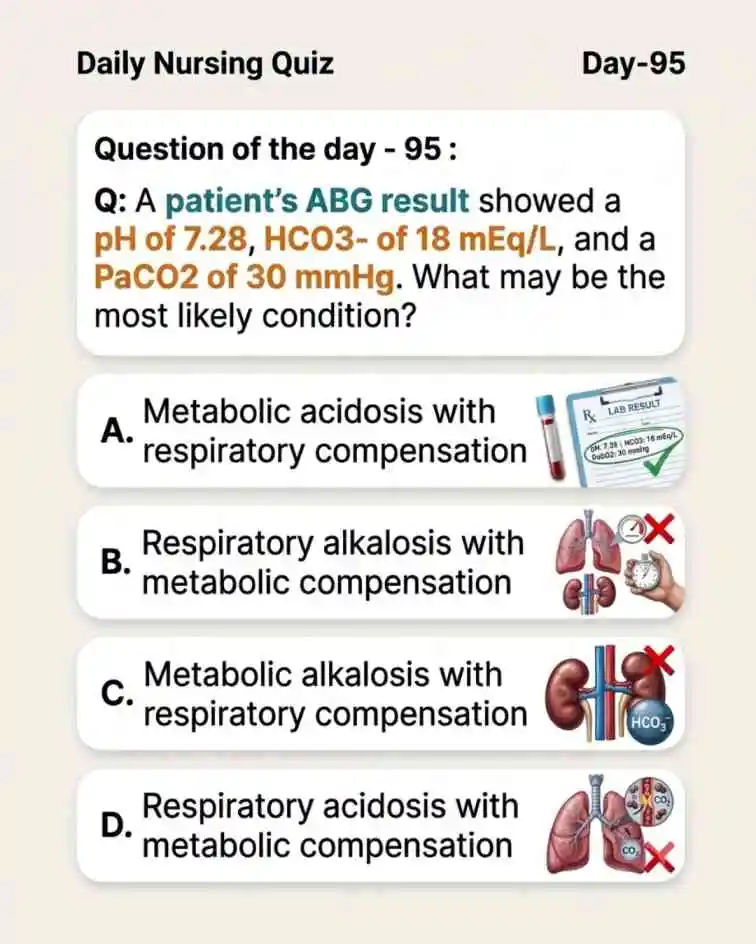
Q: A patient’s ABG result showed a pH of 7.28, HCO3- of 18 mEq/L, and a PaCO2 of 30 mmHg. What may be the most likely condition?
👆 Comment your answer and then tap an option to check your answer.
Don’t forget to Comment your answer below.
🩸 Reading ABG: Metabolic Acidosis
The pH is low, the bicarbonate is low, and the PaCO₂ is also low because the lungs are trying to remove more carbon dioxide to bring the pH back toward normal.
🔍 Start With the pH
The first step in reading an ABG is always to look at the pH.
Below 7.35 = Acidosis
Above 7.45 = Alkalosis
Here, the pH is 7.28, so the blood is acidic.
🧪 Now Look at HCO₃⁻
HCO₃⁻ means bicarbonate. It is an important base that helps control the acid–base balance of the blood.
Normal bicarbonate is approximately 22–26 mEq/L. Here it is only 18 mEq/L, so bicarbonate is decreased.
🌬️ What Is the PaCO₂ Telling Us?
PaCO₂ means the partial pressure of carbon dioxide in arterial blood. Carbon dioxide acts like an acid in the body.
Normal PaCO₂ is about 35–45 mmHg. The patient’s PaCO₂ is 30 mmHg, which is low.
Why is it low? Because the patient is likely breathing faster or deeper to remove extra CO₂. This is the body’s respiratory attempt to correct the metabolic problem.
🌬️ Low PaCO₂ = Respiratory compensation
📖 What Does “Compensation” Mean?
Compensation means the body tries to correct an acid–base disturbance using another system.
When bicarbonate falls and causes metabolic acidosis, the lungs respond quickly by increasing ventilation. This removes CO₂ and helps raise the pH toward normal.
So, the kidneys/metabolic process created the primary problem, while the lungs are trying to help correct it.
🧠 Understand the Medical Terms
Acidosis: A condition in which the blood becomes more acidic than normal. The word comes from acid + the medical suffix -osis, meaning a condition or process.
Metabolic: Related to the body’s chemical processes. Metabolism comes from the Greek metabolē, meaning change or transformation.
Respiratory: Related to breathing. It comes from Latin respirare, meaning to breathe again.
Compensation: The body’s attempt to reduce the effect of an abnormal acid–base change.
❌ Why the Other Options Are Wrong
Respiratory alkalosis would primarily have a high pH and low PaCO₂. Here, the pH is clearly acidic.
Metabolic alkalosis is associated with increased HCO₃⁻ and usually an increased pH. Here, HCO₃⁻ is low.
Respiratory acidosis occurs when CO₂ is retained, so PaCO₂ becomes high. Here, PaCO₂ is only 30 mmHg.
🩺 Common Causes of Metabolic Acidosis
- Diabetic ketoacidosis (DKA)
- Lactic acidosis from poor tissue perfusion
- Severe diarrhea causing bicarbonate loss
- Kidney failure with reduced acid excretion
- Certain toxic ingestions
A patient with significant metabolic acidosis may develop deep, rapid breathing. This is an important clinical clue because the body is trying to eliminate CO₂.
⚡ Quick ABG Method
Step 2: HCO₃⁻ ↓ → Metabolic cause
Step 3: PaCO₂ ↓ → Respiratory compensation
ROME — Respiratory Opposite, Metabolic Equal.
In metabolic acidosis, pH and HCO₃⁻ move in the same direction: both are low.
When you see low pH + low HCO₃⁻ + low PaCO₂, don’t automatically call it respiratory alkalosis. First identify the primary problem: low HCO₃⁻ is pointing to metabolic acidosis, while the low PaCO₂ represents the body’s respiratory response.
Concept clarity • Easy recall • Nursing success
Don’t forget to comment the answer below.