
🩺 Nursing Question of the Day
Challenge yourself with one exam-style nursing question every day.
✅ Think carefully • ✅ Choose your answer • ✅ Then scroll down to check the explanation.
📝 Today’s Question:
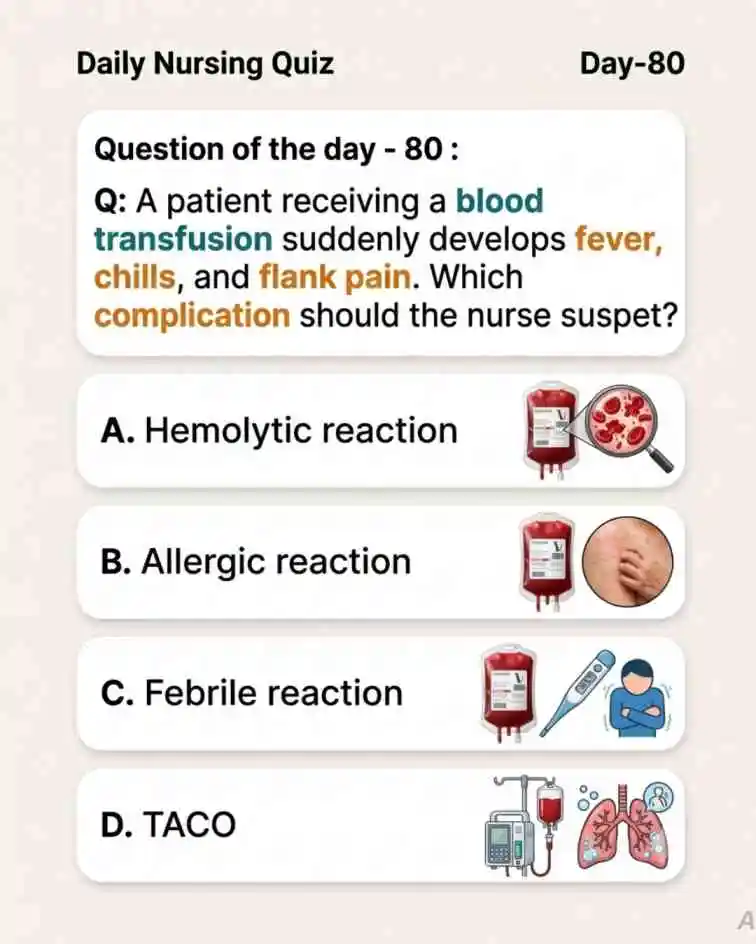
Q: A patient receiving a blood transfusion suddenly develops fever, chills, and flank pain. Which complication should the nurse suspect?
👆 Comment your answer and then tap an option to check your answer.
Don’t forget to Comment your answer below.
Acute Hemolytic Transfusion Reaction
🩸 Why is a Hemolytic Reaction the Correct Answer?
A hemolytic transfusion reaction occurs when the recipient’s immune system attacks and destroys transfused red blood cells. It most often results from an ABO-incompatible transfusion, such as giving the wrong blood type to a patient.
The reaction can begin very quickly, sometimes while the transfusion is still running. The patient’s immune antibodies attack the donor red blood cells, causing hemolysis, meaning destruction of red blood cells.
Important symptoms include fever, chills, flushing, anxiety, chest or back pain, flank pain, hypotension, nausea, and dark or reddish urine. Severe cases can progress to shock, acute kidney injury, and disseminated intravascular coagulation.
Flank pain is an especially important clue. Hemolysis releases hemoglobin into the circulation, and the kidneys attempt to remove it. This can contribute to kidney injury and pain in the flank region.
🔬 Understanding the Medical Terms
Hemolysis: Destruction or rupture of red blood cells, causing hemoglobin to be released into the blood. The word comes from Greek haima, meaning blood, and lysis, meaning loosening or breakdown.
Hemolytic: Something that causes or is related to hemolysis. So, a hemolytic reaction literally means a reaction involving red blood cell destruction.
Transfusion: The administration of blood or a blood component from one person to another through the bloodstream. The word comes from Latin transfundere, meaning to pour across or transfer.
Fever: An elevation of body temperature caused by a regulated change in the body’s temperature set point, commonly in response to infection, inflammation, or another immune stimulus.
Chills: A sensation of cold often accompanied by shivering. During a transfusion reaction, chills may occur as part of the body’s inflammatory response.
Flank: The area on the side of the body between the lower ribs and the hip. Pain in this area can be an important clue to renal or urinary problems and can occur during a severe hemolytic transfusion reaction.
⚠️ What Happens During an Acute Hemolytic Reaction?
The basic sequence is:
Because this reaction can become life-threatening, the transfusion should be treated as an emergency. The nurse should stop the transfusion immediately, maintain IV access with appropriate compatible fluid according to facility protocol, assess the patient, notify the appropriate healthcare team and blood bank, and follow the transfusion-reaction protocol.
❌ Why Are the Other Options Incorrect?
Sudden fever and chills with flank or back pain during transfusion strongly suggest acute hemolysis, especially from an ABO-incompatible blood product.
An allergic transfusion reaction usually produces itching, hives, flushing, or wheezing. Severe anaphylaxis may cause airway or circulatory compromise, but flank pain is not the characteristic clue.
A febrile nonhemolytic reaction can cause fever and chills, usually because of cytokines or antibodies reacting with donor leukocytes. However, the addition of sudden flank pain points more strongly toward acute hemolysis.
TACO means transfusion-associated circulatory overload. It occurs when the transfusion causes excessive intravascular volume and typically presents with dyspnea, pulmonary edema, hypertension, cough, and respiratory distress, rather than flank pain.
🧪 Important Term: TACO
TACO stands for Transfusion-Associated Circulatory Overload. Circulatory relates to the circulation of blood, while overload means that the vascular system has received more volume than the patient’s heart and circulation can handle.
Think of TACO as a fluid-volume problem, while an acute hemolytic reaction is primarily an immune destruction of red blood cells.
👩⚕️ Important Nursing Points
- Stop the transfusion immediately if an acute transfusion reaction is suspected.
- Keep the IV line open with an appropriate compatible solution according to institutional protocol.
- Assess vital signs and the patient’s overall condition.
- Notify the healthcare provider and blood bank promptly.
- Monitor urine output and observe for dark or reddish urine.
- Follow the facility’s transfusion-reaction protocol for blood-product and specimen handling.
“Fever + Chills + Flank Pain = Think Hemolysis.”
Flank/back pain during a transfusion is a major clue that red blood cells may be breaking down.
Fever and chills alone can occur with a febrile reaction, but when they are accompanied by flank or severe back pain, think of an acute hemolytic transfusion reaction.
Concept clarity • Easy recall • Nursing success
Don’t forget to comment the answer below.