
🩺 Nursing Question of the Day
Challenge yourself with one exam-style nursing question every day.
✅ Think carefully • ✅ Choose your answer • ✅ Then scroll down to check the explanation.
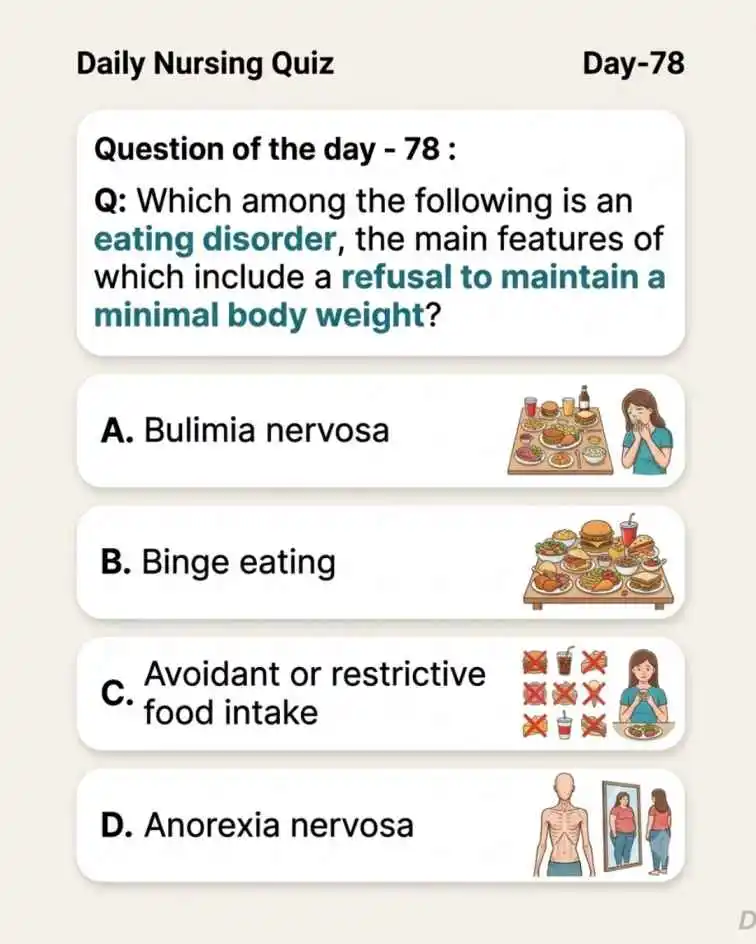
📝 Today’s Question:
Q: Which among the following is an eating disorder, the main features of which include a refusal to maintain a minimal body weight?
👆 Comment your answer and then tap an option to check your answer.
Don’t forget to Comment your answer below.
Anorexia Nervosa: Refusal to Maintain Body Weight
🍽️ First, What Is an Eating Disorder?
An eating disorder is a mental health condition involving persistent disturbances in eating behavior, food intake, or attitudes toward food, weight, and body shape.
The word anorexia comes from Greek roots: an- means “without” or “lack of,” and orexis means “appetite” or “desire for food.”
Nervosa comes from Latin nervosus, meaning “related to nerves.” In medical terminology, it is often used in disorders involving psychological or nervous-system factors.
So, anorexia nervosa does not simply mean “not feeling hungry.” It is a serious eating disorder in which restriction of food intake and disturbed attitudes toward weight and body shape are central features.
🧠 Why Is Low Body Weight Important?
A person with anorexia nervosa may severely restrict food intake because of an intense fear of gaining weight or becoming fat, even when the person is already significantly underweight.
The phrase “refusal to maintain a minimal body weight” is a classic exam clue for anorexia nervosa.
↓
Significantly low body weight
↓
Fear of gaining weight
↓
Disturbed body-image perception
↓
Anorexia nervosa
📚 Important Medical Terms — Where Do They Come From?
Anorexia nervosa
Anorexia comes from Greek an- (“without”) + orexis (“appetite/desire”). Nervosa comes from Latin and refers to a nervous or psychological origin. Together, the term describes the eating disorder rather than simple loss of appetite.
Bulimia
The word comes from Greek bous, meaning “ox,” and limos, meaning “hunger.” It gives the idea of an extremely intense hunger. In bulimia nervosa, recurrent binge-eating episodes are followed by inappropriate compensatory behaviors such as self-induced vomiting or misuse of laxatives.
Binge eating
Binge means doing something excessively or in an uncontrolled manner. A binge-eating episode involves eating an unusually large amount of food with a feeling of loss of control.
Avoidant
Avoidant comes from the word “avoid,” meaning to stay away from something. In avoidant/restrictive food intake disorder (ARFID), food intake may be restricted because of lack of interest in eating, sensory characteristics of food, or fear of aversive consequences such as choking or vomiting. It is not primarily driven by a desire to lose weight or a disturbed body image.
Body image
Body image means how a person perceives and feels about their own body, including its size and shape. In anorexia nervosa, this perception may be significantly distorted.
Compensatory behavior
Compensatory comes from Latin roots meaning “to make up for.” In eating disorders, it refers to behaviors intended to compensate for food intake, such as vomiting, fasting, or excessive exercise.
❌ Why Are the Other Options Incorrect?
❌ A. Bulimia nervosa
Bulimia nervosa is characterized by recurrent episodes of binge eating together with a sense of loss of control, followed by inappropriate compensatory behaviors. Body weight may be normal or above normal, so refusal to maintain a minimal body weight is not the defining clue.
❌ B. Binge eating
Binge eating involves recurrent episodes of eating a large amount of food with a feeling of loss of control. Unlike anorexia nervosa, it does not characteristically involve refusal to maintain a minimally healthy body weight.
❌ C. Avoidant or restrictive food intake disorder
ARFID involves significant restriction or avoidance of food, but the reason is different. It may involve sensory sensitivity, lack of interest in eating, or fear of consequences such as choking. It is not primarily caused by fear of weight gain or a distorted body image.
✅ D. Anorexia nervosa
This is the correct answer. The classic exam clue is refusal or inability to maintain an expected body weight together with restriction, fear of weight gain, and disturbed perception of body weight or shape.
🩺 Important Nursing Points
- Assess nutritional status, weight trends, vital signs, and hydration.
- Monitor for electrolyte abnormalities, especially in severely malnourished patients.
- Observe for complications such as bradycardia, hypotension, weakness, and cardiac rhythm abnormalities.
- Provide a supportive, nonjudgmental approach when discussing food and weight.
- Monitor carefully during nutritional rehabilitation because refeeding syndrome can occur in severely malnourished patients.
- Psychological and nutritional treatment usually require a multidisciplinary approach.
Anorexia nervosa is not simply a dieting habit or a lack of appetite. It is a serious psychiatric disorder that can produce severe nutritional, metabolic, cardiovascular, and other medical complications.
“AN = Away from Normal weight.”
If the question highlights very low body weight + restriction + fear of gaining weight, think Anorexia Nervosa.
The phrase “refusal to maintain a minimal body weight” is a classic clue for anorexia nervosa. Do not confuse it with bulimia, where recurrent binge eating and compensatory behaviors are the key features.
Concept clarity • Easy recall • Nursing success
Don’t forget to comment the answer below.