
🩺 Nursing Question of the Day
Challenge yourself with one exam-style nursing question every day.
✅ Think carefully • ✅ Choose your answer • ✅ Then scroll down to check the explanation.
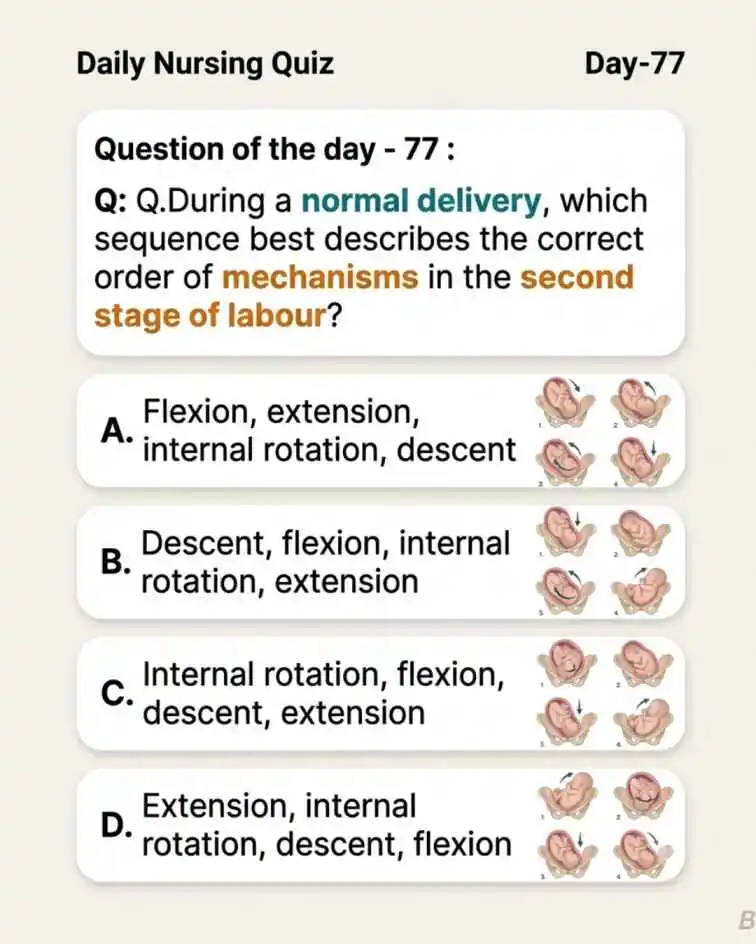
📝 Today’s Question:
Q: During a normal delivery, which sequence best describes the correct order of mechanisms in the second stage of labour?
👆 Comment your answer and then tap an option to check your answer.
Don’t forget to Comment your answer below.
Mechanisms of Normal Labour
👶 First, What Are the Mechanisms of Labour?
The mechanisms of labour are the positional and movement changes made mainly by the fetal head and body as the baby moves through the maternal pelvis during birth.
The word mechanism comes from the Greek word mēkhanē, meaning “machine” or “means of accomplishing something.” In labour, it describes the way the baby’s head and body adapt their position to pass through the birth canal.
For exam purposes, the classic sequence of the cardinal movements of the fetal head is:
↓
Flexion
↓
Internal Rotation
↓
Extension
↓
External Rotation (Restitution)
Therefore, among the given choices, Descent → Flexion → Internal Rotation → Extension is the correct sequence.
📚 Understanding Each Medical Term
Descent
Descent comes from Latin descendere, meaning “to come down.” In labour, descent means the fetal head moves downward through the maternal pelvis toward the vaginal outlet.
Flexion
Flexion comes from Latin flectere, meaning “to bend.” As the fetal head descends, the chin moves closer toward the chest. This allows a smaller diameter of the head to present through the pelvis.
Internal rotation
Internal means “inside,” while rotation means turning around an axis. During internal rotation, the fetal head turns so that its occiput moves toward the anterior part of the maternal pelvis, helping the head align with the pelvic outlet.
Extension
Extension comes from Latin extendere, meaning “to stretch out.” As the head reaches the pelvic outlet, it extends so that the occiput, face, and chin can pass over the perineum.
Occiput
The occiput is the back part of the fetal skull. In a normal vertex presentation, the occiput is an important landmark used to describe the position of the fetal head.
Vertex
Vertex comes from Latin meaning “top” or “highest point.” Vertex presentation means the top of the fetal head is the presenting part, which is the most common presentation in normal labour.
Perineum
The perineum is the area of tissue between the vaginal opening and the anus in a woman. During birth, it stretches as the baby’s head emerges.
🔍 Why Does This Sequence Occur?
1. Descent — The baby moves downward
The fetal head must move down through the mother’s pelvis. Descent is essential throughout labour and becomes especially obvious as the head approaches the pelvic outlet.
2. Flexion — The chin moves toward the chest
Flexion helps the baby present a smaller head diameter. This makes it easier for the head to negotiate the maternal pelvis.
3. Internal rotation — The head turns
The fetal head rotates to align with the mother’s pelvic dimensions. In a typical occiput-anterior birth, the occiput rotates toward the anterior pelvis.
4. Extension — The head is born
Once the head reaches the pelvic outlet, it extends. The head then emerges in a controlled sequence as it passes beneath the pubic arch and over the perineum.
Think of the baby trying to come through a narrow curved tunnel:
Come down → Tuck the chin → Turn → Lift the head out.
❌ Why Are the Other Options Incorrect?
❌ A. Flexion, extension, internal rotation, descent
This sequence is incorrect because descent is an essential movement that occurs as the head progresses through the pelvis, and extension occurs later when the head reaches the pelvic outlet. Extension should not come before internal rotation.
❌ C. Internal rotation, flexion, descent, extension
This is incorrect because the fetal head generally undergoes flexion as it descends before completing internal rotation. Internal rotation does not normally come first in this sequence.
❌ D. Extension, internal rotation, descent, flexion
This reverses several important movements. Extension is a later movement that occurs as the head passes through the pelvic outlet. It should not be placed at the beginning of the sequence.
🩺 Nursing Importance
- Understanding the mechanisms of labour helps the nurse recognize normal progress of the fetal head.
- Fetal head position and descent should be assessed during labour.
- Failure of descent or abnormal rotation may indicate a problem with labour progress.
- Continuous assessment of maternal and fetal condition remains important during the second stage.
- Encourage appropriate maternal positioning and pushing according to the clinical situation and local protocol.
For questions asking about the sequence of fetal head movements, remember the basic order:
Descent → Flexion → Internal Rotation → Extension → External Rotation.
In this question, the correct option is therefore B.
Concept clarity • Easy recall • Nursing success
Don’t forget to comment the answer below.