
🩺 Nursing Question of the Day
Challenge yourself with one exam-style nursing question every day.
✅ Think carefully • ✅ Choose your answer • ✅ Then scroll down to check the explanation.
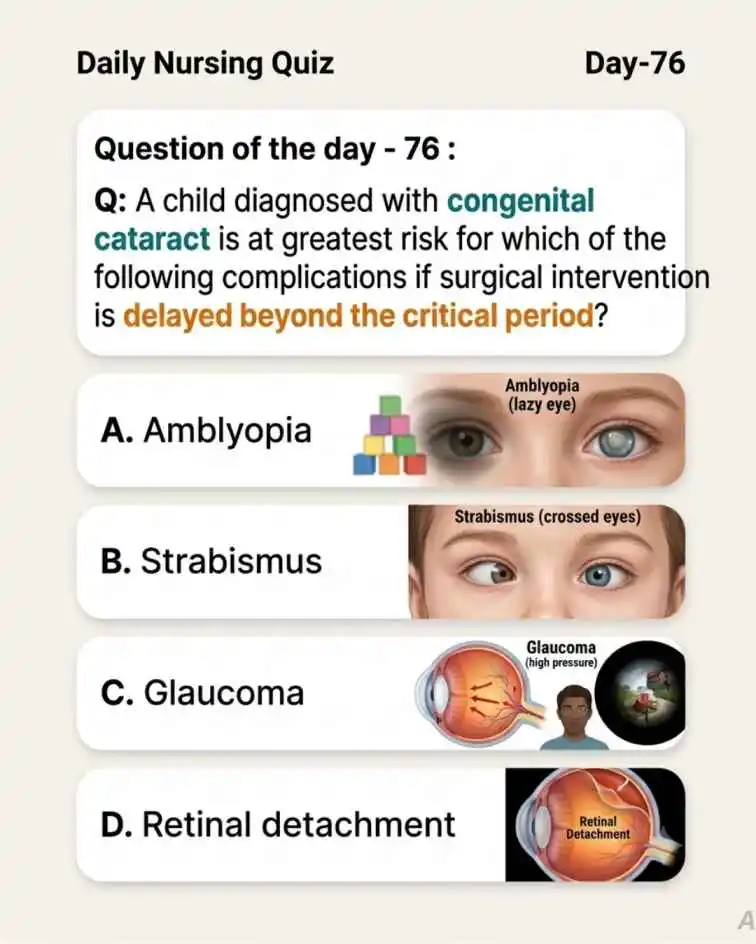
📝 Today’s Question:
Q: A child diagnosed with congenital cataract is at greatest risk for which of the following complications if surgical intervention is delayed beyond the critical period?
👆 Comment your answer and then tap an option to check your answer.
Don’t forget to Comment your answer below.
Congenital Cataract and Amblyopia
👁️ First, What Is a Cataract?
A cataract means clouding of the normally clear lens of the eye. The lens normally allows light to pass through and helps focus the image onto the retina.
The word cataract comes from the Greek word kataraktēs, meaning “waterfall.” Ancient physicians thought that the cloudy appearance in the eye looked like water flowing down over something.
Congenital means something that is present at birth. The word comes from Latin roots meaning “born together.” Therefore, a congenital cataract is a cataract that is present at birth or develops very early in life.
🧠 Why Is Early Treatment So Important?
Children’s visual systems are still developing after birth. The eyes send visual information to the brain, and the brain must learn how to interpret that information properly.
If a cataract blocks light from reaching the retina, the affected eye may send a poor-quality image to the brain. If this continues during the important period of visual development, the brain may begin to ignore the signals from that eye.
This can result in amblyopia, commonly called “lazy eye.”
↓
Blurred/blocked visual image
↓
Poor visual stimulation of the brain
↓
Abnormal visual development
↓
Amblyopia
📚 Important Medical Terms
Amblyopia
The word comes from Greek: amblys means “blunt” or “dull,” and ops means “eye.” Amblyopia is reduced vision caused by abnormal visual development during childhood, rather than simply because the eye itself is structurally damaged.
Critical period
This refers to an important window in early childhood when the visual system is especially sensitive to visual input. If clear images are not reaching the brain during this period, normal visual development can be permanently affected.
Visual development
Visual comes from Latin visus, meaning “sight.” Visual development is the process through which the eyes and brain develop the ability to see and interpret images normally.
Lens
The lens is the transparent structure behind the iris that helps focus incoming light onto the retina. The word lens comes from Latin and refers to a lentil because of its similar shape.
Retina
Retina comes from Latin rete, meaning “net.” The retina is the light-sensitive layer at the back of the eye. It contains specialized cells that convert light into nerve signals sent toward the brain.
Strabismus
From Greek strabismos, meaning “squinting.” Strabismus occurs when the eyes are not properly aligned and may point in different directions.
Glaucoma
The term comes from Greek glaukos, referring to a blue-green or grayish color. Glaucoma describes a group of disorders involving damage to the optic nerve, often associated with abnormal intraocular pressure.
❌ Why Are the Other Options Less Appropriate?
❌ B. Strabismus
Strabismus can occur in children with poor vision and may be associated with congenital cataract, but it is not the main complication the question is targeting when surgery is delayed during the critical period. The major concern is failure of normal visual development, resulting in amblyopia.
❌ C. Glaucoma
Glaucoma can occur in some children with congenital cataracts or after certain cataract surgeries, but delayed removal of a visually significant congenital cataract primarily raises concern for amblyopia.
❌ D. Retinal detachment
Retinal detachment means that the retina separates from its normal position. It is a serious eye condition, but it is not the characteristic complication expected from delayed treatment of a congenital cataract during the critical period of visual development.
👶 Why Does the Brain Matter So Much?
This is an important point in pediatric eye questions.
The problem is not simply that the cloudy lens prevents the child from seeing clearly. The developing brain also needs good-quality visual information to establish normal visual pathways.
If one eye is deprived of clear vision for too long, the brain may favor the other eye and suppress information coming from the affected eye. Even after the cataract is removed, vision may remain reduced if amblyopia has already become established.
“Cloudy lens in a developing child → Brain doesn’t learn to see → Amblyopia.”
Think of the developing brain like a student learning to read. If one eye keeps sending a blurred picture during the learning period, the brain may never learn to use that eye normally.
🩺 Nursing Points
- Congenital cataracts require timely ophthalmologic assessment.
- Do not delay referral when a significant cataract interferes with the visual axis.
- Observe for abnormal eye alignment or poor visual behavior.
- After treatment, children may require visual rehabilitation and prescribed glasses or contact lenses.
- Follow prescribed amblyopia treatment, which may include patching of the better-seeing eye in selected cases.
- Teach parents that early treatment is important because visual development occurs during childhood.
Whenever you see child + congenital cataract + delayed surgery + critical period, immediately think amblyopia. The key issue is not simply the cataract itself—it is the failure of normal visual development in the brain.
Concept clarity • Easy recall • Nursing success
Don’t forget to comment the answer below.