
🩺 Nursing Question of the Day
Challenge yourself with one exam-style nursing question every day.
✅ Think carefully • ✅ Choose your answer • ✅ Then scroll down to check the explanation.
📝 Today’s Question:
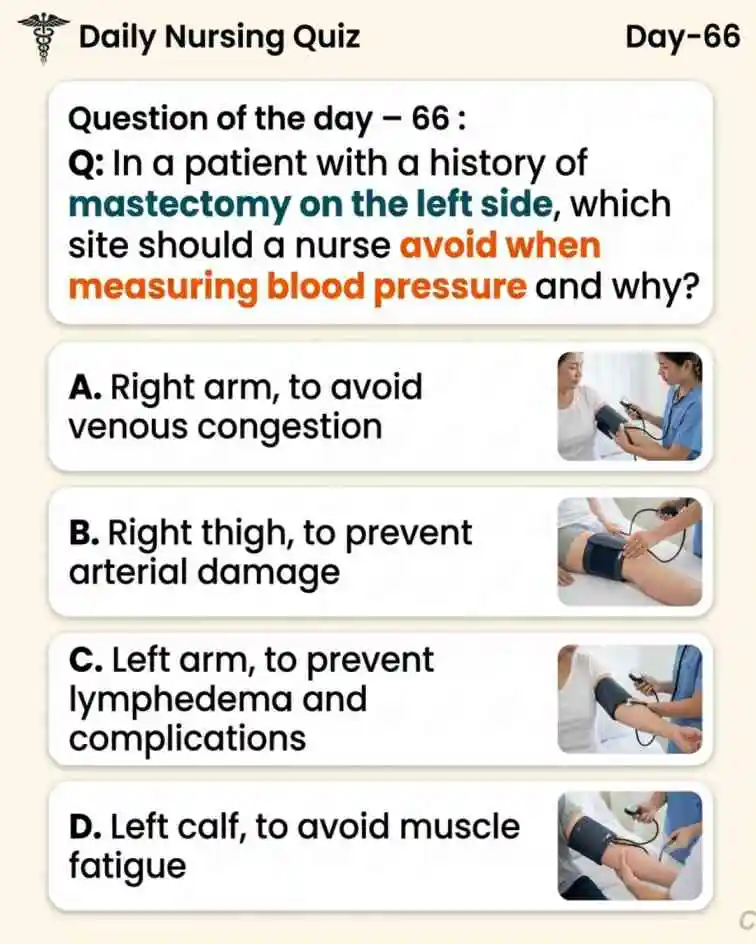
Q: In a patient with a history of mastectomy on the left side, which site should a nurse avoid when measuring blood pressure and why?
👆 Comment your answer and the tap an option to check your answer.
Don’t forget to Comment your answer below.
🩺 Blood Pressure Measurement After Mastectomy
In a patient with a history of mastectomy on the left side, which site should a nurse avoid when measuring blood pressure and why?
A. Right arm, to avoid venous congestion
B. Right thigh, to prevent arterial damage
C. Left arm, to prevent lymphedema and complications
D. Left calf, to avoid muscle fatigue
🔍 Why is C correct?
After a mastectomy, especially when axillary lymph nodes have been removed or treated, lymphatic drainage from the affected arm may be reduced. This can increase the risk of lymphedema, which is swelling caused by accumulation of lymph fluid in the tissues.
A blood pressure cuff repeatedly inflates and applies pressure around the upper arm. In an arm with impaired lymphatic drainage, unnecessary compression may contribute to swelling or other complications. Therefore, the left arm should generally be avoided when an alternative site is available, and the unaffected arm is preferred.
Mastectomy + affected lymph drainage → increased lymphedema risk → avoid unnecessary pressure on that arm.
🧠 What is lymphedema?
Lymphedema is swelling that occurs when lymph fluid cannot drain normally. After breast surgery, disruption or removal of lymphatic vessels or lymph nodes can interfere with drainage from the arm.
The swelling may involve the hand, forearm, or upper arm. The nurse should also observe for changes such as tightness, heaviness, or increasing swelling of the affected limb.
🩺 Nursing precautions for the affected arm
- Avoid blood pressure measurements on the affected arm when an appropriate alternative is available.
- Avoid unnecessary venipuncture or injections in the affected arm according to the patient’s care plan and facility guidance.
- Avoid tight clothing, jewelry, or anything that unnecessarily constricts the arm.
- Observe the arm for swelling, redness, skin changes, or discomfort.
- Teach the patient to protect the skin from cuts, burns, and infection.
Important: Current clinical guidance is more nuanced than simply saying that a blood pressure cuff can never be used on an arm after breast surgery. The risk depends on factors such as lymph-node surgery, radiation, existing lymphedema, and the patient’s individual situation. For an exam question like this, however, the expected nursing answer is to use the unaffected arm when possible.
❌ Understanding the other options
The right arm is the unaffected side in this question and is generally the preferred arm for blood pressure measurement when the left arm is affected by breast surgery.
There is no general reason to avoid the right thigh simply because the patient had a left-sided mastectomy. A thigh measurement may be used when an arm cannot be used, but it is not the routine first choice in this situation.
This is the expected answer. The left side has undergone mastectomy, and lymphatic drainage may be impaired, particularly if axillary nodes were involved. Avoiding unnecessary compression helps reduce potential complications.
A left mastectomy does not create a reason to avoid blood pressure measurement at the left calf because of muscle fatigue. The concern in this question is the affected upper limb and lymphatic drainage.
📌 Quick Clinical Example
Imagine a patient had a left mastectomy with axillary lymph-node removal. The nurse needs to check the patient’s blood pressure.
Left arm affected → lymphatic drainage may be impaired
↓
Avoid unnecessary compression
↓
Use the right arm when appropriate
“Mastectomy side = Protect the lymph side.”
If the left side is affected, remember to avoid unnecessary BP-cuff pressure on the left arm when an alternative is available.
When you see mastectomy + blood pressure in a nursing question, think about lymphatic drainage and lymphedema. The unaffected arm is usually selected when possible.
Concept clarity • Easy recall • Nursing success
Don’t forget to comment the answer below.