
🩺 Nursing Question of the Day
Challenge yourself with one exam-style nursing question every day.
✅ Think carefully • ✅ Choose your answer • ✅ Then scroll down to check the explanation.
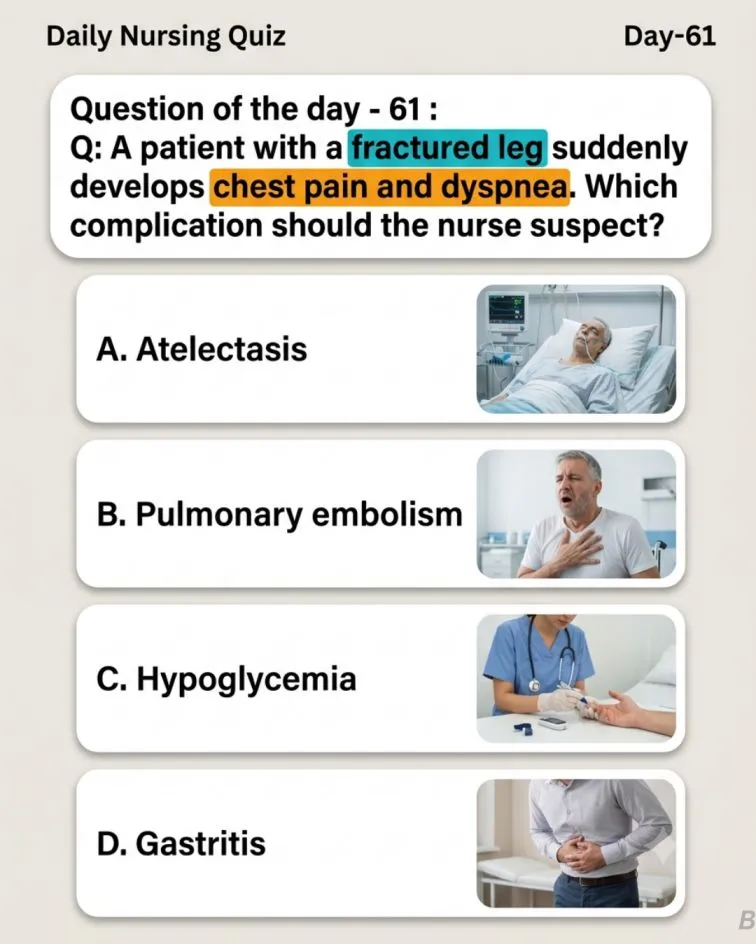
📝 Today’s Question:
A patient with a fractured leg suddenly develops chest pain and dyspnea. Which complication should the nurse suspect?
👆 Comment your answer and the tap an option to check your answer.
Don’t forget to Comment your answer below.
🫁 Pulmonary Embolism After a Leg Fracture
A patient with a fractured leg suddenly develops chest pain and dyspnea. Which complication should the nurse suspect?
A. Atelectasis
B. Pulmonary embolism
C. Hypoglycemia
D. Gastritis
🫁 What is a pulmonary embolism?
A pulmonary embolism (PE) occurs when a blood clot or other material travels through the bloodstream and becomes lodged in a pulmonary artery or one of its branches.
In a patient with a fractured leg, the major concern is formation of a deep-vein thrombosis (DVT) in the leg. Part of the clot can break away, travel through the venous circulation, and reach the lungs.
Leg fracture / immobility → venous stasis → DVT formation → part of clot breaks away → travels through venous circulation → reaches pulmonary circulation → pulmonary artery obstruction → sudden chest pain + dyspnea
⚠️ Why does a fractured leg increase the risk?
A fracture can lead to several factors that promote venous thrombosis. The patient may be immobile, which reduces the normal pumping action of the calf muscles that helps return venous blood to the heart.
Trauma can also cause vascular injury, while the body’s response to injury can increase coagulation activity. These factors contribute to the risk of venous thromboembolism.
Therefore, sudden respiratory symptoms in a patient with a leg fracture should raise concern for a potentially serious pulmonary embolism.
🚨 Important Signs of Pulmonary Embolism
| Possible finding | Why it occurs |
|---|---|
| Sudden dyspnea | Pulmonary blood flow is obstructed. |
| Sudden chest pain | May result from pulmonary vascular obstruction and pleural irritation. |
| Tachycardia | The body attempts to compensate for impaired oxygenation/circulation. |
| Tachypnea | Compensatory increase in respiratory rate. |
| Hypoxemia | Blood flow through affected pulmonary vessels is reduced. |
Severe PE can cause hypotension, syncope, severe hypoxemia, right-heart strain, obstructive shock, and cardiac arrest.
🩺 What should the nurse do?
Sudden chest pain and dyspnea in a high-risk patient is an urgent clinical finding. The nurse should immediately assess the patient’s airway, breathing, circulation, oxygen saturation, vital signs, and level of consciousness and activate the appropriate emergency/rapid-response process according to facility policy.
Oxygen may be administered as indicated, and the healthcare team should be notified promptly. Diagnostic testing and treatment are then performed as clinically indicated.
Do not dismiss sudden dyspnea and chest pain as a normal consequence of a leg fracture. In an immobilized or injured patient, think about venous thromboembolism.
❌ Why are the other options wrong?
Atelectasis is partial or complete collapse of alveoli, often associated with shallow breathing, postoperative states, or prolonged immobility. It can cause respiratory symptoms, but the sudden chest pain and dyspnea in a patient with a fractured leg strongly suggests pulmonary embolism in this question.
Correct. A leg fracture and reduced mobility increase the risk of venous thrombosis. A thrombus can travel to the lungs and suddenly obstruct pulmonary circulation, producing acute dyspnea and chest pain.
Hypoglycemia commonly produces findings such as sweating, tremors, hunger, palpitations, confusion, and altered consciousness. It does not explain the classic sudden chest pain and dyspnea in this clinical context.
Gastritis causes symptoms such as epigastric discomfort, nausea, and indigestion. It does not typically cause sudden severe dyspnea associated with a leg fracture.
📚 DVT vs Pulmonary Embolism
| Feature | DVT | Pulmonary Embolism |
|---|---|---|
| Location | Deep veins, usually leg | Pulmonary circulation |
| Common findings | Leg swelling, pain, warmth | Sudden dyspnea, chest pain, tachycardia |
| Relationship | May be the source of the clot | Can occur when a venous clot embolizes to the lungs |
“Leg clot → Lung clot → Breath suddenly stops.”
Leg fracture/immobility → DVT → embolus → pulmonary artery obstruction → sudden dyspnea ± chest pain.
When you see immobility or leg fracture + sudden dyspnea + chest pain, immediately think pulmonary embolism.
Classic clue: sudden respiratory symptoms in a patient at risk for DVT.
Concept clarity • Easy recall • Nursing success
Don’t forget to comment the answer below.