
🩺 Nursing Question of the Day
Challenge yourself with one exam-style nursing question every day.
✅ Think carefully • ✅ Choose your answer • ✅ Then scroll down to check the explanation.
📝 Today’s Question:
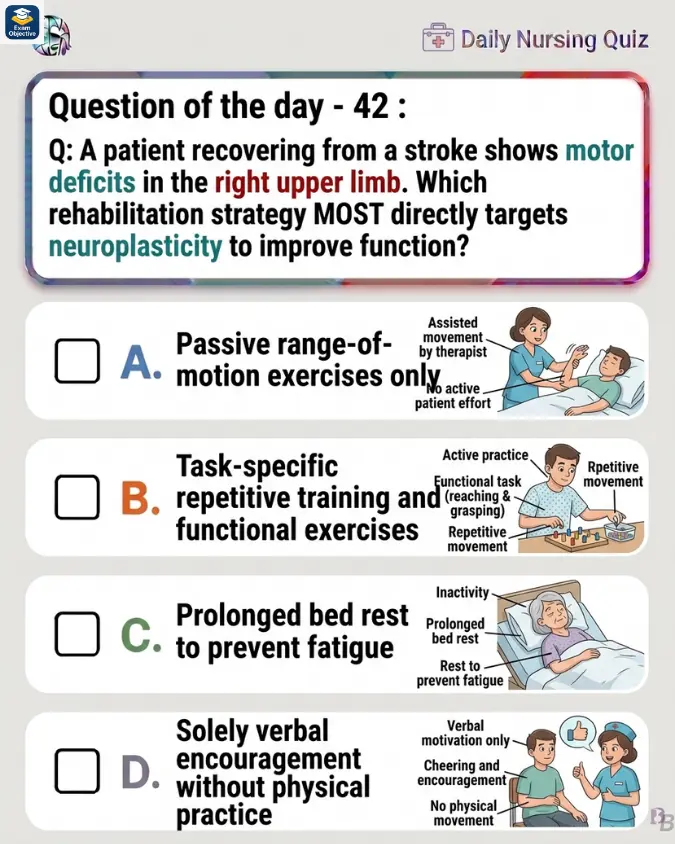
A patient recovering from a stroke shows motor deficits in the right upper limb. Which rehabilitation strategy MOST directly targets neuroplasticity to improve function?
👆 Comment your answer and the tap an option to check your answer.
Don’t forget to Comment your answer below.
🧠 Stroke Rehabilitation — Neuroplasticity
B. Task-specific repetitive training and functional exercises
C. Prolonged bed rest to prevent fatigue
D. Solely verbal encouragement without physical practice
✅ Answer: (B) Task-specific repetitive training and functional exercises
📖 Why is This the Correct Answer?
Neuroplasticity is the brain’s ability to reorganize and form new neural connections in response to learning, experience, and practice. After a stroke damages areas responsible for movement, rehabilitation aims to help the brain develop or strengthen alternative pathways that support functional movement.
The strategy that most directly promotes this process is repetitive, task-specific functional training. The patient repeatedly practices meaningful movements that are related to daily activities, such as reaching, grasping, lifting, dressing, or using the affected arm.
The key principle is “use it and improve it.” Repeatedly using the affected limb during meaningful activities provides the brain with repeated sensory and motor input, encouraging functional recovery.
🔬 How Does Neuroplasticity Help?
Following a stroke, some neural pathways may be damaged. With appropriate rehabilitation, the nervous system can adapt by strengthening remaining pathways and developing new patterns of neural activity.
For example, if the patient repeatedly practices reaching for and picking up an object with the affected right hand, the repeated practice provides consistent motor and sensory stimulation. Over time, this can help improve coordination and functional ability.
Neuroplasticity-based rehabilitation emphasizes repeated practice of meaningful tasks rather than simply moving the limb without a functional goal.
❌ Why Are the Other Options Wrong?
A. Passive range-of-motion exercises only ❌
Passive ROM can help maintain joint mobility, prevent contractures, and reduce stiffness, but it does not provide the same active, task-specific practice needed to directly promote functional motor learning.
B. Task-specific repetitive training and functional exercises ✅
This directly promotes active practice, repetition, motor learning, and functional use of the affected limb, making it the best answer for targeting neuroplasticity.
C. Prolonged bed rest to prevent fatigue ❌
Prolonged inactivity reduces opportunities for movement and functional practice. It can contribute to deconditioning and complications of immobility rather than promoting neuroplasticity.
D. Solely verbal encouragement without physical practice ❌
Emotional support and encouragement are important, but verbal encouragement alone does not provide the repetitive motor practice required for neuroplastic changes.
📊 Quick Comparison
| Strategy | Effect on Neuroplasticity |
|---|---|
| Task-specific repetition | ⭐ Strongest direct approach |
| Passive ROM | Maintains mobility |
| Bed rest | Limits practice |
| Verbal encouragement | Provides motivation |
“NEUROPLASTICITY LOVES REPETITION.”
Repeatedly practice the actual task you want the patient to regain → better opportunity for functional neural adaptation.
📌 Exam Tip: When an exam question asks which rehabilitation method best promotes neuroplasticity after stroke, look for active, repetitive, task-specific, goal-directed practice. Passive movement may maintain range of motion, but task-specific repetition is more directly aimed at functional recovery.
Concept clarity • Easy recall • Nursing success
Don’t forget to comment the answer below.