
🩺 Nursing Question of the Day
Challenge yourself with one exam-style nursing question every day.
✅ Think carefully • ✅ Choose your answer • ✅ Then scroll down to check the explanation.
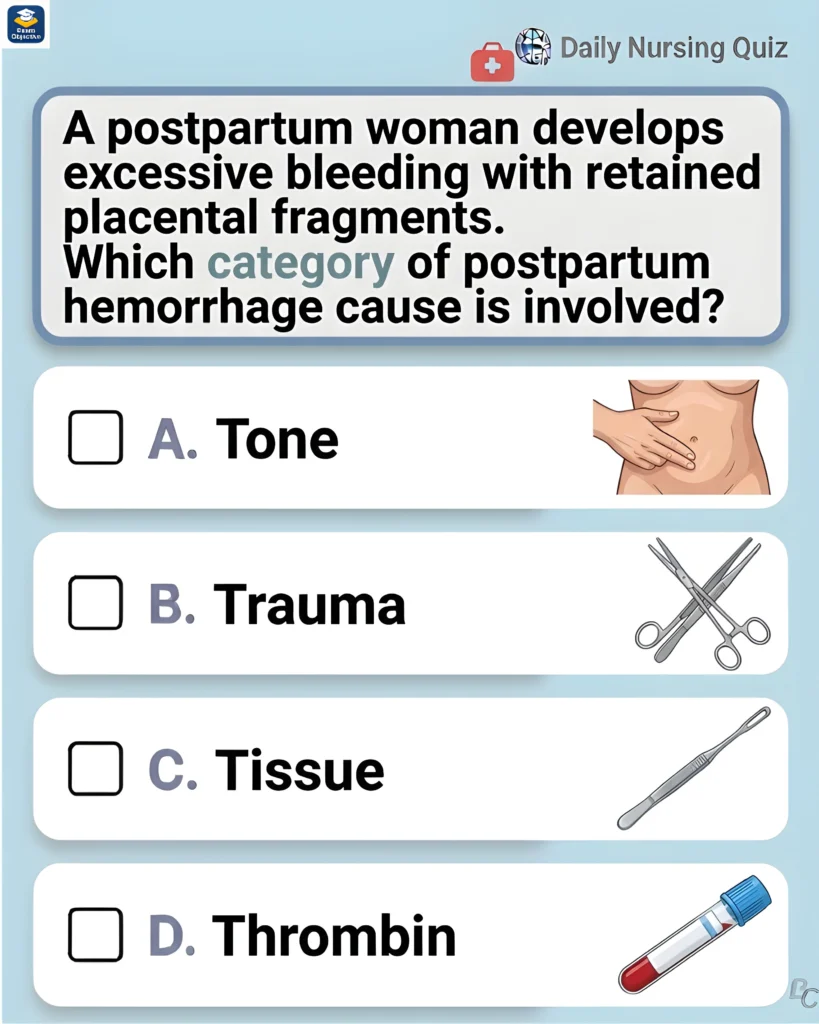
📝 Today’s Question:
A patient with pernicious anemia has impaired absorption of vitamin B12. Which substance is deficient?
👆 Comment your answer and the tap an option to check your answer.
Don’t forget to Comment your answer below.
🩸 Postpartum Hemorrhage — The 4 Ts
B. Trauma
C. Tissue
D. Thrombin
✅ Answer: (C) Tissue
📖 Why is the Answer Tissue?
The major causes of postpartum hemorrhage are commonly remembered using the 4 Ts:
Tissue refers to retained placental tissue or retained products of conception remaining inside the uterus after delivery.
Retained placental fragments can interfere with effective uterine contraction and prevent the placental site from achieving adequate hemostasis, resulting in postpartum bleeding.
⬇️
Placental fragments retained
⬇️
🩸 Placental site fails to achieve adequate hemostasis
⬇️
⚠️ Postpartum hemorrhage
🧠 The 4 Ts of Postpartum Hemorrhage
| Category | Typical Cause |
|---|---|
| Tone | Uterine atony |
| Trauma | Laceration, hematoma, uterine rupture |
| Tissue | Retained placenta/fragments |
| Thrombin | Coagulopathy |
❌ Why Are the Other Options Wrong?
A. Tone
❌ Refers primarily to uterine atony, in which the uterus fails to contract effectively after delivery.
B. Trauma
❌ Refers to genital tract injury such as cervical or vaginal lacerations, hematomas, or uterine rupture.
C. Tissue
✅ Correct. Retained placental fragments are classified under Tissue in the 4 Ts of postpartum hemorrhage.
D. Thrombin
❌ Refers to coagulation disorders that impair normal clot formation and promote bleeding.
4 Ts = Tone • Trauma • Tissue • Thrombin
🌸 Retained placenta = Tissue
💪 Uterine atony = Tone
✂️ Laceration = Trauma
🩸 Coagulopathy = Thrombin
📌 Exam Tip: Whenever a postpartum hemorrhage question mentions retained placenta, retained placental fragments, or retained products, think Tissue.
Concept clarity • Easy recall • Nursing success
Don’t forget to comment the answer below.
C
That is correct. thanks for your answer.