
🩺 Nursing Question of the Day
Challenge yourself with one exam-style nursing question every day.
✅ Think carefully • ✅ Choose your answer • ✅ Then scroll down to check the explanation.
📝 Today’s Question:
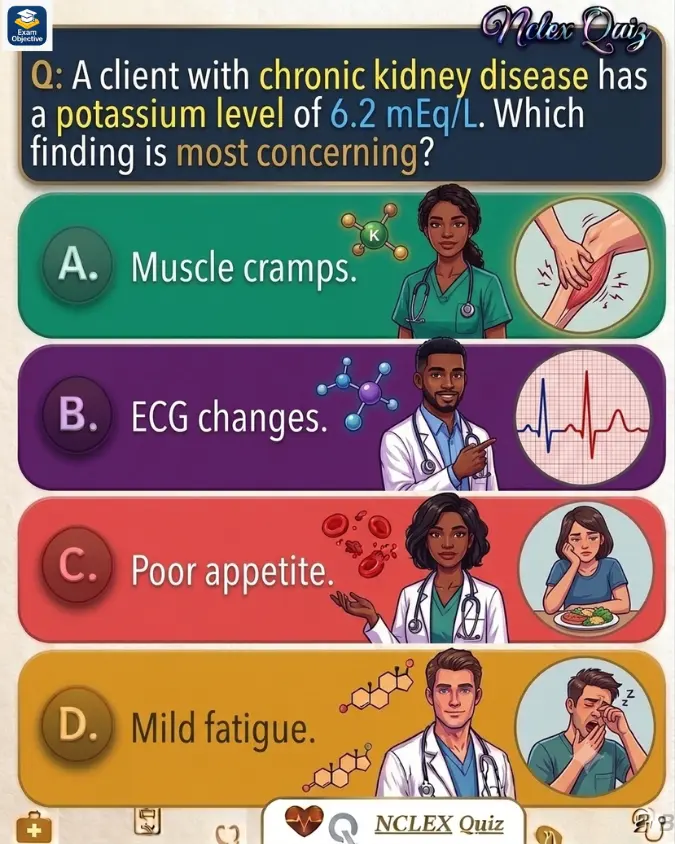
A client with chronic kidney disease has a potassium level of 6.2 mEq/L. Which finding is most concerning?
👆 Comment your answer and the tap an option to check your answer.
Don’t forget to Comment your answer below.
🩺 Hyperkalemia in Chronic Kidney Disease
B. ECG changes
C. Poor appetite
D. Mild fatigue
✅ Answer: (B) ECG changes
📖 Why is This an Emergency?
A potassium level of 6.2 mEq/L represents significant hyperkalemia. In chronic kidney disease, impaired renal potassium excretion can allow potassium to accumulate in the bloodstream.
The most dangerous complication of severe hyperkalemia is cardiac dysrhythmia. Therefore, ECG changes require immediate attention.
⬇️
Reduced potassium excretion
⬇️
📈 Serum K⁺ ↑
⬇️
❤️ Cardiac conduction abnormalities
⬇️
⚠️ Life-threatening dysrhythmias
❤️ Why is Option B Correct?
Potassium plays a major role in the electrical activity of cardiac muscle. Significant hyperkalemia can alter cardiac conduction and produce characteristic ECG abnormalities.
Possible findings include:
- 📈 Tall, peaked T waves
- ⚠️ Prolonged PR interval
- ⬇️ Widened QRS complex
- ❤️ Bradyarrhythmias
- 🚨 Severe cases may progress to ventricular arrhythmias or cardiac arrest
👉 Therefore, ECG changes are the most concerning finding because they indicate that hyperkalemia is already affecting cardiac electrical activity.
❌ Why Are the Other Options Less Concerning?
A. Muscle cramps
❌ Muscle symptoms can occur with electrolyte abnormalities, but they are less immediately life-threatening than evidence of cardiac conduction disturbance.
B. ECG changes
✅ Correct. ECG abnormalities in significant hyperkalemia indicate cardiac involvement and an increased risk of life-threatening dysrhythmias.
C. Poor appetite
❌ Poor appetite is nonspecific and does not indicate an immediate cardiac complication.
D. Mild fatigue
❌ Fatigue is nonspecific and is not as urgent as ECG evidence of hyperkalemia-related cardiac effects.
📝 Quick Recall
| Finding | Priority |
|---|---|
| Muscle cramps | Concerning, but less urgent |
| ECG changes | 🚨 Immediate concern |
| Poor appetite | Nonspecific |
| Mild fatigue | Nonspecific |
Hyperkalemia → Heart first! ❤️
When potassium is significantly elevated, always think about ECG changes and dysrhythmias.
📌 Exam Tip: In a patient with hyperkalemia, cardiac manifestations are the highest priority. An abnormal ECG can precede severe dysrhythmias and requires immediate evaluation and treatment.
Concept clarity • Easy recall • Nursing success
Don’t forget to comment the answer below.