
🩺 Nursing Question of the Day
Challenge yourself with one exam-style nursing question every day.
✅ Think carefully • ✅ Choose your answer • ✅ Then scroll down to check the explanation.
📝 Today’s Question:
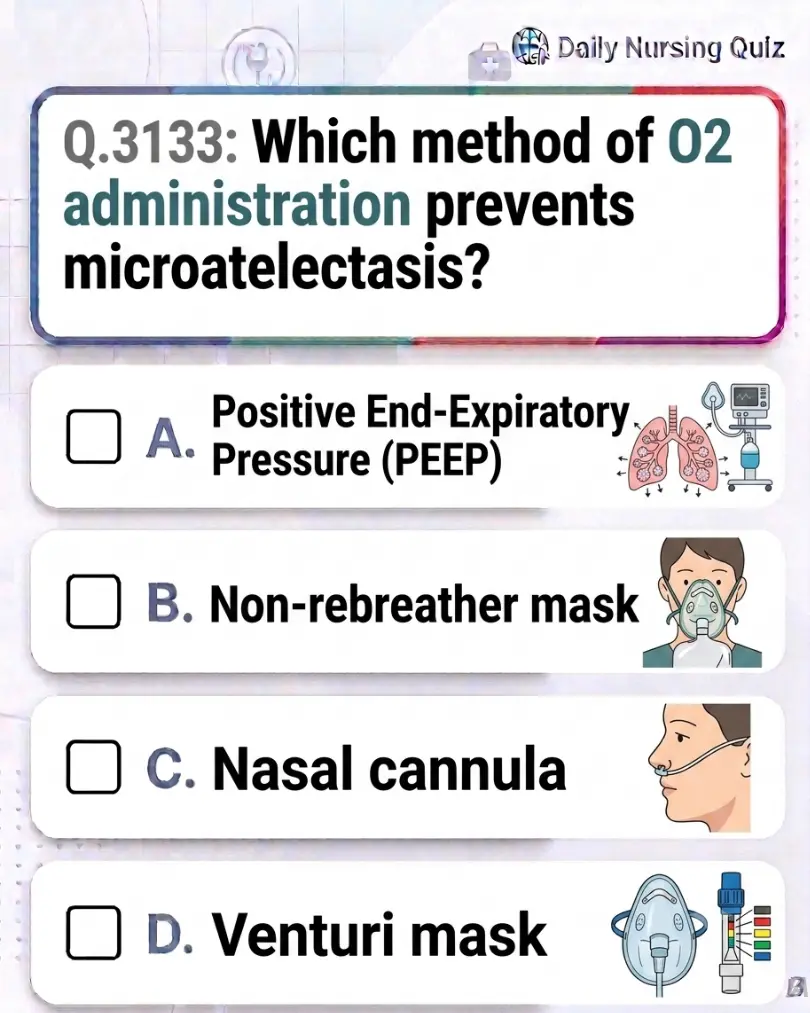
Which of the following methods of O2 administration prevents microatelectasis?
👆 Comment your answer and the tap an option to check your answer.
Don’t forget to Comment your answer below.
🫁 PEEP & Prevention of Microatelectasis
B. Non-rebreather mask
C. Nasal cannula
D. Venturi mask
✅ Answer: (A) Positive end-expiratory pressure (PEEP)
📖 What is Microatelectasis?
Micro = Very small
Atelectasis = Collapse of alveoli
👉 Microatelectasis refers to the collapse or closure of small groups of alveoli, reducing the available surface area for gas exchange.
It can occur when alveoli are not adequately maintained open, particularly during expiration.
🫁 Why is Option A Correct?
Positive end-expiratory pressure (PEEP) maintains positive pressure in the airways at the end of expiration.
This helps prevent small alveoli from collapsing and keeps them recruited for gas exchange.
⬇️
Positive pressure maintained at end-expiration
⬇️
Alveoli remain open
⬇️
🫁 Prevents/reduces microatelectasis
⬇️
📈 Improves oxygenation
👉 Therefore, PEEP is the best answer.
📖 How Does PEEP Work?
During normal expiration, airway pressure falls and some small alveoli may tend to close. PEEP provides a level of pressure that remains in the airways at the end of expiration.
This increases functional residual capacity (FRC), helps recruit previously collapsed alveoli, and improves ventilation-perfusion matching.
PEEP = “Keeps alveoli open at the end of expiration.”
❌ Why Are the Other Options Wrong?
A. Positive End-Expiratory Pressure
✅ Correct. PEEP maintains airway pressure during expiration and helps prevent alveolar collapse.
B. Non-rebreather Mask
❌ Provides a high concentration of supplemental oxygen but does not provide the sustained positive end-expiratory pressure needed to prevent alveolar collapse.
C. Nasal Cannula
❌ Provides low-flow supplemental oxygen. It does not reliably maintain positive pressure in the alveoli.
D. Venturi Mask
❌ Delivers a controlled and predictable oxygen concentration, but it does not provide therapeutic PEEP.
📝 Quick Comparison
| Method | Main Purpose |
|---|---|
| PEEP | Keeps alveoli open; reduces alveolar collapse |
| Non-rebreather mask | Delivers high-concentration oxygen |
| Nasal cannula | Low-flow oxygen delivery |
| Venturi mask | Precise FiO₂ delivery |
PEEP = Positive pressure that Prevents alveolar collapse.
🫁 “PEEP keeps the alveoli open.”
📌 Exam Tip: When a question asks which intervention prevents microatelectasis or alveolar collapse, think PEEP. It maintains positive pressure at the end of expiration and helps keep alveoli recruited.
Concept clarity • Easy recall • Nursing success
Don’t forget to comment the answer below.