
🩺 Nursing Question of the Day
Challenge yourself with one exam-style nursing question every day.
✅ Think carefully • ✅ Choose your answer • ✅ Then scroll down to check the explanation.
📝 Today’s Question:
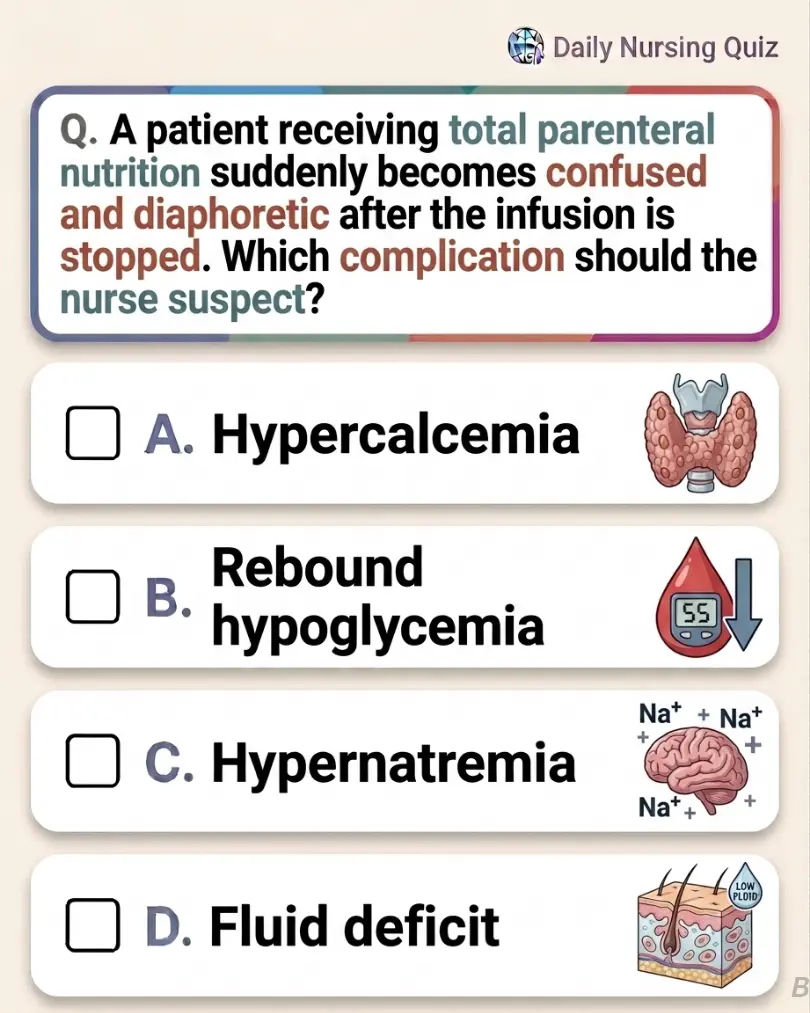
A patient receiving total parenteral nutrition suddenly becomes confused and diaphoretic after the infusion is stopped. Which complication should the nurse suspect?
👆 Comment your answer and the tap an option to check your answer.
Don’t forget to Comment your answer below.
💉 TPN Discontinuation & Rebound Hypoglycemia
B. Rebound hypoglycemia
C. Hypernatremia
D. Fluid deficit
✅ Answer: (B) Rebound hypoglycemia
📖 What is TPN?
TPN stands for Total Parenteral Nutrition.
Total = Provides the required nutritional support.
Parenteral = Given through a route other than the gastrointestinal tract.
Nutrition = Provides nutrients such as glucose, amino acids, fats, vitamins, and minerals.
👉 TPN is usually given intravenously, often through a central venous catheter, when the gastrointestinal tract cannot be used adequately.
🩺 Why is Option B Correct?
TPN solutions usually contain a high concentration of glucose. During continuous TPN administration, the body adapts to this constant glucose supply and insulin secretion increases.
If the infusion is suddenly stopped, the glucose supply disappears abruptly while insulin may remain elevated for some time.
⬇️
🍬 Glucose supply ↓
⬇️
💉 Insulin effect continues
⬇️
🩸 Blood glucose ↓
⬇️
⚠️ Rebound hypoglycemia
👉 The patient’s confusion and diaphoresis are classic warning signs of hypoglycemia, making rebound hypoglycemia the best answer.
📖 Why Does Hypoglycemia Cause These Symptoms?
The brain depends heavily on glucose for energy. When blood glucose falls, neurological symptoms such as confusion, weakness, dizziness, and altered consciousness may occur.
Low blood glucose also activates the sympathetic nervous system, producing symptoms such as:
- 💦 Sweating
- ❤️ Palpitations
- 😰 Anxiety
- 🤲 Tremors
👉 Confusion + diaphoresis after sudden TPN interruption = Think hypoglycemia.
❌ Why Are the Other Options Wrong?
A. Hypercalcemia
❌ Hypercalcemia can cause weakness, constipation, thirst, and altered mental status, but it does not explain the classic combination of diaphoresis and acute symptoms immediately after stopping TPN.
B. Rebound Hypoglycemia
✅ Correct. Abrupt discontinuation of a glucose-rich TPN infusion can cause a rapid fall in blood glucose.
C. Hypernatremia
❌ Hypernatremia can cause neurological symptoms, but it is not the characteristic complication of abruptly stopping TPN.
D. Fluid Deficit
❌ Fluid deficit develops with inadequate fluid intake or excessive fluid loss and does not typically produce sudden diaphoresis and confusion immediately after stopping TPN.
📝 Important Nursing Point
If TPN must be discontinued, the patient may require appropriate glucose-containing fluids and close blood-glucose monitoring according to the clinical situation and institutional protocol.
🧠 Quick Recall
| Finding | Think |
|---|---|
| TPN stopped suddenly | Glucose supply suddenly falls |
| Diaphoresis | Hypoglycemia warning sign |
| Confusion | Brain affected by low glucose |
| Overall diagnosis | Rebound hypoglycemia |
“TPN = Lots of glucose. Stop suddenly → Glucose drops.”
💉 TPN stopped + 💦 sweating + 🧠 confusion = 🍬 Hypoglycemia
📌 Exam Tip: A patient receiving TPN who suddenly develops diaphoresis, confusion, tremors, or weakness after the infusion is stopped should make you think of rebound hypoglycemia.
Concept clarity • Easy recall • Nursing success
Don’t forget to comment the answer below.