
🩺 Nursing Question of the Day
Challenge yourself with one exam-style nursing question every day.
✅ Think carefully • ✅ Choose your answer • ✅ Then scroll down to check the explanation.
Added on Dated 14.08.2026.
📝 Today’s Question:
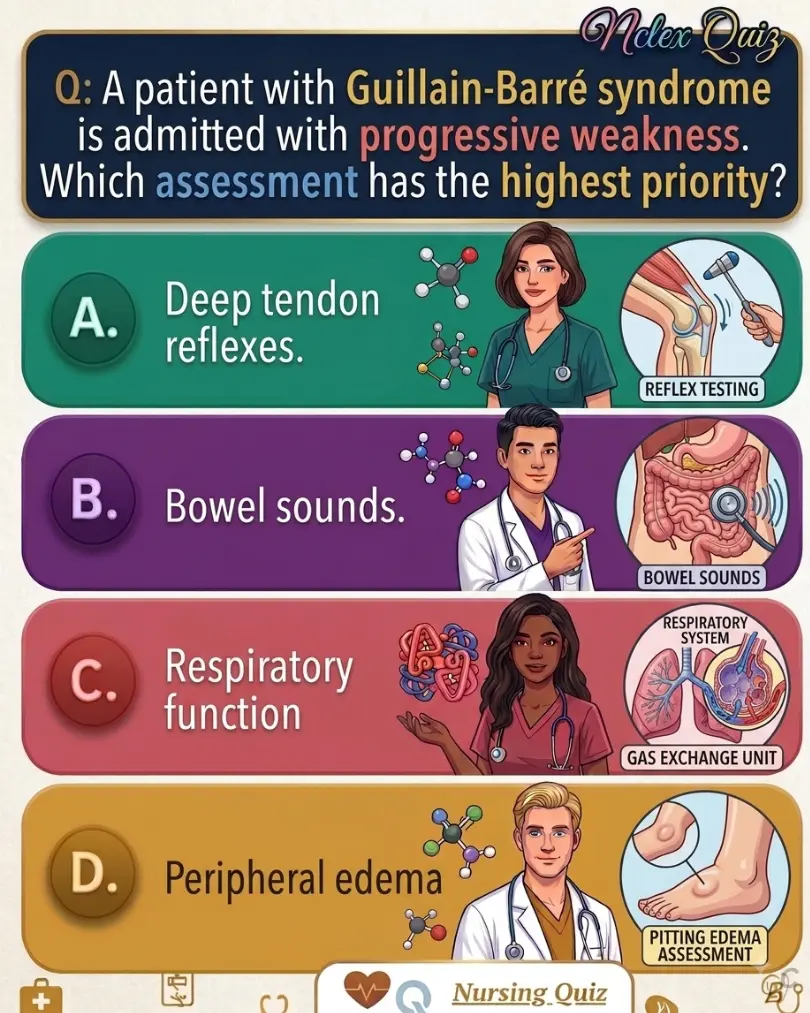
A patient with Guillain-Barré syndrome is admitted with progressive weakness. Which assessment has the highest priority?
👆 Comment your answer and the tap an option to check your answer.
Don’t forget to Comment your answer below.
🫁 Guillain-Barré Syndrome — Priority Assessment
B. Bowel sounds
C. Respiratory function
D. Peripheral edema
✅ Answer: (C) Respiratory function
📖 What is Guillain-Barré Syndrome?
Guillain-Barré syndrome (GBS) is an acute immune-mediated disorder in which the peripheral nerves are affected, commonly producing progressive, symmetrical muscle weakness.
Guillain and Barré = Named after the neurologists Georges Guillain and Jean Alexandre Barré, who described the syndrome.
Syndrome = A group of signs and symptoms occurring together.
🩺 Why is Option C Correct?
The most serious complication of GBS is respiratory muscle weakness.
As the weakness progresses, the muscles required for breathing can become impaired. This can lead to:
- 🫁 Decreased vital capacity
- 🫁 Weak cough
- 🫁 Difficulty clearing secretions
- 🫁 Hypoventilation
- 🚨 Respiratory failure
👉 Therefore, respiratory function must receive the highest priority.
📖 What Should the Nurse Assess?
The nurse should closely monitor respiratory status, including:
- Respiratory rate and pattern
- Oxygen saturation
- Ability to cough and clear secretions
- Breath sounds
- Vital capacity and other respiratory measurements, when indicated
A patient can deteriorate quickly, so respiratory assessment is a priority even before severe respiratory symptoms become obvious.
❌ Why Are the Other Options Less Priority?
A. Deep Tendon Reflexes
❌ Reduced or absent reflexes are characteristic of GBS and are important for neurological assessment, but respiratory compromise is the more immediate life-threatening concern.
B. Bowel Sounds
❌ Bowel function may need monitoring, particularly because of immobility or autonomic dysfunction, but it is not the highest immediate priority.
C. Respiratory Function
✅ Correct. Progressive weakness can involve the respiratory muscles and cause potentially fatal respiratory failure.
D. Peripheral Edema
❌ Edema is not the defining acute threat in GBS and is lower priority than respiratory assessment.
📝 Priority in GBS
| Assessment | Priority |
|---|---|
| Respiratory function | 🚨 Highest — respiratory failure can occur |
| Deep tendon reflexes | Important neurological finding |
| Bowel sounds | Monitor as indicated |
| Peripheral edema | Lower priority |
GBS = “Breathing Before Reflexes.”
🫁 Progressive weakness → Check respiratory muscles first.
📌 Exam Tip: In Guillain-Barré syndrome, always think “Can the patient breathe?” Respiratory muscle weakness is a potentially life-threatening complication, making respiratory assessment the priority.
Concept clarity • Easy recall • Nursing success
Don’t forget to comment the answer below.