
🩺 Nursing Question of the Day
Challenge yourself with one exam-style nursing question every day.
✅ Think carefully • ✅ Choose your answer • ✅ Then scroll down to check the explanation.
Added on Dated 05.08.2026.
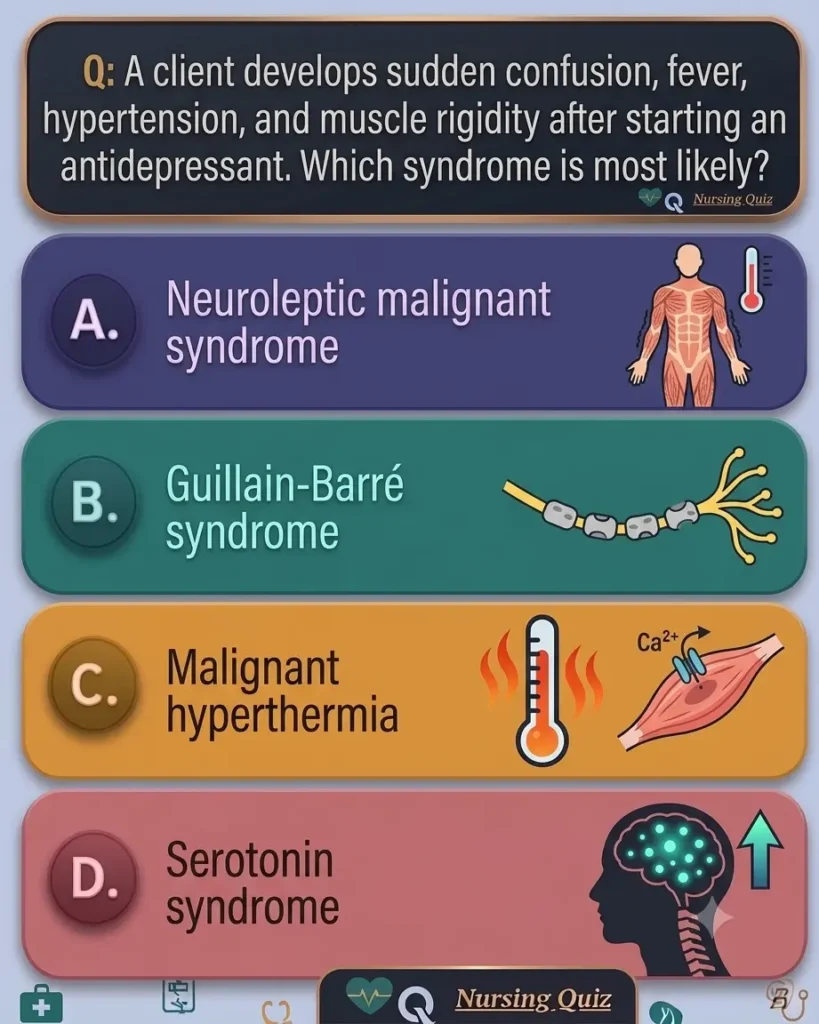
📝 Today’s Question:
A client develops sudden confusion, fever, hypertension, and muscle rigidity after starting an antidepressant. Which syndrome is most likely?
👆 Comment your answer and the tap an option to check your answer.
Don’t forget to Comment your answer below.
💊 Serotonin Syndrome
✅ Answer: (D) Serotonin Syndrome
📖 What is Serotonin Syndrome?
Serotonin = A neurotransmitter involved in mood, sleep, and behavior.
Syndrome = A group of signs and symptoms.
👉 Serotonin Syndrome is a potentially life-threatening condition caused by excess serotonin activity, usually after starting, increasing, or combining serotonergic medications such as SSRIs, SNRIs, MAOIs, tramadol, linezolid, or St. John’s wort.
🩺 Why is Option (D) Correct?
The client developed symptoms soon after starting an antidepressant, including:
- ✔ Confusion
- ✔ High fever (hyperthermia)
- ✔ Hypertension
- ✔ Muscle rigidity
Other common findings include:
- ✔ Agitation
- ✔ Tremor
- ✔ Hyperreflexia
- ✔ Clonus
- ✔ Diaphoresis (profuse sweating)
👉 These features strongly suggest Serotonin Syndrome.
❌ Why Other Options Are Wrong?
(A) Neuroleptic Malignant Syndrome (NMS)
❌ Usually occurs after antipsychotic (neuroleptic) medications such as haloperidol. It develops more gradually and is characterized by severe “lead-pipe” rigidity, hyperthermia, and elevated creatine kinase.
(B) Guillain-Barré Syndrome
❌ An autoimmune disorder causing ascending muscle weakness and areflexia. Fever and hypertension after antidepressants are not typical.
(C) Malignant Hyperthermia
❌ Occurs after exposure to general anesthetic agents or succinylcholine, not antidepressants.
📝 Serotonin Syndrome vs Neuroleptic Malignant Syndrome
| Feature | Serotonin Syndrome | Neuroleptic Malignant Syndrome |
|---|---|---|
| Cause | Antidepressants (SSRIs, MAOIs, etc.) | Antipsychotic drugs |
| Onset | Rapid (hours) | Gradual (1–3 days) |
| Reflexes | Hyperreflexia, clonus | Normal or decreased reflexes |
| Treatment | Stop drug, supportive care, cyproheptadine | Stop drug, dantrolene or bromocriptine |
💊 SSRI → Serotonin Syndrome
🌡️ Hot + High BP + Hyperreflexia + Confusion = Serotonin Syndrome
🤖 Neuroleptic Drug → Neuroleptic Malignant Syndrome (NMS)
📌 Exam Tip: If symptoms develop soon after starting or increasing an antidepressant, think of Serotonin Syndrome. Key clues include rapid onset, hyperthermia, agitation, hyperreflexia, clonus, and autonomic instability. Immediate treatment involves stopping the offending drug, providing supportive care, and administering cyproheptadine when indicated.
Concept clarity • Easy recall • Nursing success
Don’t forget to comment the answer below.