
🩺 Nursing Question of the Day
Challenge yourself with one exam-style nursing question every day.
✅ Think carefully • ✅ Choose your answer • ✅ Then scroll down to check the explanation.
Added on Dated 03.08.2026.
📝 Today’s Question:
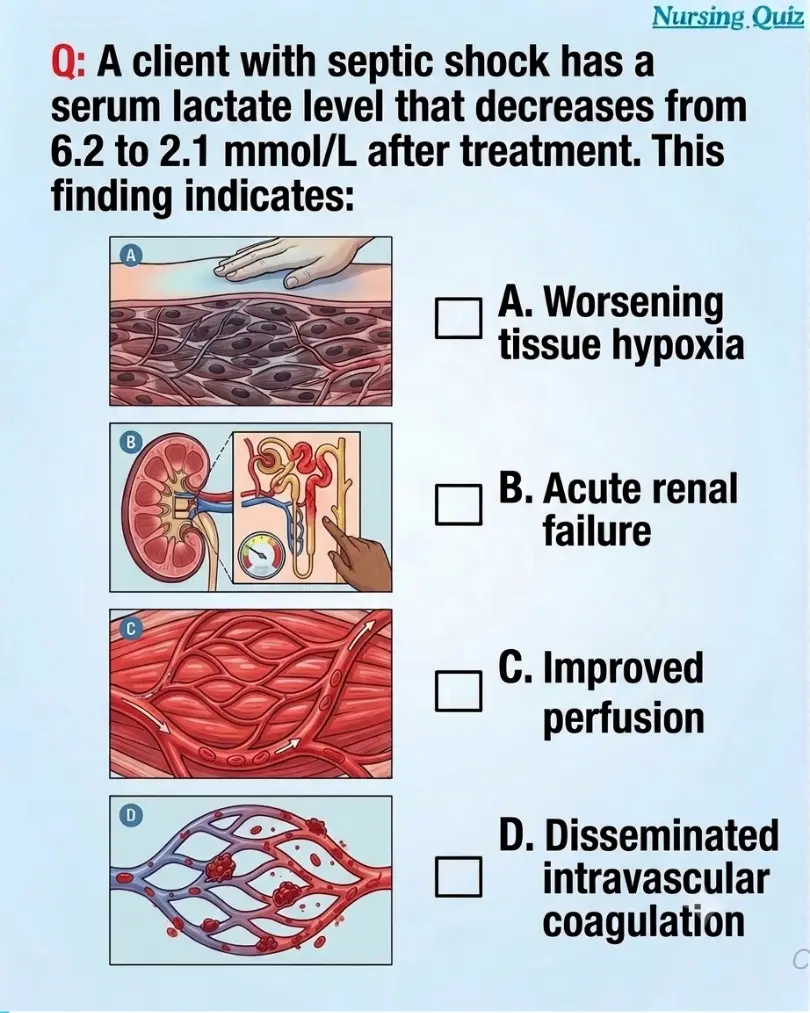
A client with septic shock has a serum lactate level that decreases from 6.2 to 2.1 mmol/L after treatment. This finding indicates:
👆 Comment your answer and the tap an option to check your answer.
Don’t forget to Comment your answer below.
🩸 Septic Shock and Serum Lactate
✅ Answer: (C) Improved Tissue Perfusion
📖 What is Septic Shock?
Septic = Caused by severe infection
Shock = Inadequate blood flow to body tissues
👉 Septic shock is a life-threatening condition in which severe infection causes profound circulatory failure, resulting in poor tissue perfusion and inadequate oxygen delivery to organs.
📖 What is Serum Lactate?
Lactate is a substance produced when body cells generate energy without enough oxygen (anaerobic metabolism).
👉 Normal serum lactate is approximately 0.5–2.0 mmol/L.
A high lactate level usually indicates:
- ✔ Poor tissue perfusion
- ✔ Tissue hypoxia
- ✔ Severe shock or sepsis
🩺 Why is Option (C) Correct?
The patient’s lactate level decreased from:
6.2 mmol/L → 2.1 mmol/L
This significant reduction means:
- ✔ Blood flow to tissues has improved
- ✔ Oxygen delivery has increased
- ✔ Anaerobic metabolism has decreased
- ✔ The patient is responding well to treatment
👉 This process is called lactate clearance, which is a positive prognostic sign in septic shock.
❌ Why Other Options Are Wrong?
(A) Worsening Tissue Hypoxia
❌ Worsening hypoxia would cause the lactate level to increase, not decrease.
(B) Acute Renal Failure
❌ Although kidney dysfunction can occur in septic shock, a falling lactate level specifically indicates improved tissue perfusion rather than renal failure.
(D) Disseminated Intravascular Coagulation (DIC)
❌ DIC is a serious complication of sepsis involving widespread clotting and bleeding. A falling lactate level does not indicate DIC.
📝 Interpretation of Serum Lactate
| Lactate Level | Clinical Meaning |
|---|---|
| 0.5–2.0 mmol/L | Normal tissue perfusion |
| > 2 mmol/L | Possible tissue hypoperfusion |
| ≥ 4 mmol/L | Severe hypoperfusion; associated with septic shock |
| Falling Lactate | Improved tissue perfusion and response to treatment |
🩸 High Lactate = Low Oxygen
📉 Lactate Going Down = Patient Getting Better
Lactate Clearance = Improved Perfusion
📌 Exam Tip: In septic shock, serial serum lactate measurements are used to monitor treatment response. A decreasing lactate level (lactate clearance) is a strong indicator of improved tissue perfusion, better oxygen delivery, and a favorable prognosis.
Concept clarity • Easy recall • Nursing success
Don’t forget to comment the answer below.