
🩺 Nursing Question of the Day
Challenge yourself with one exam-style nursing question every day.
✅ Think carefully • ✅ Choose your answer • ✅ Then scroll down to check the explanation.
Added on Dated 02.08.2026.
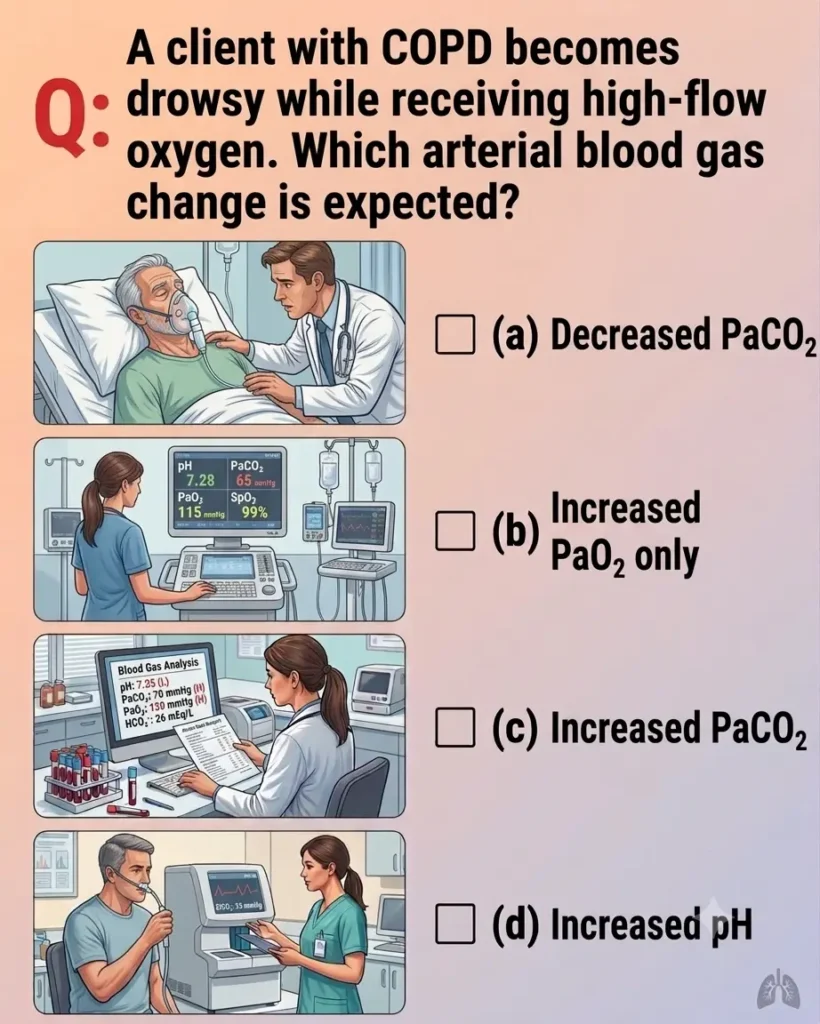
📝 Today’s Question:
A client with COPD becomes drowsy while receiving high-flow oxygen. Which arterial blood gas change is expected?
👆 Comment your answer and the tap an option to check your answer.
Don’t forget to Comment your answer below.
🫁 COPD and High-Flow Oxygen Therapy
✅ Answer: (C) Increased PaCO₂
📖 What is COPD?
Chronic = Long-term
Obstructive = Airflow blockage
Pulmonary Disease = Lung disease
👉 COPD is a chronic lung disease (mainly chronic bronchitis and emphysema) that causes persistent airflow limitation and difficulty in breathing.
📖 What is PaCO₂?
PaCO₂ = Partial Pressure of Carbon Dioxide in Arterial Blood.
👉 Normal value: 35–45 mmHg
An increased PaCO₂ indicates carbon dioxide retention (hypercapnia).
🩺 Why is Option (C) Correct?
Some patients with severe COPD have chronic CO₂ retention and rely partly on low oxygen levels (hypoxic drive) to stimulate breathing.
If excessive oxygen is administered:
- ✔ Ventilation may decrease in susceptible patients
- ✔ Carbon dioxide begins to accumulate
- ✔ PaCO₂ rises (hypercapnia)
- ✔ The patient may become drowsy, confused, or difficult to arouse (CO₂ narcosis)
👉 Therefore, the expected ABG finding is increased PaCO₂.
❌ Why Other Options Are Wrong?
(A) Decreased PaCO₂
❌ Incorrect. High-flow oxygen in susceptible COPD patients tends to increase, not decrease, PaCO₂.
(B) Increased PaO₂ Only
❌ Oxygen therapy raises PaO₂, but the key clinical concern in this scenario is the accompanying rise in PaCO₂.
(D) Increased pH
❌ Increased PaCO₂ causes respiratory acidosis, so the pH usually decreases, not increases.
📝 ABG Changes in Oxygen-Induced Hypercapnia
| ABG Parameter | Expected Change |
|---|---|
| PaCO₂ | ⬆ Increased |
| PaO₂ | ⬆ Increased |
| pH | ⬇ Decreased (Respiratory Acidosis) |
🫁 COPD + Too Much Oxygen = CO₂ Goes Up
😴 Drowsy Patient = Think CO₂ Narcosis → ↑ PaCO₂
📌 Exam Tip: In COPD, oxygen should be administered carefully and titrated to a target oxygen saturation of about 88–92% in patients at risk of hypercapnic respiratory failure. Excessive oxygen may lead to oxygen-induced hypercapnia, characterized by increased PaCO₂ and drowsiness.
Concept clarity • Easy recall • Nursing success
Don’t forget to comment the answer below.