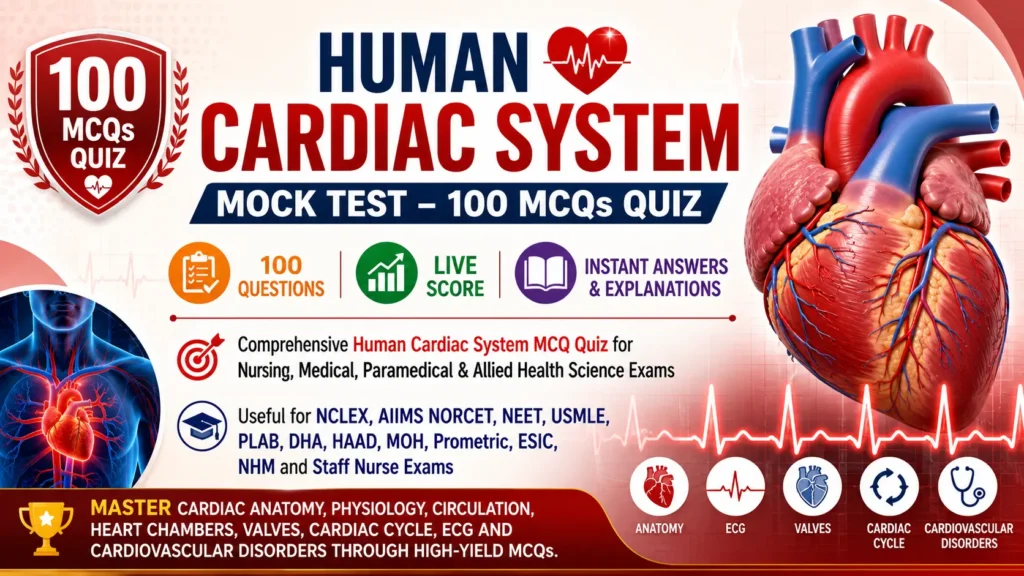
Human Cardiac System Mock Test banner showing heart anatomy, ECG waveform, nursing exam MCQs, 100 questions quiz with live score and cardiac system concepts.

Cardiovascular System Mock Test for Nursing Exam review, Quiz with live score.

❀️ Human Cardiac System Mock Test – 100 MCQs Quiz with Live Score

100 Questions | Live Score | Instant Answers & Explanations

Comprehensive Human Cardiac System MCQ Quiz for Nursing, Medical, Paramedical & Allied Health Science Exams

Useful for NCLEX, AIIMS NORCET, NEET, USMLE, PLAB, DHA, HAAD, MOH, Prometric, ESIC, NHM and Staff Nurse Exams

Master cardiac anatomy, physiology, circulation, heart chambers, valves, cardiac cycle, ECG and cardiovascular disorders through high-yield MCQs.

Human Cardiovascular System 100 MCQ Mock Test with Answers and Explanations for Nursing Exams

❀️ Human Cardiac System Test Information

❀️ Questions: 100 MCQs
❀️ Scoring: 1 Mark for Each Correct Answer
❀️ Negative Marking: None
❀️ Difficulty: Easy β€’ Moderate β€’ High
❀️ Explanations: Included
❀️ Suitable For: NCLEX, AIIMS NORCET, NEET, USMLE, PLAB, ESIC, NHM & Medical Entrance Exams

Start Test

0%
0/100
Question 1
A nurse is palpating the apical pulse of a client. In which anatomical location is the apex of the heart typically found?
A. Fourth intercostal space, right of the sternum.
B. Fifth intercostal space near the left midclavicular line.
C. Second intercostal space, right sternal border.
D. Third intercostal space, left sternal border.
Explanation:
The apex is the pointed lower part of the heart directed toward the left hip. It is specifically situated at the level of the fifth intercostal space. This location is also where the mitral valve is best auscultated.
Question 2
Which part of the heart’s intrinsic conduction system serves as the primary pacemaker?
A. Bundle of His.
B. Purkinje fibres.
C. Sinoatrial (SA) node.
D. Atrioventricular (AV) node.
Explanation:
The SA node has the highest rate of depolarisation, allowing it to control the heart’s rhythm. It initiates the electrical impulse that spreads through the atria. If the SA node fails, the AV node acts as a backup.
Question 3
During a cardiac cycle, which mechanical event follows the depolarisation of the atria?
A. Ventricular relaxation.
B. Opening of the aortic valve.
C. Atrial contraction (systole).
D. Closing of the semilunar valves.
Explanation:
Electrical depolarisation of the atria triggers their mechanical contraction, known as atrial systole. This event is represented by the P wave on an EKG. It functions to force the remaining blood into the ventricles.
Question 4
A client is diagnosed with left-sided heart failure. Which clinical finding is the nurse most likely to observe?
A. Peripheral pitting edema.
B. Pulmonary crackles (rales).
C. Hepatomegaly.
D. Jugular vein distention (JVD).
Explanation:
In left-sided heart failure, the ventricle fails to pump blood to the body, causing fluid to back up into the pulmonary circulation. This backup leads to pulmonary congestion and shortness of breath. Right-sided failure typically results in peripheral edema.
Question 5
Which heart valve prevents the backward flow of blood from the left ventricle into the left atrium?
A. Tricuspid valve.
B. Pulmonary semilunar valve.
C. Mitral (bicuspid) valve.
D. Aortic semilunar valve.
Explanation:
The mitral valve is located between the left atrium and left ventricle. It ensures one-way flow by closing during ventricular contraction. Improper closure results in mitral insufficiency.
Question 6
A nurse is reviewing EKG results and identifies “saw-tooth” shaped waves between QRS complexes. What rhythm is most likely present?
A. Sinus bradycardia.
B. Atrial flutter.
C. Ventricular tachycardia.
D. Atrial fibrillation.
Explanation:
Atrial flutter is characterized by rapid, regular atrial impulses that appear saw-toothed on the strip. The atrial rate is typically much higher than the ventricular rate. Treatment focuses on managing the ventricular response rate.
Question 7
What is the primary therapeutic action of sublingual Nitroglycerin in a client with angina?
A. Strengthening the force of ventricular contraction.
B. Increasing the heart rate.
C. Reducing the volume of blood in the ventricles.
D. Dilating coronary arteries to improve myocardial oxygen supply.
Explanation:
Nitroglycerin induces vasodilation, which increases blood flow to the heart muscle. This action relieves ischemic pain by balancing oxygen supply and demand. A common side effect is headache due to meningeal vessel dilation.
Question 8
According to the JNC 7 guidelines, a blood pressure of 138/88 mmHg is classified as:
A. Stage 2 Hypertension.
B. Prehypertension.
C. Normal.
D. Stage 1 Hypertension.
Explanation:
Prehypertension is defined as a systolic pressure between 120-139 mmHg or a diastolic pressure between 80-89 mmHg. This stage indicates a high risk for developing full hypertension. Stage 1 Hypertension begins at 140/90 mmHg.
Question 9
Which laboratory value is the most specific indicator of acute myocardial damage?
A. B-type natriuretic peptide (BNP).
B. Creatine Kinase (CK-MB).
C. Troponin I.
D. Myoglobin.
Explanation:
Troponin I is a highly specific cardiac protein released only when the myocardium is damaged. It remains elevated for several days, making it useful for diagnosis. Myoglobin rises earlier but is less specific.
Question 10
A client’s cardiac output is 5.0 L/min, and their body surface area is 2.0 mΒ². What is the client’s Cardiac Index (CI)?
A. 7.0 L/min/mΒ².
B. 10.0 L/min/mΒ².
C. 2.5 L/min/mΒ².
D. 3.0 L/min/mΒ².
Explanation:
The Cardiac Index is calculated by dividing cardiac output by the body surface area. In this case, 5.0 divided by 2.0 equals 2.5 L/min/mΒ². This value helps determine if output is adequate for the patient’s size.
Question 11
Which layer of the heart is composed of thick bundles of cardiac muscle responsible for contraction?
A. Endocardium.
B. Myocardium.
C. Epicardium.
D. Visceral pericardium.
Explanation:
The myocardium is the middle layer of the heart wall. It consists of cardiac muscle tissue that actually performs the pumping action. Inflammation of this layer is known as myocarditis.
Question 12
In an EKG, the PR interval represents the time required for:
A. The ventricles to depolarise.
B. The atria to repolarise.
C. An impulse to travel from the SA node to the ventricles.
D. The ventricles to relax.
Explanation:
The PR interval measures the time from the start of atrial depolarisation to the start of ventricular depolarisation. It is determined by counting squares from the P wave start to the QRS complex start. A normal interval is 0.12 to 0.20 seconds.
Question 13
Which intervention is the treatment of choice for a client experiencing life-threatening ventricular fibrillation?
A. Digoxin bolus.
B. Defibrillation.
C. Synchronized cardioversion.
D. IV Atropine.
Explanation:
Defibrillation is the most effective treatment for converting ventricular fibrillation back to a normal rhythm. CPR must be maintained until the defibrillator is ready to use. Cardioversion is generally used for rhythms with a pulse.
Question 14
A client is taking Furosemide (Lasix) for heart failure. Which electrolyte imbalance should the nurse monitor for?
A. Hypernatremia.
B. Hyperkalemia.
C. Hypokalemia.
D. Hypocalcemia.
Explanation:
Loop diuretics like furosemide increase the excretion of potassium in the urine. Low potassium, or hypokalemia, significantly increases the risk of digoxin toxicity. Patients are often encouraged to eat potassium-rich foods.
Question 15
Which set of symptoms constitutes “Beck’s Triad,” indicating cardiac tamponade?
A. Bradycardia, hypotension, and wide QRS complexes.
B. Fever, chest pain, and a friction rub.
C. Muffled heart sounds, JVD, and elevated central venous pressure.
D. Hypertension, tachycardia, and clear lungs.
Explanation:
Cardiac tamponade is an emergency where fluid compresses the heart. Classic signs include muffled heart sounds and jugular vein distention. Pulsus paradoxus is another hallmark finding in these patients.
Question 16
What is the clinical significance of a B-type natriuretic peptide (BNP) level of 800 pg/mL?
A. It indicates a massive myocardial infarction.
B. It is highly indicative of heart failure.
C. It suggests pulmonary embolism.
D. It indicates a normal, healthy heart.
Explanation:
BNP is a hormone secreted by the ventricles when they are stretched due to volume overload. Levels above 100 pg/mL suggest heart failure, with higher values indicating greater severity. A value of 800 pg/mL represents significant dysfunction.
Question 17
Which EKG lead is most commonly used as the positive electrode in a three-electrode telemetry system for Lead II monitoring?
A. Right arm.
B. Left leg (lower abdomen).
C. Right leg.
D. Left arm.
Explanation:
In standard Lead II monitoring, the positive electrode is typically placed on the left leg or lower abdomen. The negative electrode is on the right arm. This configuration looks at the heart from the base toward the apex.
Question 18
A nurse identifies a high-pitched, blowing systolic murmur loudest at the apex. This finding most likely indicates:
A. Pulmonic regurgitation.
B. Tricuspid stenosis.
C. Mitral insufficiency.
D. Aortic stenosis.
Explanation:
Mitral insufficiency (regurgitation) allows blood to flow back into the left atrium during systole. It produces a characteristic blowing murmur heard best at the apex. Unlike tricuspid murmurs, it does not change with inspiration.
Question 19
Which vascular disorder is characterized by a “tearing” or “ripping” sensation of pain in the chest or back?
A. Acute myocardial infarction.
B. Pericarditis.
C. Dissecting aortic aneurysm.
D. Mitral valve prolapse.
Explanation:
A dissecting aneurysm involves a tear in the aortic wall layers, causing excruciating, tearing pain. This pain is often felt in the back, neck, or shoulders. It is a medical emergency requiring immediate blood pressure control.
Question 20
During the cardiac cycle, “atrial kick” refers to:
A. The passive filling of the ventricles.
B. The final 30% of ventricular filling provided by atrial contraction.
C. The closure of the AV valves.
D. The start of SA node firing.
Explanation:
Most ventricular filling occurs passively during diastole. Atrial contraction, or the “atrial kick,” provides the remaining 30% of blood to the ventricles. This contribution is lost in rhythms like atrial fibrillation.
Question 21
A nurse is preparing to administer Digoxin. Which assessment is the priority before giving the dose?
A. Monitoring the patient’s respiratory rate.
B. Auscultating the apical pulse for one full minute.
C. Checking for peripheral edema.
D. Checking the patient’s blood pressure.
Explanation:
Digoxin slows the heart rate and should be withheld if the apical pulse is below 60 beats/minute. It strengthens contractility but can cause dangerous bradycardia. Nurses must also monitor for blurred vision as a sign of toxicity.
Question 22
Which EKG finding is the classic hallmark of Second-degree AV block, Type I (Wenckebach)?
A. No relationship between P waves and QRS complexes.
B. Progressive lengthening of the PR interval until a QRS is dropped.
C. More P waves than QRS complexes with a constant PR interval.
D. A constant PR interval with dropped QRS complexes.
Explanation:
In Wenckebach (Type I), the conduction delay through the AV node increases with each beat. Eventually, an impulse is blocked entirely, resulting in a dropped QRS complex. This creates a pattern of grouped beats.
Question 23
Which drug is an ACE inhibitor commonly used to treat hypertension and heart failure?
A. Metoprolol.
B. Losartan.
C. Enalapril.
D. Amlodipine.
Explanation:
Enalapril is an ACE inhibitor, typically ending in “-pril”. These drugs work by dilating blood vessels to decrease systemic vascular resistance. A nagging cough is a common side effect that may lead to discontinuation.
Question 24
A client has a capillary refill time of 5 seconds. How should the nurse interpret this result?
A. A sign of adequate cardiac output.
B. Delayed refill indicating decreased peripheral perfusion.
C. A normal physiological finding.
D. A result of normal aging of the skin.
Explanation:
Normal capillary refill time is 3 seconds or less. A time greater than 3 seconds is considered delayed and suggests reduced blood flow to the tissues. It should be reported to the healthcare provider immediately.
Question 25
Which heart chamber receives oxygenated blood directly from the pulmonary veins?
A. Right ventricle.
B. Left ventricle.
C. Left atrium.
D. Right atrium.
Explanation:
Four pulmonary veins return oxygen-rich blood from the lungs to the heart. These veins empty into the left atrium. From there, blood moves through the mitral valve into the left ventricle.
Question 26
What is the standard duration of a normal QRS complex on an EKG?
A. Greater than 0.22 seconds.
B. Less than 0.12 seconds.
C. 0.20 to 0.40 seconds.
D. 0.12 to 0.20 seconds.
Explanation:
A normal QRS complex is narrow, reflecting rapid ventricular depolarisation. It should be less than 0.12 seconds (3 small squares). Widened complexes often indicate a bundle-branch block.
Question 27
A patient with acute pericarditis reports chest pain. What is a hallmark characteristic of this pain?
A. It occurs only during physical exertion.
B. It is relieved by sublingual nitroglycerin.
C. It increases with deep inspiration and improves when leaning forward.
D. It is a heavy weight or crushing sensation.
Explanation:
Pleuritic pain in pericarditis is sharp and worsens with deep breathing or lying flat. Sitting up and leaning forward pulls the heart away from the pleura, providing relief. A friction rub may also be heard on auscultation.
Question 28
Which electrolyte is primarily responsible for the “twisting” QRS complexes seen in Torsades de Pointes?
A. Potassium.
B. Magnesium.
C. Sodium.
D. Calcium.
Explanation:
Torsades de Pointes is a polymorphic ventricular tachycardia often triggered by hypomagnesemia. It features QRS complexes that appear to rotate around the baseline. Treatment typically includes IV magnesium administration.
Question 29
Which cardiac enzyme appears in the blood within 30 minutes of injury but lacks specificity to the heart?
A. Troponin T.
B. Myoglobin.
C. LDH.
D. CK-MB.
Explanation:
Myoglobin is the earliest biomarker to rise after muscle damage, often within 30 minutes to 4 hours. Because it is also found in skeletal muscle, it is not highly specific for MI. Troponin is preferred for definitive diagnosis.
Question 30
A nurse notes a regular rhythm on the EKG with a rate of 45 bpm and inverted P waves. This is likely a:
A. Sinus bradycardia.
B. Ventricular escape rhythm.
C. Junctional escape rhythm.
D. First-degree AV block.
Explanation:
A junctional escape rhythm originates in the AV junction when the SA node fails. It typically has a regular rate of 40 to 60 bpm and inverted P waves due to retrograde conduction. The QRS complex remains normal.
Question 31
Which medication class is considered first-line for reducing afterload in clients with dilated cardiomyopathy?
A. Beta-blockers.
B. ACE inhibitors.
C. Cardiac glycosides.
D. Calcium channel blockers.
Explanation:
ACE inhibitors are primary therapy for cardiomyopathy because they cause vasodilation. This reduces the afterload the heart must pump against, improving survival. They work by blocking the production of angiotensin II.
Question 32
The “lub” sound (S1) is produced by the closure of which valves?
A. Tricuspid and pulmonary.
B. Mitral and aortic.
C. Mitral and tricuspid.
D. Aortic and pulmonary.
Explanation:
The first heart sound (S1) occurs at the beginning of ventricular systole. It is caused by the atrioventricular (AV) valves snapping shut to prevent backflow into the atria. These are the mitral and tricuspid valves.
Question 33
A patient has an INR of 2.5 while on Warfarin therapy. The nurse should:
A. Notify the doctor of a high risk for bleeding.
B. Administer Vitamin K.
C. Document this as a therapeutic result.
D. Withhold the next dose.
Explanation:
The therapeutic INR range for most patients on warfarin is 2.0 to 3.0. A result of 2.5 indicates that the medication is effective and stable. Vitamin K is the antidote for warfarin overdose.
Question 34
Which condition is characterized by a weak and strong pulse pattern occurring in a regular cycle?
A. Pulsus paradoxus.
B. Pulsus alternans.
C. Pulsus bisferiens.
D. Pulsus bigeminus.
Explanation:
Pulsus alternans features a regular, alternating pattern of high and low amplitude pulses. It is a classic sign of left-sided heart failure. Pulsus paradoxus is related to the respiratory cycle instead.
Question 35
During CPR, what is the recommended rate for chest compressions?
A. 120–140 per minute.
B. 80–100 per minute.
C. At least 100 per minute.
D. 60–80 per minute.
Explanation:
Current CPR guidelines emphasize pushing hard and fast to maintain circulation. The compression rate should be at least 100 per minute. Full chest recoil must be allowed between compressions.
Question 36
A nurse observes chaotic electrical activity on the monitor with no discernible P waves or QRS complexes. This rhythm is:
A. Ventricular tachycardia.
B. Atrial fibrillation.
C. Ventricular fibrillation.
D. Asystole.
Explanation:
Ventricular fibrillation is characterized by chaotic, wavy lines on the EKG. There are no identifiable waves, and the patient will have no pulse. Defibrillation is the only definitive treatment.
Question 37
What is the primary function of the Atrioventricular (AV) node?
A. To accelerate the impulse into the Purkinje system.
B. To delay the impulse to allow for ventricular filling.
C. To initiate the heartbeat.
D. To act as the heart’s main ground.
Explanation:
The AV node acts as a resistor, slowing the electrical impulse from the atria. This pause allows the ventricles time to fill with blood before they contract. It serves as a backup if the SA node fails.
Question 38
Which drug class works by blocking the effects of norepinephrine at alpha receptors to treat hypertension?
A. Diuretics.
B. Beta-blockers.
C. Alpha-adrenergic blockers.
D. Calcium channel blockers.
Explanation:
Alpha-adrenergic blockers like prazosin relax vascular smooth muscle. This results in vasodilation and a significant drop in blood pressure. They are often used for resistant hypertension.
Question 39
A client is diagnosed with Abdominal Aortic Aneurysm (AAA). Which finding would most likely indicate a rupture?
A. Warm, flushed skin.
B. Severe abdominal pain and signs of shock.
C. Hypertension and bradycardia.
D. A loud systolic murmur at the apex.
Explanation:
Rupture of an aortic aneurysm is a surgical emergency with a high mortality rate. Signs include sudden, steady abdominal pain and hypovolemic shock. The priority is maintaining a patent airway and rapid fluid replacement.
Question 40
Which blood vessel layer is composed of a single layer of endothelial cells to allow for gas exchange?
A. Vein.
B. Arteriole.
C. Capillary.
D. Artery.
Explanation:
Capillaries are the smallest vessels and have extremely thin walls. They are made of only one cell layer, the tunica intima. This structure facilitates the exchange of gases and nutrients between blood and tissues.
Question 41
What does the T wave represent on a normal EKG strip?
A. Atrial repolarisation.
B. Ventricular repolarisation.
C. Atrial contraction.
D. Ventricular depolarisation.
Explanation:
The T wave reflects the electrical recovery of the ventricles after they have contracted. It is usually rounded and upright in lead II. If ischemia is present, the T wave may become inverted.
Question 42
A nurse identifies a “saw-tooth” pattern on the EKG with an atrial rate of 300 and a ventricular rate of 75. This indicates:
A. Atrial fibrillation.
B. Ventricular tachycardia.
C. 4:1 Atrial flutter.
D. 2:1 Atrial flutter.
Explanation:
In atrial flutter, the AV node filters impulses. A 4:1 ratio means only one out of every four atrial impulses (300/4 = 75) is conducted to the ventricles. This ratio determines the patient’s ventricular rate.
Question 43
Which laboratory test evaluates the intrinsic pathway of blood clotting and is used to monitor Heparin therapy?
A. BNP.
B. PT.
C. PTT.
D. INR.
Explanation:
The Partial Thromboplastin Time (PTT) test measures the time it takes for a clot to form. It is used to evaluate the intrinsic pathway of coagulation. A normal clot forms in 21 to 35 seconds during this test.
Question 44
Where is the best anatomical location to auscultate the aortic valve?
A. Fourth intercostal space, left sternal border.
B. Fifth intercostal space, left midclavicular line.
C. Second intercostal space, left sternal border.
D. Second intercostal space, right sternal border.
Explanation:
The aortic area is located at the second intercostal space to the right of the sternum. This is where sounds from the aortic semilunar valve are heard clearest. The pulmonic area is at the same level on the left side.
Question 45
Which heart sound is often heard in healthy children but may indicate heart failure in older adults?
A. S2.
B. S3.
C. S1.
D. S4.
Explanation:
The S3 (ventricular gallop) occurs early in diastole during rapid ventricular filling. It is a normal physiological finding in children and young adults. In older adults, it often signals congestive heart failure.
Question 46
What is the clinical hallmark of Atrial Fibrillation (A-fib) on an EKG strip?
A. A regular rhythm with no P waves.
B. An irregularly irregular rhythm with absent P waves.
C. Wide, bizarre QRS complexes at 150 bpm.
D. Progressively widening PR intervals.
Explanation:
Atrial fibrillation results from chaotic impulses that cause the atria to quiver. This results in indiscernible atrial activity and a classic irregularly irregular ventricular rhythm. The P waves are replaced by wavy fibrillatory lines.
Question 47
A patient has an Abdominal Aortic Aneurysm. Which assessment finding is a classic sign of this condition?
A. Distended neck veins.
B. High-pitched breath sounds.
C. A pulsating mass in the periumbilical area.
D. Diminished radial pulses.
Explanation:
A pulsating abdominal mass is the most significant finding in AAA. Patients may also report a throbbing sensation in the abdomen while lying down. Many aneurysms are asymptomatic until they expand or rupture.
Question 48
Which medication is the drug of choice for treating symptomatic Sinus Bradycardia?
A. Digoxin.
B. Epinephrine.
C. Atropine.
D. Amiodarone.
Explanation:
Atropine is used to increase the heart rate by blocking vagal stimulation to the SA node. It is the standard treatment for bradycardia that causes symptoms like hypotension. If ineffective, pacemaker insertion may be required.
Question 49
In the heart wall, what is the thin, glistening innermost sheet of endothelium?
A. Fibrous pericardium.
B. Endocardium.
C. Epicardium.
D. Myocardium.
Explanation:
The endocardium lines the heart chambers and covers the valves. It is continuous with the endothelium lining the blood vessels. Bacterial invasion of this layer is known as endocarditis.
Question 50
Which parameter is determined by counting squares between two R waves and dividing 1,500 by that number?
A. QT duration.
B. Ventricular rate.
C. PR interval.
D. Atrial rhythm.
Explanation:
The ventricular rate is calculated by the distance between R waves, representing ventricular contractions. Dividing 1,500 by the number of small squares provides the beats per minute. The atrial rate is calculated similarly using P waves.
Question 51
Which condition involves excruciating “tearing” chest pain and a blood pressure difference between the right and left arm?
A. Pericarditis.
B. Pulmonary Embolism.
C. Dissecting Aortic Aneurysm.
D. Acute Myocardial Infarction.
Explanation:
A classic sign of a dissecting aneurysm is a significant blood pressure discrepancy between the arms. The pain is often described as sudden and tearing. This separates it from the crushing pressure of a heart attack.
Question 52
A nurse identifies a tall, notched R wave in lead V6 and a widened QRS complex. This finding indicates:
A. Hyperkalemia.
B. Left Bundle-Branch Block (LBBB).
C. Normal Sinus Rhythm.
D. Right Bundle-Branch Block (RBBB).
Explanation:
LBBB is characterized by a QRS wider than 0.12 seconds and a notched R wave in lead V6. In this block, the impulse activates the septum from right to left, the opposite of normal. It often signals significant heart disease.
Question 53
What is the standard first-line treatment for a stable client with wide-complex monomorphic ventricular tachycardia?
A. Carotid massage.
B. Amiodarone.
C. Defibrillation.
D. Atropine.
Explanation:
Stable patients with ventricular tachycardia are typically treated with antiarrhythmics like amiodarone. If the patient becomes unstable, synchronized cardioversion is performed immediately. Defibrillation is reserved for pulseless patients.
Question 54
Which cardiac chamber has the thickest muscular wall to pump blood against systemic resistance?
A. Right ventricle.
B. Left atrium.
C. Left ventricle.
D. Right atrium.
Explanation:
The left ventricle must generate enough pressure to pump blood throughout the entire body. Consequently, its myocardium is much thicker and more powerful than the right side. Failure of this chamber leads to pulmonary edema.
Question 55
A patient with heart failure is switched from Enalapril to Losartan. What is the most likely reason for this change?
A. Enalapril caused dangerous bradycardia.
B. Losartan is more effective at strengthening contractions.
C. The patient developed a nagging cough and angioedema.
D. The patient’s blood pressure remained too high.
Explanation:
ACE inhibitors often cause a nagging cough or life-threatening angioedema. When these occur, patients are typically switched to ARBs like losartan. ARBs provide similar benefits without the same side effect profile.
Question 56
In an EKG, what does the P wave represent?
A. Ventricular depolarisation.
B. Atrial repolarisation.
C. Atrial depolarisation.
D. Ventricular repolarisation.
Explanation:
The P wave is the small, first wave on the EKG strip. It shows the electrical impulse spreading through the atria, causing them to contract. Abnormal P waves are seen in rhythms like atrial flutter.
Question 57
Which finding is a common sign of Digoxin toxicity?
A. Sharp, pleuritic chest pain.
B. Blurred vision and yellow-green halos.
C. Excessive weight gain.
D. Hypertension and tachycardia.
Explanation:
Visual changes, specifically halos and blurred vision, are classic indicators of digoxin toxicity. Other signs include nausea, vomiting, and confusion. Toxicity is often triggered by low potassium levels.
Question 58
What occurs during “isovolumetric relaxation” in the cardiac cycle?
A. The AV valves open to allow blood into the ventricles.
B. All four heart valves are closed as ventricular pressure drops.
C. The ventricles contract and eject blood into the aorta.
D. The atria contract to provide the atrial kick.
Explanation:
After the ventricles eject blood, their pressure falls. During isovolumetric relaxation, the semilunar valves close while the AV valves have not yet opened. For a brief moment, all valves are shut as the heart rests.
Question 59
Which laboratory test evaluates the extrinsic clotting pathway and is used to monitor Warfarin (Coumadin) therapy?
A. BNP.
B. PT/INR.
C. Troponin.
D. PTT.
Explanation:
Prothrombin Time (PT) and the International Normalized Ratio (INR) are used to monitor warfarin efficacy. PT normally ranges from 10 to 14 seconds. Patients on therapy aim for an INR of 2.0 to 3.0.
Question 60
A nurse is auscultating the heart of a child and hears a low-pitched gallop after S2. This is documented as:
A. A sign of rheumatic heart disease.
B. A result of tricuspid stenosis.
C. A normal physiological S3 sound.
D. A pathologic S4 gallop.
Explanation:
An S3 sound is considered a normal finding in healthy children and adolescents. It is heard during the phase of rapid ventricular filling in diastole. In older adults, it is a significant sign of heart failure.
Question 61
Which vascular disorder involves a bulging outpouching of the entire circumference of the aortic wall?
A. False aneurysm.
B. Fusiform aneurysm.
C. Dissecting aneurysm.
D. Saccular aneurysm.
Explanation:
A fusiform aneurysm is a spindle-shaped enlargement that encompasses the entire circumference of the vessel. A saccular aneurysm is a localized outpouching on only one side. Dissecting aneurysms involve a tear between wall layers.
Question 62
What is the primary purpose of an exercise stress test?
A. To directly inject dye into the coronary arteries.
B. To visualize the heart’s valves using sound waves.
C. To assess cardiovascular response to an increased workload.
D. To measure the electrical resistance of the skin.
Explanation:
An exercise stress test provides diagnostic data that cannot be obtained while the patient is at rest. It monitors EKG changes and symptoms during physical exertion. The test is stopped if the patient develops chest pain or dyspnea.
Question 63
Which EKG hallmark identifies a Premature Atrial Contraction (PAC)?
A. A prolonged PR interval greater than 0.20 seconds.
B. A premature P wave with an abnormal shape.
C. The absence of a T wave after the QRS.
D. A wide and bizarre QRS complex.
Explanation:
A PAC originates from an irritable focus in the atria before the next sinus beat. The premature P wave often has a configuration different from the normal sinus P wave. It may even be embedded in the previous T wave.
Question 64
A client with a permanent pacemaker feels light-headed and their pulse is 50 bpm despite a setting of 70. This suggests:
A. Success of the “atrial kick.”
B. Pacemaker failure to pace.
C. Normal pacemaker function.
D. Digoxin toxicity.
Explanation:
Pacemakers function in DEMAND mode, preventing the heart rate from falling below a preset rate. A rate of 50 when set at 70 indicates the device is not firing correctly. This requires immediate investigation to prevent syncope.
Question 65
Which drug is a catecholamine used to treat cardiogenic shock by increasing contractility?
A. Atenolol.
B. Lisinopril.
C. Dopamine.
D. Prazosin.
Explanation:
Dopamine is a naturally occurring catecholamine that increases heart rate and force of contraction. It is commonly used in emergencies like shock to improve cardiac output. Adverse reactions can include dangerous palpitations.
Question 66
What is the standard anatomical location to identify the mitral valve sound (Point of Maximal Impulse)?
A. Under the left second rib.
B. Third intercostal space, left sternal border.
C. Second intercostal space, right of the sternum.
D. Fifth intercostal space, left midclavicular line.
Explanation:
The mitral area is located at the apex of the heart. This is specifically at the fifth intercostal space near the midclavicular line. Heart sounds like S1 are loudest here.
Question 67
Which finding on an EKG strip is indicative of Right Bundle-Branch Block (RBBB)?
A. A shortened PR interval of 0.08 seconds.
B. Inverted T waves in all chest leads.
C. A broad S wave in lead V6 and RSR’ in V1.
D. A tall, notched R wave in lead V6.
Explanation:
RBBB features a classic RSR’ pattern (bunny ears) in lead V1. Lead V6 typically shows a broad S wave reflecting delayed right ventricular activation. This block can be a potential complication of a myocardial infarction.
Question 68
A nurse identifies chaotic baseline waves on the EKG with no identifiable P waves and an irregular rhythm. This is:
A. Ventricular fibrillation.
B. Atrial fibrillation.
C. Atrial flutter.
D. Sinus tachycardia.
Explanation:
Atrial fibrillation is distinguished by erratic fibrillatory waves and a completely irregular ventricular response. It is the most common atrial arrhythmia. Patients are at high risk for thrombus formation due to quivering atria.
Question 69
Which set of heart valves are called the “semilunar” valves?
A. Tricuspid and Pulmonary.
B. Aortic and Pulmonary.
C. Mitral and Aortic.
D. Mitral and Tricuspid.
Explanation:
The semilunar valves guard the outlets of the heart. These are the aortic valve and pulmonary valve. They prevent backflow into the ventricles.
Question 70
What is the primary action of a loop diuretic like Furosemide?
A. Directly dilating coronary arteries.
B. Reducing blood volume by increasing urine output.
C. Slowing conduction through the AV node.
D. Strengthening the force of the heartbeat.
Explanation:
Diuretics treat fluid overload by decreasing total blood volume and circulatory congestion. This effectively reduces the preload on the heart. Rapid fluid loss can lead to orthostatic hypotension.
Question 71
Which vascular sound is heard as a “blowing” or “swishing” noise during auscultation of an artery?
A. Friction rub.
B. Bruit.
C. Murmur.
D. S3 gallop.
Explanation:
A bruit is a murmur-like sound of vascular origin. It is caused by turbulent blood flow through a narrowed or partially occluded artery. It often indicates atherosclerotic disease.
Question 72
A patient has a blood pressure of 165/105 mmHg. This is classified as:
A. Stage 1 Hypertension.
B. Malignant Hypertension.
C. Stage 2 Hypertension.
D. Prehypertension.
Explanation:
Stage 2 Hypertension is defined as a systolic pressure of 160 or higher, or a diastolic pressure of 100 or higher. This requires aggressive management to prevent stroke or myocardial infarction. Stage 1 ranges from 140–159 systolic.
Question 73
In the EKG, which segment represents the period between ventricular depolarisation and repolarisation?
A. PR interval.
B. ST segment.
C. TP segment.
D. QT interval.
Explanation:
The ST segment connects the QRS complex to the T wave. It represents the period when the ventricles are fully depolarised. Changes in this segment, like elevation or depression, are critical signs of ischemia.
Question 74
What is the most common underlying cause of a Myocardial Infarction (MI)?
A. Chronic stress.
B. Coronary Artery Disease (CAD).
C. High dietary sodium.
D. Electrolyte imbalances.
Explanation:
CAD involves the narrowing of coronary arteries due to plaque buildup. When a plaque ruptures and a clot forms, it leads to an MI by blocking blood flow. CAD is also the leading cause of sudden cardiac death.
Question 75
Which medication is the primary treatment for “variant” (Prinzmetal’s) angina caused by vasospasm?
A. Loop diuretics.
B. Digoxin.
C. Calcium channel blockers.
D. Beta-blockers.
Explanation:
Calcium channel blockers are highly effective at preventing coronary artery spasms. Beta-blockers are usually avoided in pure vasospastic angina as they may worsen the spasm. They work by relaxing vascular smooth muscle.
Question 76
Which fetal structure allows most blood to bypass the lungs by flowing from the right atrium to the left atrium?
A. Umbilical vein.
B. Foramen ovale.
C. Ductus arteriosus.
D. Ductus venosus.
Explanation:
The foramen ovale is an opening in the septal wall that allows blood to move directly between the atria. This bypasses the non-functioning fetal lungs. The ductus arteriosus is another bypass connecting the pulmonary trunk to the aorta.
Question 77
A patient has an EKG rhythm with a rate of 180 bpm and wide, bizarre QRS complexes. This is likely:
A. Sinus tachycardia.
B. Atrial tachycardia.
C. Ventricular tachycardia.
D. Atrial flutter with 1:1 conduction.
Explanation:
Ventricular tachycardia is characterized by wide QRS complexes (>0.12 seconds) at a rate of 100–250 bpm. It results from increased irritability in the Purkinje system. If the patient has no pulse, defibrillation is required.
Question 78
Which electrolyte abnormality should be corrected to prevent “Digitalis” toxicity?
A. Hypomagnesemia.
B. Hypercalcemia.
C. Hypokalemia.
D. Hyponatremia.
Explanation:
Low potassium levels sensitize the myocardium to digoxin, making toxic effects more likely even at normal doses. Patients on loop diuretics are at particularly high risk. Nurses must monitor serum potassium regularly.
Question 79
What is the hallmark finding in an EKG for a patient with First-degree atrioventricular (AV) block?
A. Inverted P waves.
B. A PR interval consistently greater than 0.20 seconds.
C. Dropped QRS complexes.
D. An irregular ventricular rhythm.
Explanation:
First-degree AV block involves a consistent delay in conduction through the AV node. The only indication on an EKG is a prolonged PR interval. Every P wave is still followed by a QRS complex.
Question 80
Which procedure involves a nonsurgical alternative to coronary artery bypass surgery to open occluded vessels?
A. Echocardiogram.
B. PTCA (Percutaneous Transluminal Coronary Angioplasty).
C. Cardioversion.
D. Heart transplant.
Explanation:
PTCA is performed in the cardiac catheterization lab under local anesthesia. It uses a balloon-tipped catheter to dilate narrowed arteries. It is less costly and requires shorter hospitalization than bypass surgery.
Question 81
A nurse auscultating the heart hears a “lub-dub-pah” rhythm. The extra sound occurring late in diastole is likely:
A. S2.
B. S4.
C. S3.
D. S1.
Explanation:
The S4 (atrial gallop) occurs late in diastole, just before S1. It is caused by the atria contracting into stiff, non-compliant ventricles. It is often associated with hypertension or cardiomyopathy.
Question 82
Which set of EKG findings supports a diagnosis of Premature Junctional Contractions (PJCs)?
A. Chaotic baseline with irregular QRS.
B. Saw-toothed P waves and regular QRS.
C. Normal QRS with an inverted P wave and short PR interval (<0.12s).
D. Wide QRS and no P waves.
Explanation:
PJCs originate in the AV junction, causing an early beat. Because the impulse travels backward to the atria, the P wave is inverted. The PR interval is shortened because the impulse is closer to the ventricles.
Question 83
Which condition is the most common cause of sudden cardiac death in adults?
A. Mitral valve prolapse.
B. Dilated cardiomyopathy.
C. Coronary Artery Disease (CAD).
D. Hypertrophic heart failure.
Explanation:
CAD is responsible for the vast majority of sudden cardiac deaths. It usually results from lethal arrhythmias triggered by acute myocardial ischemia. Cardiomyopathy is the second most common cause.
Question 84
What is the standard maximum daily sodium intake recommended for reducing cardiovascular risk?
A. 3,300 mg.
B. 5,000 mg.
C. 1,500 mg.
D. 2,300 mg.
Explanation:
General guidelines recommend limiting sodium intake to 2,300 mg or less per day. High sodium intake leads to fluid retention and hypertension. Lower limits may be set for patients with established heart failure.
Question 85
A patient with an Implantable Cardioverter-Defibrillator (ICD) is being discharged. Which instruction is most important?
A. Stop all cardiac medications now that the device is in.
B. Carry an ICD medical alert card at all times.
C. Avoid all physical exercise forever.
D. Avoid using microwave ovens entirely.
Explanation:
Patients must carry ICD identification so emergency personnel are aware of the device. They should also avoid placing excessive pressure over the insertion site. Family members are strongly encouraged to learn CPR.
Question 86
During an EKG, an upward (positive) deflection indicates that the wave of depolarisation flows:
A. Toward the ground electrode.
B. Perpendicularly to the positive electrode.
C. Toward the positive electrode.
D. Away from the positive electrode.
Explanation:
An upward deflection on the EKG occurs when electrical energy moves toward the positive lead. A downward deflection means it is moving away. Biphasic waves occur when flow is perpendicular.
Question 87
Which finding is a cardinal sign of Arterial Insufficiency during a peripheral vascular assessment?
A. Warm, red extremities.
B. Pedal pulses that disappear when the leg is elevated.
C. Varicose veins.
D. Pitting edema in the ankles.
Explanation:
Arterial insufficiency involves reduced blood flow to the limbs. Signs include diminished pulses, cool skin, and pallor that worsens with elevation. Venous insufficiency more commonly results in edema.
Question 88
What is the primary action of Digoxin (Lanoxin) in the heart?
A. Positive chronotropic (speeds heart rate).
B. Positive dromotropic (speeds conduction).
C. Negative inotropic (weakens contraction).
D. Positive inotropic (strengthens contraction).
Explanation:
Digoxin is a cardiac glycoside that increases the force of myocardial contraction. This helps the heart pump more efficiently, increasing cardiac output. It also has a negative chronotropic effect, slowing the heart rate.
Question 89
A nurse auscultating the 2nd intercostal space, left sternal border, is listening to which valve area?
A. Tricuspid.
B. Pulmonic.
C. Mitral.
D. Aortic.
Explanation:
The pulmonic area is located at the 2nd intercostal space to the left of the sternum. Auscultation here allows the nurse to hear sounds from the pulmonary semilunar valve. The tricuspid area is at the 4th left intercostal space.
Question 90
Which electrolyte abnormality is most likely to cause “Torsades de Pointes”?
A. Hypernatremia.
B. Hypomagnesemia.
C. Hypocalcemia.
D. Hyperkalemia.
Explanation:
Low magnesium levels can prolong the QT interval, leading to polymorphic ventricular tachycardia. This specific rhythm is known as Torsades de Pointes. IV magnesium is the treatment of choice to stabilize the rhythm.
Question 91
What is the standard PR interval duration?
A. Less than 0.12 seconds.
B. 0.12 to 0.20 seconds.
C. 0.22 to 0.30 seconds.
D. 0.04 to 0.10 seconds.
Explanation:
A normal PR interval is between 0.12 and 0.20 seconds, or 3 to 5 small squares. A longer interval indicates a conduction block. A shorter interval may be seen in junctional rhythms.
Question 92
Which blood pressure reading is classified as Stage 1 Hypertension according to JNC 7?
A. 130/85 mmHg.
B. 115/75 mmHg.
C. 145/95 mmHg.
D. 165/105 mmHg.
Explanation:
Stage 1 Hypertension is classified by a systolic pressure of 140–159 mmHg or a diastolic pressure of 90–99 mmHg. A reading of 145/95 mmHg falls within this range. Readings above 160/100 mmHg are classified as Stage 2 Hypertension.
Question 93
During a stress test, a patient develops ST-segment depression. This most likely indicates:
A. Successful adaptation to workload.
B. A normal response to exercise.
C. Myocardial ischemia.
D. Digoxin therapeutic effect.
Explanation:
ST-segment depression is a classic sign that the heart muscle is not receiving enough oxygen during exertion. If this occurs during a stress test, the test should be stopped and evaluated. It often indicates coronary artery disease.
Question 94
Which cardiac chamber receives deoxygenated blood from the superior and inferior vena cavae?
A. Right ventricle.
B. Right atrium.
C. Left atrium.
D. Left ventricle.
Explanation:
The right atrium receives systemic deoxygenated blood through the superior vena cava, inferior vena cava, and coronary sinus. Blood then passes through the tricuspid valve into the right ventricle.
Question 95
What is the phase of the cardiac cycle during which the ventricles contract and eject blood?
A. Diastole.
B. Refractory period.
C. Systole.
D. Isovolumetric relaxation.
Explanation:
Systole is the contraction phase of the cardiac cycle when the ventricles pump blood into the pulmonary artery and aorta. Diastole is the relaxation and filling phase.
Question 96
Which medication acts as an antagonist to reverse opioid overdose?
A. Morphine.
B. Naloxone.
C. Atropine.
D. Fentanyl.
Explanation:
Naloxone is a pure opioid antagonist that rapidly reverses opioid-induced respiratory depression. It is the drug of choice in opioid overdose emergencies.
Question 97
A nurse hears a mid-systolic click followed by a late systolic murmur. This finding suggests:
A. Aortic stenosis.
B. Mitral valve prolapse.
C. Pericarditis.
D. Mitral insufficiency.
Explanation:
Mitral valve prolapse occurs when the mitral valve leaflets bulge into the left atrium during ventricular contraction. A mid-systolic click is the hallmark auscultatory finding.
Question 98
Which electrolyte imbalance is most commonly associated with U waves on an EKG?
A. Hypernatremia.
B. Hypomagnesemia.
C. Hypokalemia.
D. Hyperkalemia.
Explanation:
Hypokalemia commonly produces U waves, flattened T waves, and ST-segment depression. Severe potassium depletion can result in life-threatening arrhythmias.
Question 99
What is the primary function of the skeletal muscle pump in the cardiovascular system?
A. To regulate blood pressure in the brain.
B. To help the heart contract more forcefully.
C. To assist venous return from the lower extremities to the heart.
D. To pump oxygenated blood into the muscles during exercise.
Explanation:
Contraction of skeletal muscles compresses veins and pushes blood toward the heart. One-way venous valves prevent backflow and improve venous return.
Question 100
A nurse identifies a regular rhythm with an atrial rate of 300 and a saw-tooth baseline. This rhythm is:
A. Ventricular tachycardia.
B. Sinus tachycardia.
C. Atrial flutter.
D. Atrial fibrillation.
Explanation:
Atrial flutter originates from a single irritable focus in the atria and produces characteristic saw-toothed F waves. The ventricular rate depends on the AV conduction ratio, such as 2:1 or 4:1.
πŸ”₯ Continue Your Nursing MCQ Practice
❀️ Human Cardiac System
Heart β€’ Circulation β€’ Cardiology
Start Quiz
🧬 Endocrine System
Diabetes β€’ Thyroid β€’ Hormones
Start Quiz
🫁 Respiratory System
Lungs β€’ Airways β€’ Gas Exchange
Start Quiz
πŸš€ More Body System MCQ Mock Tests Coming Soon
Nervous System β€’ Digestive System β€’ Urinary System β€’ Reproductive System β€’ Musculoskeletal System β€’ Blood & Lymphatic System
πŸ“š Go to Nursing Exam Prep Dashboard
🎯 Practice Daily β€’ Improve Accuracy β€’ Crack NCLEX, NORCET, AIIMS, ESIC & NHM

πŸ† Nursing Questions – Quizzes for practice

πŸ“š Read Nursing Objective Questions (MCQ)

Continue learning topic-wise! Tap any subject below to explore detailed Nursing MCQs with answers, explanations, and practice sets β€” designed for RN, AN, PN, BSc, GNM, ANM, MSc Nursing and other nursing students.

🩺 NCLEX Practice & Score Check

Practice β€’ Learn β€’ Track Your Score

Each question gives you instant feedback with the correct answer and a clear explanation. Your score updates automatically as you practice.

βœ” Instant Answer Feedback   |   βœ” Live Score Update   |   βœ” Exam-Style Questions

πŸ“Š Live Score Tracking As soon as you select an option, your score updates instantly. Use this feedback to adjust your approach and strengthen weak areas.
πŸ“ˆ Start Learning

Subscribe
Notify of
guest
0 Comments
Shopping Cart
Scroll to Top