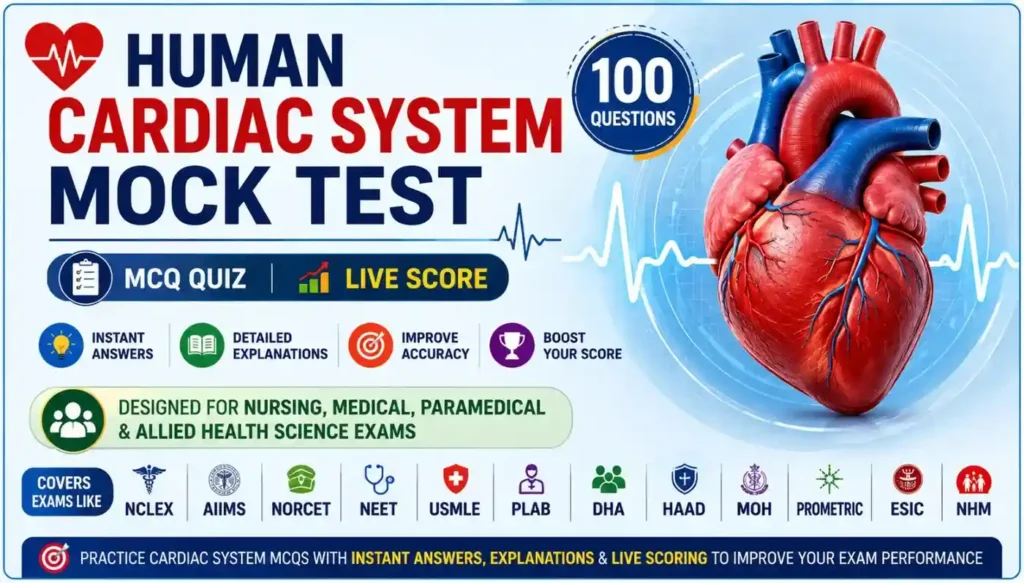
Human Cardiac System 100 MCQ Mock Test with Answers and Explanations for Nursing Exams including NCLEX, NORCET, AIIMS, ESIC and CHO

Human Cardiac System 100 MCQ Mock Test with Answers & Explanations for Nursing Exams (NCLEX, NORCET, ESIC, AIIMS, CHO)

❀️ Human Cardiac System Mock Test

100 Questions | MCQ Quiz with Live Score

Designed for Nursing, Medical, Paramedical & Allied Health Science Exams

Covers exams like NCLEX, AIIMS, NORCET, NEET, USMLE, PLAB, DHA, HAAD, MOH, Prometric, ESIC, NHM

Practice Cardiac System MCQs with instant answers, explanations & live scoring to improve your exam performance

Human Cardiac System 100 MCQ Mock Test with Answers and Explanations for Nursing Exams

πŸ“‹ About This Test

πŸ”Ή Number of Questions: 100 MCQs
πŸ”Ή Marks: 1 Point / Correct Answer
πŸ”Ή Negative Marking: No
πŸ”Ή Difficulty: Easy β€’ Moderate β€’ High
πŸ”Ή Explanations: Yes
πŸ”Ή Relevance: NCLEX, AIIMS, NEET, USMLE, PLAB, ESIC, NHM & Other Nursing/Medical Exams
0%
0/100
Question 1
Which layer of the heart is composed of thick bundles of cardiac muscle and is responsible for the actual pumping action?
A. Epicardium
B. Myocardium
C. Endocardium
D. Pericardium
Explanation:
The myocardium consists of thick bundles of cardiac muscle arranged in a complex pattern. It is the layer responsible for contraction and pumping blood throughout the body. The epicardium and pericardium serve protective functions, while the endocardium lines the heart chambers. Therefore, the myocardium is the heart’s primary pumping layer.
Question 2
A patient taking an ACE inhibitor such as Lisinopril reports a persistent dry cough. What is the nurse’s best action?
A. Advise the patient to take the medication with food
B. Instruct the patient to increase fluid intake
C. Hold the next dose and reassure the patient
D. Assess the patient and advise reporting the side effect to the provider
Explanation:
A persistent dry cough is a common adverse effect of ACE inhibitors. Patients should report this symptom because it may require changing the medication. Angiotensin receptor blockers (ARBs) such as Losartan are often used as alternatives. Prompt assessment and communication with the provider are essential.
Question 3
In the pulmonary circuit, which vessel carries oxygen-rich blood back to the heart?
A. Pulmonary vein
B. Pulmonary artery
C. Aorta
D. Superior vena cava
Explanation:
Pulmonary veins return oxygenated blood from the lungs to the left atrium. This is an exception to the general rule that veins carry deoxygenated blood. Pulmonary arteries transport deoxygenated blood from the heart to the lungs.
Question 4
The first heart sound (“lub”) is primarily caused by the:
A. Opening of the semilunar valves
B. Closing of the semilunar valves
C. Closing of the atrioventricular (AV) valves
D. Contraction of the atria
Explanation:
The first heart sound (S1) occurs when the mitral and tricuspid valves close. This marks the beginning of ventricular systole. The second heart sound (S2) is produced by closure of the aortic and pulmonary valves.
Question 5
Which fetal structure bypasses the lungs by connecting the pulmonary trunk to the aortic arch?
A. Foramen ovale
B. Ductus venosus
C. Ductus arteriosus
D. Umbilical vein
Explanation:
The ductus arteriosus diverts blood from the pulmonary trunk directly into the aorta. This allows fetal blood to bypass the non-functioning lungs. After birth it closes and becomes the ligamentum arteriosum.
Question 6
A nurse is preparing to administer Digoxin (Lanoxin). Which assessment finding requires withholding the medication?
A. Apical pulse of 58 beats per minute
B. Serum potassium level of 4.5 mEq/L
C. Digoxin level of 1.2 ng/mL
D. Blood pressure of 130/80 mmHg
Explanation:
Digoxin should be withheld if the apical pulse is below 60 beats per minute in adults. Bradycardia can indicate excessive drug effect or toxicity. The nurse should notify the healthcare provider before administration.
Question 7
What is the hallmark clinical sign of an Abdominal Aortic Aneurysm (AAA)?
A. Ripping chest pain
B. Finger pain in cold weather
C. A pulsating abdominal mass
D. Lower extremity edema
Explanation:
The classic sign of an abdominal aortic aneurysm is a pulsating mass in the abdomen. Patients may also experience abdominal, back, or flank pain. A ruptured aneurysm can become a life-threatening emergency.
Question 8
Which classification describes a patient at high risk for heart failure but without structural heart disease or symptoms?
A. Stage A
B. Stage B
C. Stage C
D. Stage D
Explanation:
Stage A heart failure includes patients who are at risk for developing heart failure. These individuals have no structural heart disease and no symptoms. Risk factors include hypertension, diabetes, and coronary artery disease.
Question 9
A P-R interval of 0.24 seconds on an ECG indicates:
A. Normal sinus rhythm
B. Delayed conduction through the AV node
C. Rapid ventricular depolarization
D. Normal atrial repolarization
Explanation:
The normal P-R interval ranges from 0.12 to 0.20 seconds. A value of 0.24 seconds indicates delayed conduction through the AV node. This finding is commonly associated with first-degree AV block.
Question 10
Which medication is the primary treatment for Malignant Hyperthermia?
A. Succinylcholine
B. Atropine
C. Dantrolene
D. Epinephrine
Explanation:
Dantrolene is the only specific treatment for Malignant Hyperthermia. It reduces calcium release from skeletal muscle cells and stops the hypermetabolic reaction. Early administration can be life-saving.
Question 11
Substances are exchanged between the blood and body cells through the thin walls of:
A. Arterioles
B. Venules
C. Capillaries
D. Arteries
Explanation:
Capillaries consist of a single layer of endothelial cells. Their extremely thin walls allow oxygen, carbon dioxide, nutrients, and waste products to move between blood and body tissues. They are the primary sites of exchange within the circulatory system.
Question 12
A patient with right-sided heart failure is likely to exhibit which clinical manifestation?
A. Pulmonary crackles and wheezing
B. Orthopnea
C. Jugular vein distention (JVD)
D. Frothy, pink-tinged sputum
Explanation:
Right-sided heart failure causes blood to back up into the systemic circulation. Common findings include jugular vein distention, peripheral edema, hepatomegaly, and weight gain. Pulmonary symptoms are more characteristic of left-sided heart failure.
Question 13
Which medication is used as an antidote to reverse the effects of Heparin?
A. Vitamin K
B. Protamine sulfate
C. Calcium gluconate
D. Digibind
Explanation:
Protamine sulfate is the specific antidote for heparin overdose or severe bleeding. It rapidly neutralizes heparin’s anticoagulant effects. Vitamin K is used to reverse warfarin, while Digibind reverses digoxin toxicity.
Question 14
The QRS complex on an ECG represents:
A. Atrial depolarization
B. Ventricular depolarization
C. Ventricular repolarization
D. Atrial repolarization
Explanation:
The QRS complex reflects ventricular depolarization, which triggers ventricular contraction. It normally measures less than 0.12 seconds. The P wave represents atrial depolarization, while the T wave represents ventricular repolarization.
Question 15
Which vessel returns deoxygenated blood from the head, neck, and upper extremities to the right atrium?
A. Inferior vena cava
B. Coronary sinus
C. Pulmonary vein
D. Superior vena cava
Explanation:
The superior vena cava carries deoxygenated blood from the upper body to the right atrium. The inferior vena cava drains blood from structures below the diaphragm. Pulmonary veins carry oxygenated blood from the lungs.
Question 16
Buerger’s Disease (thromboangiitis obliterans) is most strongly associated with:
A. High-sodium diets
B. Use of tobacco products
C. Chronic alcohol consumption
D. Sedentary lifestyle
Explanation:
Buerger’s disease is an inflammatory vascular disorder strongly linked to tobacco use. Smoking cessation is the most important treatment. Continued tobacco use can lead to severe ischemia and possible amputation.
Question 17
Which drug is a Class III antiarrhythmic that requires monitoring for pulmonary toxicity and thyroid dysfunction?
A. Adenosine
B. Amiodarone
C. Metoprolol
D. Diltiazem
Explanation:
Amiodarone can cause pulmonary fibrosis, thyroid abnormalities, and liver dysfunction. Patients receiving long-term therapy require regular monitoring. Its iodine content contributes to thyroid-related adverse effects.
Question 18
Starling’s Law of the Heart states that the critical factor controlling stroke volume is:
A. The heart rate
B. The thickness of the ventricular wall
C. The stretch of cardiac muscle cells before contraction
D. The total volume of blood in the body
Explanation:
Starling’s Law states that increased stretching of cardiac muscle fibers before contraction results in a stronger contraction. Greater venous return increases ventricular filling and stroke volume. This mechanism helps balance cardiac output with venous return.
Question 19
What is the most common site for palpating a person’s pulse in a clinical setting?
A. Brachial artery
B. Carotid artery
C. Femoral artery
D. Radial artery
Explanation:
The radial artery, located on the thumb side of the wrist, is the most commonly used site for pulse assessment. It is easy to access and generally provides a strong pulse. Other pulse sites are used in specific clinical situations.
Question 20
“Dependent rubor” (a red-blue discoloration when legs are hanging down) is a characteristic of:
A. Venous insufficiency
B. Peripheral Arterial Disease (PAD)
C. Deep Vein Thrombosis (DVT)
D. Normal aging changes
Explanation:
Dependent rubor occurs in Peripheral Arterial Disease due to poor arterial blood flow. The affected limb may appear pale when elevated and reddish-blue when lowered. It is an important assessment finding indicating arterial insufficiency.
Question 21
Which medication ends in “-pril” and is the first-line therapy for heart failure to reduce mortality?
A. Beta-blockers
B. Calcium channel blockers
C. ACE Inhibitors
D. Loop diuretics
Explanation:
ACE inhibitors such as Lisinopril and Quinapril are cornerstone therapies for heart failure. They reduce mortality, slow disease progression, and decrease cardiac workload by inhibiting the renin-angiotensin-aldosterone system. They are often considered first-line treatment in heart failure management.
Question 22
The “pacemaker” of the heart, which initiates the electrical impulse, is the:
A. AV node
B. Purkinje fibers
C. SA node
D. Bundle of His
Explanation:
The sinoatrial (SA) node is located in the right atrium and initiates the heartbeat. It has the highest intrinsic rate of depolarization and therefore serves as the heart’s natural pacemaker. Electrical impulses then travel to the AV node and throughout the ventricles.
Question 23
A patient with an ejection fraction (EF) of 30% is likely to be diagnosed with:
A. Normal cardiac function
B. Heart failure with reduced ejection fraction
C. Hypertension
D. Cardiac arrest
Explanation:
A normal ejection fraction ranges from approximately 55% to 70%. An EF of 30% indicates significantly impaired ventricular pumping ability and is classified as heart failure with reduced ejection fraction (HFrEF). These patients are at increased risk for cardiovascular complications.
Question 24
Which clinical sign is one of the most common indicators of a massive Pulmonary Embolism (PE)?
A. Severe abdominal mass
B. Feeling of impending doom
C. High-grade fever
D. Metallic taste in the mouth
Explanation:
A feeling of impending doom is a classic symptom associated with massive pulmonary embolism. Patients may also experience sudden shortness of breath, chest pain, tachycardia, anxiety, and low oxygen saturation. Immediate medical attention is required.
Question 25
Virchow’s Triad, describing factors that lead to DVT, includes:
A. Hypertension, Obesity, and Diabetes
B. Stasis, Endothelial Injury, and Hypercoagulability
C. Pallor, Pulselessness, and Paralysis
D. Chest pain, Dyspnea, and Tachycardia
Explanation:
Virchow’s Triad explains the three major contributors to venous thrombosis: endothelial injury, venous stasis, and hypercoagulability. These factors significantly increase the risk of deep vein thrombosis formation.
Question 26
Which medication is a potassium-sparing diuretic that can cause gynecomastia in men?
A. Furosemide
B. Hydrochlorothiazide
C. Spironolactone
D. Mannitol
Explanation:
Spironolactone is a potassium-sparing diuretic and aldosterone antagonist. Its anti-androgenic properties may cause gynecomastia in men and menstrual irregularities in women. Monitoring potassium levels is also important during therapy.
Question 27
The valve located between the left atrium and left ventricle is the:
A. Tricuspid valve
B. Aortic semilunar valve
C. Bicuspid (mitral) valve
D. Pulmonary semilunar valve
Explanation:
The bicuspid or mitral valve separates the left atrium from the left ventricle. It contains two cusps and prevents backflow of blood during ventricular contraction. The tricuspid valve is located on the right side of the heart.
Question 28
In the classification of heart failure, “Stage C” refers to patients with:
A. High risk for heart failure but no structural disease
B. Structural heart disease but no symptoms
C. Structural heart disease with prior or current symptoms
D. Refractory end-stage heart failure
Explanation:
Stage C heart failure includes patients with structural heart disease who currently have or previously had symptoms of heart failure. Management typically includes medications such as ACE inhibitors, beta-blockers, and diuretics.
Question 29
Which medication is the drug of choice for immediate treatment of acute angina pectoris?
A. Atorvastatin
B. Warfarin
C. Nitroglycerin
D. Metoprolol
Explanation:
Nitroglycerin rapidly relieves angina by dilating coronary arteries and reducing cardiac workload. It improves oxygen delivery to the myocardium and decreases oxygen demand. Sublingual nitroglycerin is commonly used for acute chest pain episodes.
Question 30
What is the primary function of the lymphatic system as it relates to the cardiovascular system?
A. To pump oxygenated blood to the brain
B. To return interstitial fluid to the blood
C. To produce red blood cells
D. To regulate blood pressure through vasoconstriction
Explanation:
The lymphatic system collects excess interstitial fluid that leaks from capillaries and returns it to the bloodstream. This process helps maintain blood volume, tissue fluid balance, and circulatory stability. It also plays an important role in immune defense.
Question 31
The average length of one complete cardiac cycle is approximately:
A. 0.5 seconds
B. 1.2 seconds
C. 0.8 seconds
D. 2.0 seconds
Explanation:
At a normal heart rate of about 75 beats per minute, one complete cardiac cycle lasts approximately 0.8 seconds. This includes atrial systole, ventricular systole, and the relaxation phases of the heart.
Question 32
Which serious complication of MI is characterized by the heart transforming from “Gothic architecture” to “Romanesque architecture”?
A. Aortic stenosis
B. Raynaud’s Syndrome
C. Congestive Heart Failure
D. Pulmonary Embolism
Explanation:
In congestive heart failure, the normal helical arrangement of myocardial fibers is lost. The ventricle becomes enlarged and less efficient, resembling a more rounded “Romanesque” structure rather than the normal “Gothic” architecture.
Question 33
A nurse is caring for a patient who sees yellow halos around lights. These are classic signs of:
A. Heparin overdose
B. Digoxin toxicity
C. ACE inhibitor hypersensitivity
D. Beta-blocker overdose
Explanation:
Yellow vision, halos around lights, blurred vision, nausea, and confusion are classic manifestations of digoxin toxicity. Early recognition is essential to prevent serious cardiac complications.
Question 34
Which vessel returns deoxygenated blood from body regions located below the diaphragm?
A. Superior vena cava
B. Inferior vena cava
C. Pulmonary trunk
D. Coronary sinus
Explanation:
The inferior vena cava carries deoxygenated blood from the lower body back to the right atrium. It is the largest vein in the human body.
Question 35
The first branch off the aortic arch is the:
A. Left common carotid artery
B. Left subclavian artery
C. Brachiocephalic trunk
D. Right coronary artery
Explanation:
The brachiocephalic trunk is the first branch of the aortic arch. It subsequently divides into the right common carotid artery and right subclavian artery.
Question 36
Which position should a nurse place a patient in who is experiencing severe orthopnea?
A. Supine with feet elevated
B. Trendelenburg
C. High-Fowler’s (head of bed at 90Β°)
D. Left lateral recumbent
Explanation:
High-Fowler’s position helps reduce pulmonary congestion and improves lung expansion. It is the preferred position for patients experiencing orthopnea and severe breathing difficulty.
Question 37
What is the normal range for an adult’s resting heart rate (pulse)?
A. 40–60 bpm
B. 90–110 bpm
C. 70–76 bpm
D. 120–140 bpm
Explanation:
The average resting adult pulse is approximately 70–76 beats per minute. Rates below 60 bpm are considered bradycardia, while rates above 100 bpm indicate tachycardia.
Question 38
Which of the following receives oxygenated blood from the lungs?
A. Right atrium
B. Right ventricle
C. Left atrium
D. Left ventricle
Explanation:
Oxygenated blood returns from the lungs through the pulmonary veins and enters the left atrium. From there, it passes into the left ventricle before being pumped to the body.
Question 39
Which medication is a “clot buster” that must be administered within a narrow time window for acute ischemic stroke?
A. Heparin
B. Warfarin
C. Alteplase (tPA)
D. Clopidogrel
Explanation:
Alteplase (tPA) is a thrombolytic medication used to dissolve blood clots in acute ischemic stroke. It is most effective when administered within 3–4.5 hours of symptom onset.
Question 40
The pointed inferior part of the heart that rests on the diaphragm is called the:
A. Base
B. Mediastinum
C. Auricle
D. Apex
Explanation:
The apex is the pointed lower tip of the heart directed toward the left side. It is primarily formed by the left ventricle and rests on the diaphragm.
Question 41
Intermittent claudication (pain during exercise relieved by rest) is a classic sign of:
A. Venous insufficiency
B. Peripheral Arterial Disease (PAD)
C. Deep Vein Thrombosis (DVT)
D. Right-sided heart failure
Explanation:
Intermittent claudication occurs when narrowed arteries cannot supply enough oxygen during exercise. The pain typically resolves with rest and is a hallmark symptom of PAD.
Question 42
Which layer of a blood vessel is composed mainly of smooth muscle and elastic fibers?
A. Tunica intima
B. Tunica media
C. Tunica externa
D. Endothelium
Explanation:
The tunica media is the middle layer of blood vessels. It contains smooth muscle and elastic tissue responsible for vasoconstriction and vasodilation.
Question 43
What is the drug of choice for treating a patient in septic shock to increase blood pressure?
A. Dopamine
B. Epinephrine
C. Norepinephrine (Levophed)
D. Atropine
Explanation:
Norepinephrine is the first-line vasopressor for septic shock. It causes vasoconstriction and helps restore blood pressure and tissue perfusion.
Question 44
Which laboratory test is most specific for diagnosing a Myocardial Infarction (MI)?
A. BNP
B. Creatinine
C. Troponin
D. Hemoglobin
Explanation:
Cardiac troponin is the most sensitive and specific biomarker for myocardial injury. Elevated troponin levels strongly suggest myocardial infarction.
Question 45
Raynaud’s Syndrome is characterized by vasospasms of small arteries usually triggered by:
A. High-fat meals
B. Exercise
C. Cold or emotion
D. Standing for long periods
Explanation:
Raynaud’s syndrome causes exaggerated vasoconstriction of small arteries in response to cold temperatures or emotional stress. Affected fingers often become pale, blue, and then red.
Question 46
How many chambers are found in the human heart?
A. Two
B. Three
C. Four
D. Six
Explanation:
The human heart has four chambers: two atria and two ventricles. The atria receive blood, while the ventricles pump blood out of the heart.
Question 47
Which medication is a potassium-sparing diuretic that may also be used to treat acne or facial hair in women?
A. Furosemide
B. Hydrochlorothiazide
C. Spironolactone
D. Lisinopril
Explanation:
Spironolactone has anti-androgenic properties in addition to its diuretic effects. These properties make it useful for treating acne and hirsutism in some women.
Question 48
A nurse is about to give Metoprolol. The drug should be withheld and the provider notified if:
A. The heart rate is 55 bpm
B. The blood pressure is 140/90 mmHg
C. The patient has a history of hypertension
D. The patient reports a headache
Explanation:
Metoprolol is a beta-blocker that lowers heart rate. The medication is generally withheld if the heart rate is below 60 bpm to prevent severe bradycardia.
Question 49
Which vessel returns deoxygenated blood from the heart’s own circulation to the right atrium?
A. Superior vena cava
B. Inferior vena cava
C. Pulmonary artery
D. Coronary sinus
Explanation:
The coronary sinus collects venous blood from the myocardium and empties directly into the right atrium. It is the primary drainage vessel of the heart muscle itself.
Question 50
The “Homan’s sign” was historically used to assess for DVT. What does it involve?
A. Pain in the calf upon dorsiflexion of the foot
B. Redness and warmth in the thigh
C. Swelling of the ankles when standing
D. A pulsating sensation in the abdomen
Explanation:
Homan’s sign refers to calf pain that occurs when the foot is dorsiflexed. Although historically associated with DVT assessment, it is now considered unreliable and should not be used alone for diagnosis.
Question 51
In fetal circulation, the umbilical vein carries:
A. Deoxygenated blood from the fetus to the placenta
B. Oxygenated blood from the placenta to the fetus
C. Mixed blood from the lungs to the heart
D. Waste products from the fetus to the mother
Explanation:
The umbilical vein is unique because it carries oxygenated, nutrient-rich blood from the placenta to the fetus. In contrast, the umbilical arteries carry deoxygenated blood back to the placenta.
Question 52
A narrow QRS complex (less than 0.12 seconds) on an ECG suggests the rhythm originates in:
A. The ventricles
B. The atria or AV junction
C. The pericardium
D. The pulmonary artery
Explanation:
A narrow QRS complex indicates that ventricular depolarization is occurring through the normal conduction pathway. This suggests the impulse originated above the ventricles, typically in the atria or AV junction.
Question 53
Which medication is the specific reversal agent for Warfarin (Coumadin)?
A. Protamine sulfate
B. Vitamin K
C. Atropine
D. Naloxone
Explanation:
Vitamin K reverses the anticoagulant effects of warfarin. Protamine sulfate is used to reverse heparin therapy.
Question 54
Sublingual Nitroglycerin should be stored in:
A. A clear plastic container for easy viewing
B. The refrigerator to maintain potency
C. Its original dark glass bottle, away from light
D. A bathroom cabinet for easy access during a shower
Explanation:
Nitroglycerin is highly sensitive to light, heat, and moisture. It should always be stored in its original dark glass container to maintain effectiveness.
Question 55
Which of the following is a non-modifiable risk factor for cardiovascular disease?
A. Smoking
B. Obesity
C. Age
D. Physical inactivity
Explanation:
Age is a non-modifiable cardiovascular risk factor. Lifestyle factors such as smoking, obesity, and inactivity can be modified to reduce cardiovascular risk.
Question 56
A weight gain of more than how much in 24 hours should a heart failure patient report?
A. 1 lb
B. 2 lbs
C. 5 lbs
D. 10 lbs
Explanation:
Heart failure patients should report a weight gain of more than 2 pounds in 24 hours or 5 pounds in one week. Rapid weight gain often indicates fluid retention and worsening heart failure.
Question 57
Which medication is used to slow AV node conduction during Supraventricular Tachycardia (SVT)?
A. Epinephrine
B. Adenosine
C. Atropine
D. Digoxin
Explanation:
Adenosine temporarily blocks conduction through the AV node. It is commonly used to terminate re-entrant SVT and restore normal sinus rhythm.
Question 58
Left-sided heart failure primarily affects which organ system?
A. The digestive system
B. The kidneys
C. The lungs
D. The musculoskeletal system
Explanation:
Left-sided heart failure causes blood to back up into the pulmonary circulation. This results in pulmonary congestion, pulmonary edema, shortness of breath, and crackles.
Question 59
Which heart chamber has the thickest walls because it must pump blood throughout the entire body?
A. Right atrium
B. Right ventricle
C. Left atrium
D. Left ventricle
Explanation:
The left ventricle generates the highest pressure because it pumps blood into the systemic circulation. Its muscular wall is significantly thicker than that of the right ventricle.
Question 60
What is the primary side effect of administering Vancomycin too quickly?
A. Ototoxicity
B. Red Man Syndrome
C. Hypertension
D. Nephrotoxicity
Explanation:
Rapid infusion of vancomycin may cause Red Man Syndrome, characterized by flushing, itching, rash, and hypotension. To prevent this reaction, the drug should be infused slowly over at least 60 minutes.
Question 61
The T wave on an ECG represents:
A. Atrial contraction
B. Ventricular relaxation (repolarization)
C. Ventricular depolarization
D. Closure of the semilunar valves
Explanation:
The T wave reflects ventricular repolarization, the process that prepares the ventricles for the next cardiac cycle. It is commonly referred to as ventricular relaxation.
Question 62
A patient has an INR of 5.5. The nurse should anticipate administering:
A. More Warfarin
B. Heparin
C. Vitamin K
D. Protamine sulfate
Explanation:
An INR of 5.5 indicates excessive anticoagulation and a high risk of bleeding. Vitamin K is administered to reverse the effects of warfarin.
Question 63
Which vessel returns oxygenated blood to the left atrium?
A. Pulmonary artery
B. Pulmonary vein
C. Aorta
D. Vena cava
Explanation:
Pulmonary veins return oxygen-rich blood from the lungs to the left atrium. They are unique because they carry oxygenated blood despite being veins.
Question 64
The middle, bulky layer of the heart composed of cardiac muscle is the:
A. Epicardium
B. Endocardium
C. Myocardium
D. Pericardium
Explanation:
The myocardium is the thick muscular middle layer of the heart. It is responsible for the heart’s pumping action and generation of contractile force.
Question 65
Which drug is a vasodilator used in hypertensive emergencies and must be protected from light?
A. Nitroglycerin
B. Nitroprusside (Nipride)
C. Lisinopril
D. Amlodipine
Explanation:
Nitroprusside is a potent intravenous vasodilator used in hypertensive emergencies. It is highly light-sensitive and must be protected from light during administration.
Question 66
A heart rate of more than 100 beats per minute is termed:
A. Bradycardia
B. Normocardia
C. Tachycardia
D. Asystole
Explanation:
Tachycardia refers to a heart rate greater than 100 beats per minute. Bradycardia refers to a heart rate below 60 beats per minute.
Question 67
Which medication is contraindicated in a patient taking sildenafil (Viagra)?
A. Lisinopril
B. Digoxin
C. Nitroglycerin
D. Heparin
Explanation:
Combining nitroglycerin with sildenafil can cause severe, life-threatening hypotension. These medications should never be administered together.
Question 68
The first-line medication used in the ACLS algorithm for a patient in cardiac arrest is:
A. Atropine
B. Adenosine
C. Epinephrine
D. Amiodarone
Explanation:
Epinephrine is administered during cardiac arrest to improve coronary and cerebral perfusion through vasoconstriction. It is a key medication in ACLS resuscitation protocols.
Question 69
Which laboratory value is used to monitor Heparin therapy?
A. INR
B. aPTT
C. Platelet count
D. Creatinine
Explanation:
Activated Partial Thromboplastin Time (aPTT) is used to evaluate and adjust unfractionated heparin therapy. Therapeutic levels help prevent clot formation while minimizing bleeding risk.
Question 70
Orthostatic hypotension is a drop in blood pressure that occurs when:
A. A patient eats a large meal
B. A patient moves from a lying to a standing position
C. A patient experiences severe pain
D. A patient is given a dose of epinephrine
Explanation:
Orthostatic hypotension occurs when blood pressure falls after changing from lying or sitting to standing. Patients commonly experience dizziness, weakness, or lightheadedness.
Question 71
Which anticoagulant does not require regular blood monitoring (like INR or aPTT)?
A. Warfarin
B. Heparin
C. Rivaroxaban (Xarelto)
D. Enoxaparin
Explanation:
Rivaroxaban is a Direct Oral Anticoagulant (DOAC) that does not require routine INR or aPTT monitoring. This makes it more convenient than warfarin or unfractionated heparin for many patients.
Question 72
The median cubital vein is frequently chosen by nurses as the site for:
A. Palpating a pulse
B. Inserting a central line
C. Blood removal for testing
D. Measuring blood pressure
Explanation:
The median cubital vein is located in the antecubital fossa and is one of the most common sites for venipuncture. Its large size and accessibility make blood collection easier.
Question 73
A patient on Furosemide (Lasix) should be encouraged to eat which of the following?
A. Salt substitutes
B. Low-sodium, low-potassium foods
C. Bananas and orange juice (potassium-rich)
D. High-fat dairy products
Explanation:
Furosemide is a loop diuretic that can cause potassium loss. Patients are encouraged to consume potassium-rich foods such as bananas, oranges, and potatoes to prevent hypokalemia.
Question 74
Which valve prevents the backflow of blood from the aorta into the left ventricle?
A. Mitral valve
B. Tricuspid valve
C. Aortic semilunar valve
D. Pulmonary semilunar valve
Explanation:
The aortic semilunar valve closes during ventricular relaxation (diastole) and prevents blood from flowing back into the left ventricle.
Question 75
What is the primary clinical sign of left-sided heart failure?
A. Edema in the ankles
B. Enlarged liver (hepatomegaly)
C. Pulmonary crackles (wet lung sounds)
D. Jugular vein distention (JVD)
Explanation:
Left-sided heart failure causes blood to back up into the lungs, producing pulmonary congestion and crackles on auscultation. JVD and peripheral edema are more common in right-sided heart failure.
Question 76
Which medication is used to treat severe bradycardia by blocking parasympathetic signals?
A. Adenosine
B. Epinephrine
C. Atropine
D. Metoprolol
Explanation:
Atropine blocks vagal stimulation of the heart, increasing the heart rate. It is commonly used in symptomatic bradycardia according to ACLS guidelines.
Question 77
A patient reports severe muscle pain while taking Atorvastatin (Lipitor). The nurse should suspect:
A. Normal medication side effects
B. Heart failure
C. Rhabdomyolysis
D. Dehydration
Explanation:
Severe muscle pain and weakness while taking statins may indicate rhabdomyolysis. This serious condition can lead to acute kidney injury if not recognized promptly.
Question 78
In the cardiac cycle, “systole” refers to:
A. Heart relaxation
B. Heart contraction
C. Ventricular filling
D. Closing of the valves
Explanation:
Systole is the contraction phase of the cardiac cycle when blood is ejected from the heart. Diastole is the relaxation phase when the chambers fill with blood.
Question 79
Which vessel returns deoxygenated blood from the head and neck?
A. Internal jugular vein
B. Carotid artery
C. Subclavian artery
D. Pulmonary vein
Explanation:
The internal jugular vein drains blood from the brain, face, and neck and returns it toward the superior vena cava and right atrium.
Question 80
What is the gold standard diagnostic tool for visualizing coronary artery occlusions?
A. ECG
B. ECHO
C. Stress Test
D. Cardiac Catheterization (Angiography)
Explanation:
Cardiac catheterization with coronary angiography provides direct visualization of coronary arteries and is considered the gold standard for identifying arterial blockages.
Question 81
The P wave on an ECG represents:
A. Ventricular depolarization
B. Atrial depolarization
C. Ventricular repolarization
D. Atrial repolarization
Explanation:
The P wave reflects electrical activation and depolarization of the atria before atrial contraction occurs.
Question 82
Which of the following is NOT a modifiable risk factor for hypertension?
A. High sodium intake
B. Smoking
C. Family history (Genetics)
D. Sedentary lifestyle
Explanation:
Genetics and family history cannot be altered and are considered non-modifiable risk factors. Diet, smoking habits, and physical activity can be modified.
Question 83
A patient has a “Gothic” shaped heart. This indicates:
A. Advanced heart failure
B. A healthy heart
C. A prior myocardial infarction
D. Valvular stenosis
Explanation:
A healthy heart has a helical muscle fiber arrangement often described as “Gothic architecture.” This structure supports efficient contraction and blood ejection.
Question 84
Which medication ends in “-sartan” and is used as an alternative to ACE inhibitors?
A. Beta-blockers
B. ARBs (Angiotensin Receptor Blockers)
C. Calcium channel blockers
D. Statins
Explanation:
ARBs such as Losartan and Valsartan end with “-sartan.” They are often prescribed when patients cannot tolerate ACE inhibitors due to side effects such as cough.
Question 85
What is the primary complication of prolonged or high-dose Nitroprusside infusion?
A. Ototoxicity
B. Cyanide toxicity
C. Hypertension
D. Dry cough
Explanation:
Prolonged Nitroprusside administration can lead to cyanide or thiocyanate accumulation. Patients receiving long-term infusions require careful monitoring.
Question 86
The median antebrachial vein is commonly used for:
A. Pulse checks
B. Blood withdrawal
C. Measuring oxygen saturation
D. Cardiac pacing
Explanation:
The median antebrachial vein is a superficial forearm vein commonly used for venipuncture and blood sample collection.
Question 87
Which drug is a skeletal muscle relaxant used for Malignant Hyperthermia?
A. Succinylcholine
B. Dantrolene
C. Vecuronium
D. Morphine
Explanation:
Dantrolene is the definitive treatment for Malignant Hyperthermia. It works by reducing calcium release from skeletal muscle cells.
Question 88
The Great Saphenous Vein is found in the:
A. Arm
B. Neck
C. Leg/Thigh
D. Heart
Explanation:
The great saphenous vein is the longest vein in the body and runs along the medial side of the leg and thigh. It is frequently harvested for coronary artery bypass grafting (CABG).
Question 89
A normal P-R interval should be less than how many small squares on ECG paper?
A. 3
B. 5
C. 10
D. 12
Explanation:
Each small ECG square equals 0.04 seconds. Five small squares equal 0.20 seconds, which is the upper limit of a normal P-R interval.
Question 90
Which medication is an osmotic diuretic used to reduce intracranial pressure?
A. Furosemide
B. Spironolactone
C. Mannitol
D. Hydrochlorothiazide
Explanation:
Mannitol is an osmotic diuretic that draws fluid from tissues into the bloodstream. It is commonly used to reduce intracranial pressure and cerebral edema.
Question 91
What does a “bruit” heard over the abdomen suggest?
A. Normal digestion
B. An Abdominal Aortic Aneurysm
C. Heart failure
D. Pulmonary edema
Explanation:
A bruit is an abnormal blowing or swishing sound heard during auscultation. It indicates turbulent blood flow and may suggest the presence of an abdominal aortic aneurysm or arterial narrowing.
Question 92
Which medication is a “High Alert” medication that can cause fatal respiratory depression if mixed with benzodiazepines?
A. Lisinopril
B. Digoxin
C. Morphine (Opioids)
D. Atorvastatin
Explanation:
Opioids such as Morphine can cause profound respiratory depression. The risk becomes significantly higher when combined with benzodiazepines or other central nervous system depressants.
Question 93
Which heart valve has only two cusps?
A. Tricuspid valve
B. Pulmonary semilunar valve
C. Mitral (bicuspid) valve
D. Aortic semilunar valve
Explanation:
The mitral valve is called the bicuspid valve because it consists of two cusps. It is located between the left atrium and left ventricle.
Question 94
The “Lub-Dupp” sounds of the heart are produced by:
A. The contraction of the muscle
B. The opening of the valves
C. The closing of the valves
D. The flow of blood through the aorta
Explanation:
The first heart sound (Lub) is caused by closure of the mitral and tricuspid valves. The second heart sound (Dupp) occurs when the aortic and pulmonary semilunar valves close.
Question 95
A patient taking Warfarin should maintain a consistent intake of:
A. Red meat
B. Green leafy vegetables (Vitamin K)
C. Water
D. Salt
Explanation:
Vitamin K directly affects Warfarin activity. Patients should not drastically increase or decrease their intake of green leafy vegetables, but should maintain a consistent amount.
Question 96
Which drug is used to reverse an opioid overdose?
A. Atropine
B. Naloxone (Narcan)
C. Protamine sulfate
D. Vitamin K
Explanation:
Naloxone is an opioid antagonist that rapidly reverses respiratory depression and sedation caused by opioid overdose. It is commonly used in emergency situations.
Question 97
The systemic circuit begins when blood is pumped from the:
A. Right ventricle to the lungs
B. Left ventricle to the body
C. Left atrium to the left ventricle
D. Right atrium to the right ventricle
Explanation:
The systemic circulation starts when oxygenated blood leaves the left ventricle through the aorta and is distributed to body tissues.
Question 98
Which medication can “mask” the symptoms of hypoglycemia in diabetic patients?
A. Lisinopril
B. Metoprolol (Beta-blockers)
C. Furosemide
D. Digoxin
Explanation:
Beta-blockers can hide warning signs of hypoglycemia such as tachycardia and palpitations. Diabetic patients should monitor blood glucose carefully while taking these medications.
Question 99
The epicardium is also known as the:
A. Visceral pericardium
B. Parietal pericardium
C. Endocardium
D. Myocardium
Explanation:
The epicardium is the outermost layer of the heart wall and is also called the visceral layer of the pericardium. It helps protect the heart and contains blood vessels and nerves.
Question 100
A patient has a feeling of impending doom and sudden shortness of breath. The priority nursing action is to:
A. Administer a sedative
B. Assess vital signs and oxygen saturation (ABCDE)
C. Call the patient’s family
D. Check the patient’s blood glucose
Explanation:
A feeling of impending doom with sudden dyspnea may indicate a life-threatening emergency such as pulmonary embolism. The nurse should immediately assess airway, breathing, circulation, vital signs, and oxygen saturation using the ABCDE approach.
πŸ”₯ Continue Your Nursing MCQ Practice
🧬 Endocrine System
Diabetes β€’ Thyroid β€’ Hormones
Start Quiz
🫁 Respiratory System
Lungs β€’ Airways β€’ Gas Exchange
Start Quiz
πŸš€ More Body System MCQ Mock Tests Coming Soon
Nervous System β€’ Digestive System β€’ Urinary System β€’ Reproductive System β€’ Musculoskeletal System β€’ Blood & Lymphatic System
πŸ“š Go to Nursing Exam Prep Dashboard
🎯 Practice Daily β€’ Improve Accuracy β€’ Crack NCLEX, NORCET, AIIMS, ESIC & NHM

πŸ† Nursing Questions – Quizzes for practice

πŸ“š Read Nursing Objective Questions (MCQ)

Continue learning topic-wise! Tap any subject below to explore detailed Nursing MCQs with answers, explanations, and practice sets β€” designed for RN, AN, PN, BSc, GNM, ANM, MSc Nursing and other nursing students.

🩺 NCLEX Practice & Score Check

Practice β€’ Learn β€’ Track Your Score

Each question gives you instant feedback with the correct answer and a clear explanation. Your score updates automatically as you practice.

βœ” Instant Answer Feedback   |   βœ” Live Score Update   |   βœ” Exam-Style Questions

πŸ“Š Live Score Tracking As soon as you select an option, your score updates instantly. Use this feedback to adjust your approach and strengthen weak areas.
πŸ“ˆ Start Learning

Subscribe
Notify of
guest
0 Comments
Shopping Cart
Scroll to Top